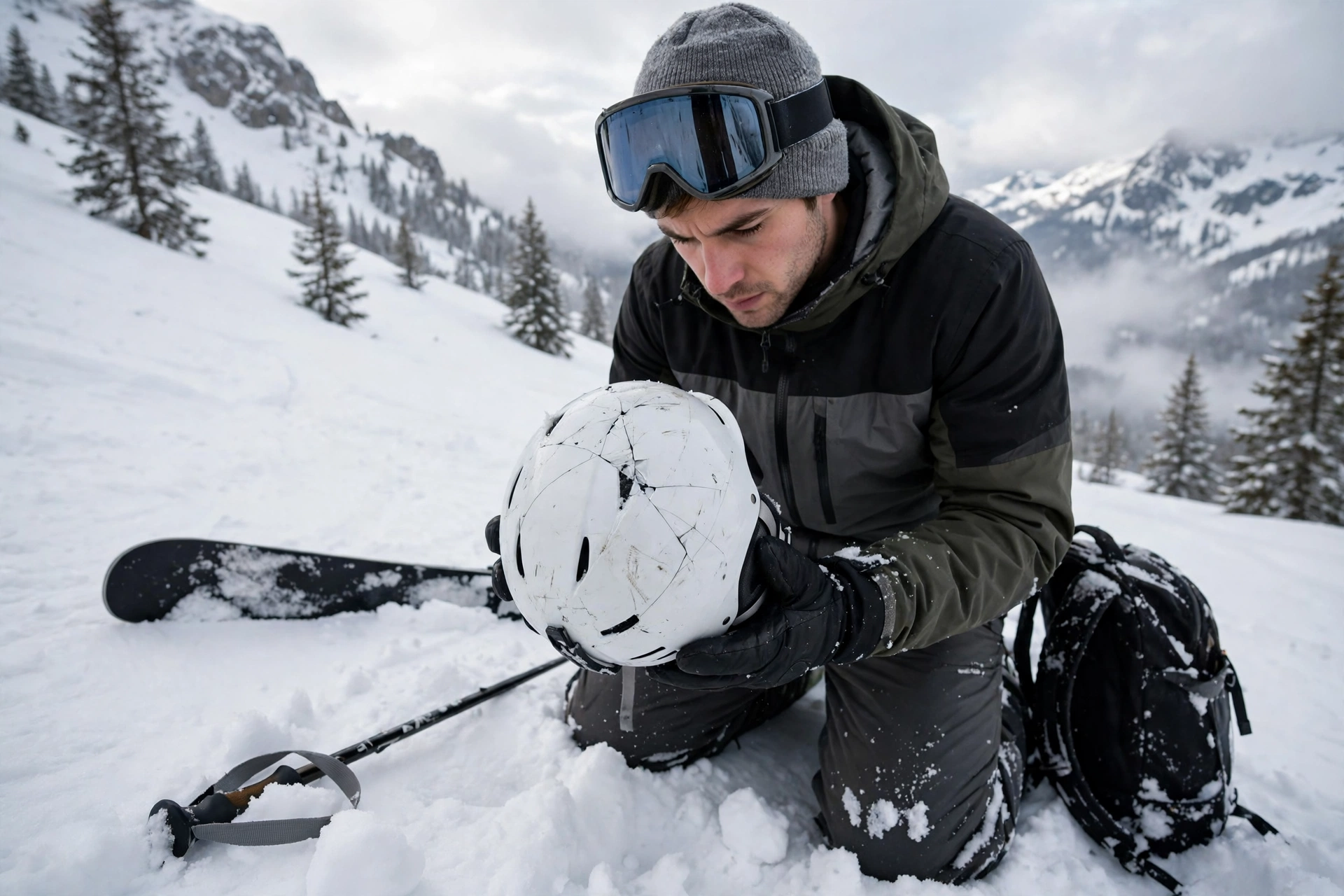
After any significant fall where your head struck the snow, ice, a tree, a lift pole, or another skier, you should replace your ski helmet — even if it looks completely fine on the outside. The foam inside a ski helmet is designed to protect you once, and a hard impact can use up that protection without leaving visible marks. When in doubt, retire it.
Should you replace a ski helmet after every fall?
Not every tumble ends a helmet’s life. If you tipped over at walking speed into soft powder and your head barely touched down, the helmet most likely took no real impact. The falls that matter are the ones with force behind them: catching an edge at speed, hitting hardpack or ice, striking a fixed object, or any fall where you felt a real jolt to the head.
The problem is that the protective layer inside the helmet — a rigid EPS foam liner — absorbs energy by crushing permanently. That crush damage is often invisible because the hard outer shell flexes back into shape and hides what happened underneath. A helmet that looks undamaged can have a section of foam that is already compressed, and that section cannot absorb a second impact the same way. This is why the honest rule is simple: one significant impact, one new helmet.
Also treat any fall that left you dizzy, nauseous, or with a headache seriously on two levels. Get checked for a concussion, and retire the helmet — a hit hard enough to affect you was hard enough to damage the foam.
How do you inspect a ski helmet for damage after a crash?
Start with the outer shell under a bright light. Look for cracks, deep gouges, dents, or areas where the shell has separated from the foam edge. Run your fingers over the surface; a soft or uneven spot can point to crushed foam beneath. Check the vents and any dial or adjustment parts for cracks too.
Next, remove the comfort liner and ear pads if your model allows it, and examine the EPS foam itself. Healthy EPS is smooth and uniform. Warning signs include visible cracks in the foam, white stress lines, crumbling or flaking, and any area that looks compressed, flattened, or thinner than the foam around it. Press gently across the foam — damaged sections can feel softer or denser than intact foam.
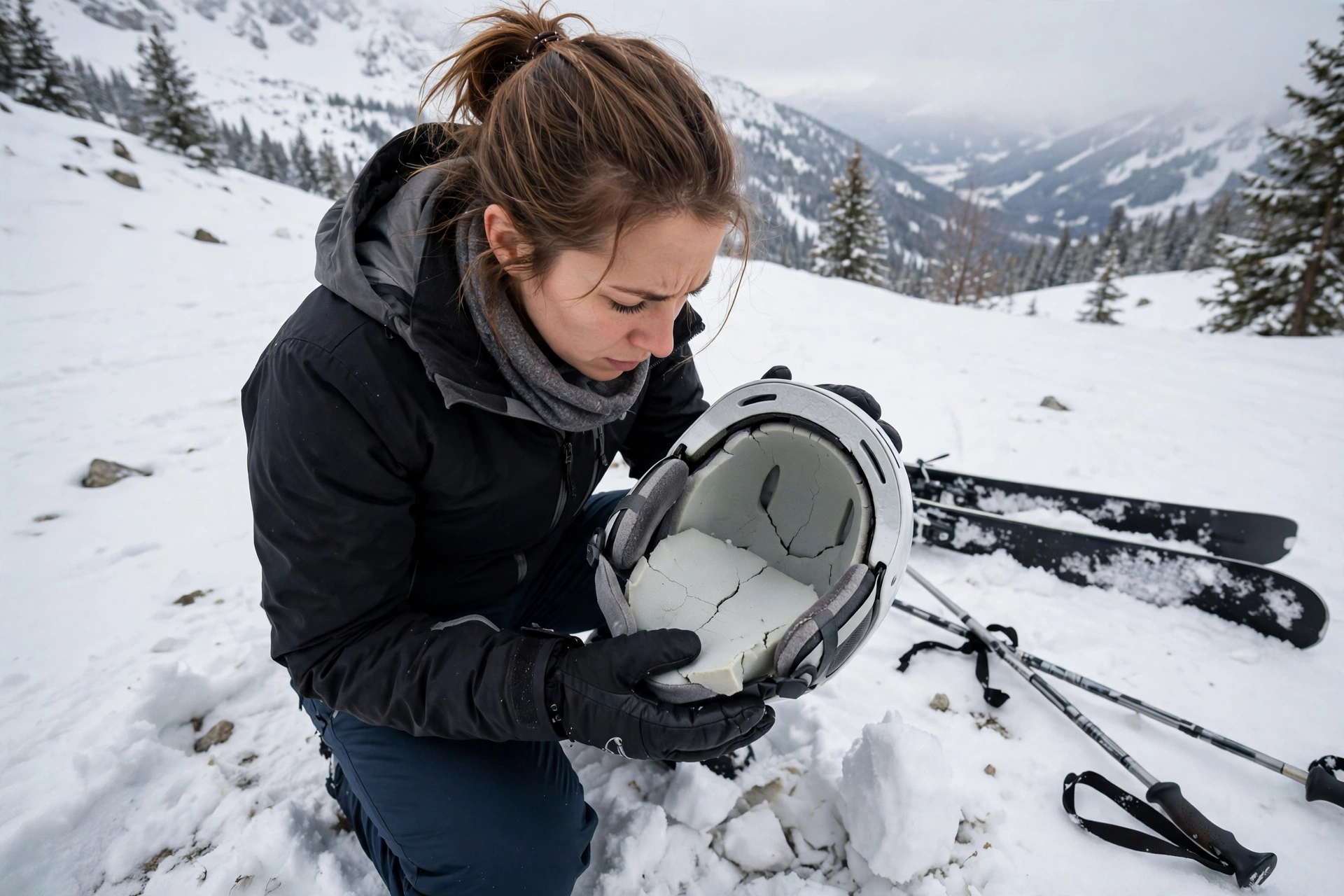
Finally, check the retention system. Inspect the chin strap webbing for fraying, test that the buckle clicks and holds firmly, and confirm the fit dial still tightens evenly. Damage to the strap or buckle is sometimes repairable with manufacturer parts, but foam or shell damage never is. If your inspection turns up any of these problems — or if you simply cannot be sure the foam survived — replace the helmet.
What do manufacturers say about replacing a crashed helmet?
Every major ski helmet maker gives the same guidance: a helmet that has been in a crash should be replaced, and most state it plainly in the owner’s manual and on their websites. The reason is the one-time design of the EPS liner. Unlike the soft comfort padding, which is only there for fit, the EPS is the part that manages impact energy, and it does so by deforming.
Manufacturers also note that damage may not be visible, which is why inspection alone can never fully clear a crashed helmet. Some brands offer crash replacement programs that provide a discount on a new helmet if you send in the damaged one within a set period, so it is worth checking before you buy a replacement at full price. Keep your proof of purchase — it speeds up both warranty and crash-replacement claims.
Safety features do not change this rule. Rotational impact systems — if you are unsure what they do, our guide to what MIPS is and how it works explains the technology — reduce certain forces in angled impacts, but they work together with the EPS liner, not instead of it. A MIPS-equipped helmet with crushed foam is just as finished as a basic one.
How long does a ski helmet last if it has never crashed?
Even a helmet that has never taken a hit has a service life. Most manufacturers recommend replacing a ski helmet about every five years from first use, and some suggest counting from the manufacture date printed on the sticker inside. Over time, sweat, sunscreen, heat, UV exposure, and everyday knocks in the car and gear bag break down the foam and dry out the comfort padding.
Replace an uncrashed helmet sooner if the fit has become loose because the padding has packed down, if straps or buckles are worn, if the shell is scuffed and crazed from years of use, or if the foam shows any flaking. A helmet that no longer fits snugly cannot do its job properly, whatever its age. When you shop for the replacement, bring your goggles — the helmet and goggle fit together matters as much as the helmet alone.
Is the rule different for a rental helmet after a fall?
The physics is identical, but the responsibility is shared. Rental shops inspect their fleets and retire damaged helmets, and many check helmets in and out on every rental. Your part is honesty: if you take a hard fall in a rental helmet, tell the shop when you return it, and if the fall happens early in the day, swap it for another helmet right away rather than skiing the rest of the day in a possibly compromised one.
The bigger difference is knowledge. With your own helmet you know its full history — every drop off the tailgate and every season it has served. With a rental you do not, which is one reason frequent skiers buy their own. Either way, never keep skiing in a helmet you know took a significant impact just because a replacement feels like a hassle.
Frequently Asked Questions
Can I keep using my ski helmet after a small fall?
If your head barely touched soft snow at low speed, the helmet is almost certainly fine. If there was real force — hard snow, speed, a fixed object, or symptoms afterward — replace it.
Can a crashed ski helmet be repaired?
No. Shell and EPS foam damage cannot be repaired, and gluing or patching foam does not restore its impact protection. Only comfort padding, straps, and buckles can sometimes be replaced with manufacturer parts.
How can I tell how old my ski helmet is?
Look for the production date sticker inside the shell or under the liner. If the helmet is around five years old or older, plan on replacing it even if it has never been crashed.

Olivia
Writer at Helmet Today, covering helmet reviews, fit and riding safety.