
Honest answer: no — a real scratch cannot be safely removed from a helmet visor. If you can feel the scratch with a fingernail, it is a groove cut into the plastic and its coatings, and polishing it out means removing material unevenly, which distorts your vision and strips the protective layers. Very light surface haze can sometimes be improved, but for scratches in your line of sight, replacement is the only safe fix.
This is not what most riders want to hear, because a quality visor is not cheap and the scratch always seems to sit exactly where you look. But a visor is a safety component, not a cosmetic panel. Understanding what a scratch actually is explains why the quick fixes sold online so often make things worse.
Why Can’t Scratches Be Polished Out of a Visor?
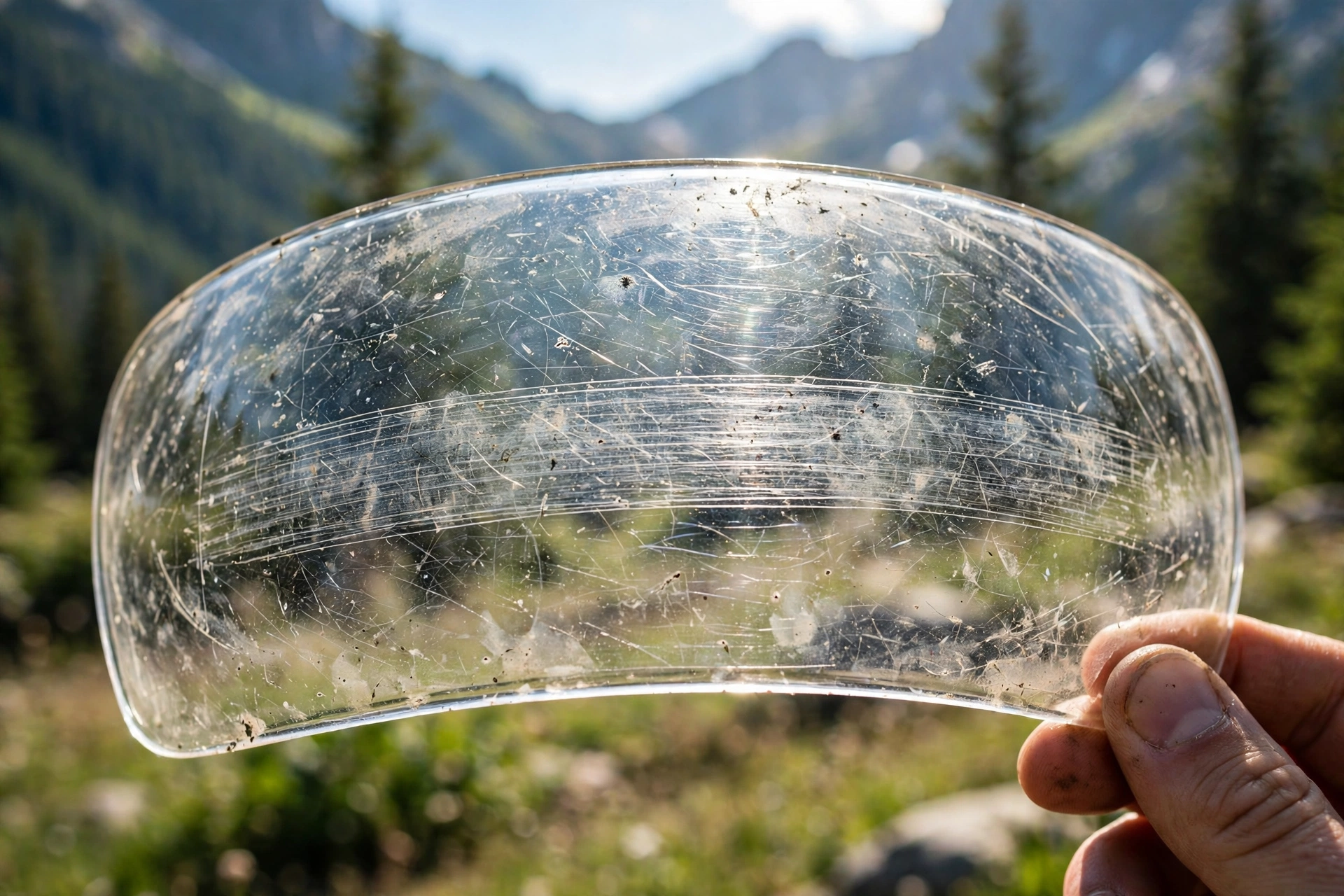
A motorcycle visor is moulded polycarbonate with thin functional coatings: a hard anti-scratch layer, usually an anti-fog treatment inside, and often UV filtering. The scratch you see has usually cut through the hard coat and into the soft plastic beneath. There is no way to “fill” that groove with a home product in a way that stays optically clear.
Polishing works by abrading the surrounding surface down to the depth of the scratch. On a visor, that leaves a shallow lens-shaped patch with different optical properties from the rest of the shield. Looking through it, straight lines bend and lights smear — worst at night and in rain, exactly when you need clarity most. Polishing also removes the hard coat in that area, so the patch scratches again far more easily than the rest of the visor.
What About Very Light Haze and Fine Surface Marks?
Not all cloudiness is scratching. A grey film of dried road spray, soap residue, or a smeared anti-fog coating can look like damage but washes off. Before condemning a visor, clean it properly: soak off the dirt with a wet microfiber, wash with mild soap, and pat dry. If the “scratches” disappear, they were never in the plastic at all.
Genuine micro-marring — the fine swirl pattern from months of slightly-too-dry wiping — sits in the hard coat only. A dedicated plastic polish may reduce its appearance slightly, but the risk is real: one grade too coarse and you have converted a faint haze into a permanent dull patch, and most makers warn that polishing voids any coating warranty. If you experiment at all, test on a bottom corner outside your view first — and never use any polish on a Pinlock insert, whose soft anti-fog surface is ruined by abrasives.
Do Toothpaste and DIY Scratch Remedies Actually Work?
Toothpaste is a mild abrasive, which is why it appears in so many DIY videos. On a visor it does exactly what any abrasive does: it grinds the surface, trading a visible scratch for a frosted area of micro-scratches and removing the coatings in the process. Headlight restoration kits are worse — they are formulated for car headlight lenses, which are thicker, differently coated, and not something you look through at 70 mph inches from your eyes.
Heat tricks, solvents, and “scratch filler” pens have the same problem in different forms: anything strong enough to change the plastic can cloud it, craze it, or leave a residue that smears in rain. None of these methods restores the anti-scratch or anti-fog coatings, so even a cosmetically improved visor has lost protection it originally had.
When Is Replacement the Only Safe Option?
Replace the visor if a scratch sits anywhere in your central field of view, if oncoming headlights burst into stars or streaks at night, if the visor is cracked at the edges or around the pivots, or if the surface is so generally hazed that contrast drops in flat light. These are not cosmetic faults — glare and distortion delay how fast you read the road.
If the scratch came from a crash or a hard drop, inspect the whole helmet before simply ordering a new shield. An impact strong enough to gouge a visor may also have damaged the EPS liner or the low-friction layer described in our guide to what MIPS is for helmets, even when the shell looks unmarked. And when you do replace the visor, buy the correct shield for your exact helmet model — fit and seal matter, and a genuine visor restores all the original coatings at once.
There is a simple way to judge what you are dealing with before you decide. Run a fingernail lightly across the mark: if the nail catches, the scratch is a true groove in the plastic and no polish will save it. If the nail glides over, the mark is likely surface haze or dried film, and a proper soak-and-wash may clear it. Then hold the visor up to a bright light and look through it at an angle, and finally take a short dusk ride — a visor that looks acceptable on the workbench can still flare badly under streetlights. Judge it by the night test, not the kitchen test, because night glare is where a marginal visor becomes a dangerous one.
How Do You Prevent Visor Scratches in the First Place?
Almost all visor damage is self-inflicted during cleaning. Soak dirt loose before touching the surface, use only clean microfiber, and never wipe a dry, dusty visor — a visor cover or the helmet’s storage bag keeps dust off between rides. Set the helmet down on its side or crown, never resting on the visor, and keep it in its bag in the garage rather than on a shelf where it can be knocked off.
On trips, carry a small microfiber cloth so a fuel-stop clean does not become a glove or paper-towel wipe. Riders who do a lot of miles often keep a spare visor so a damaged one can be swapped immediately instead of ridden “one more month”. Prevention is genuinely cheap compared with replacement.
Frequently Asked Questions
Can a scratched visor actually be dangerous?
Yes. Scratches in the eye line scatter light, causing glare and starbursts from headlights at night and reduced contrast in rain and low sun, which slows how quickly you can read hazards.
Will polishing a visor remove its anti-fog coating?
On the inside surface, yes — abrasive polishing strips the anti-fog treatment. That is one reason makers advise against polishing, and why a polished visor often fogs worse than before.
How long should a motorcycle visor last?
With careful cleaning and storage, many riders get a couple of seasons from a visor. Heavy use, harsh cleaning, or a scratch in the eye line shortens that — it is a wear item, like brake pads.

Olivia
Writer at Helmet Today, covering helmet reviews, fit and riding safety.