

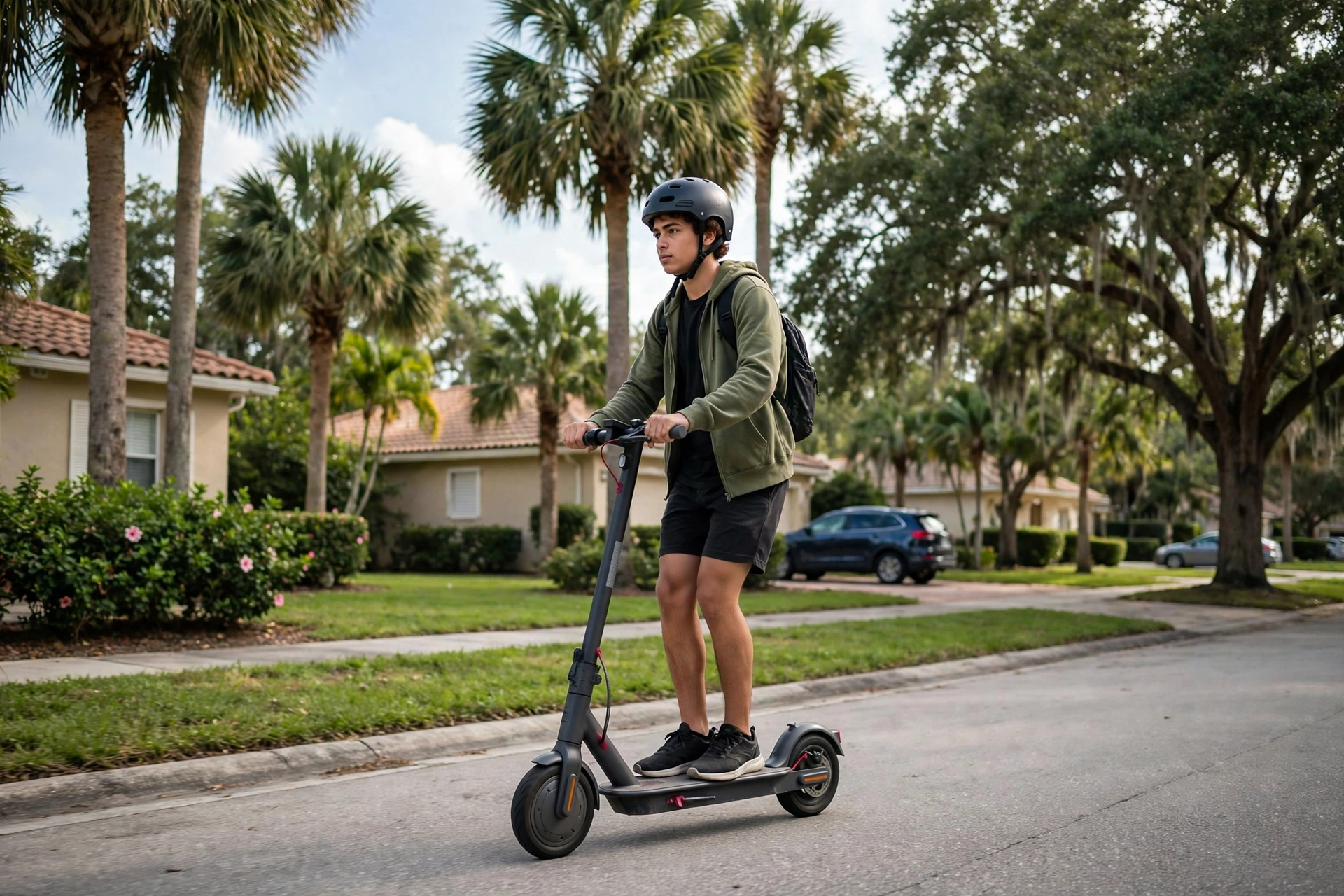
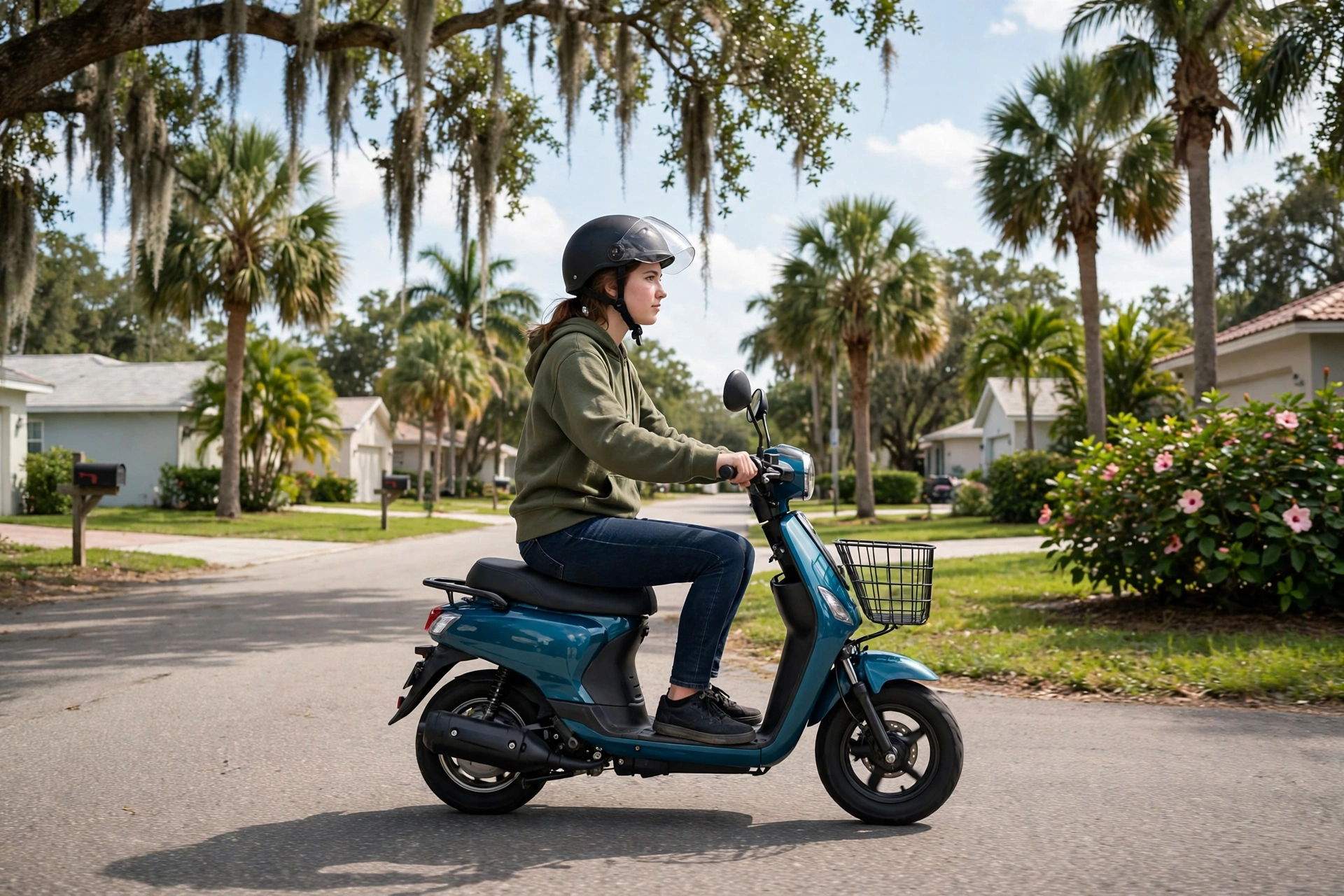
Florida’s helmet rules for motorized scooters come in layers, and the layer that applies depends on the vehicle and the rider’s age. On motorcycle-class scooters, Florida’s motorcycle law controls: riders and passengers under 21 must wear a helmet. On mopeds and low-speed motorized scooters, Florida requires a helmet for riders under 16. For stand-up e-scooters and other micromobility devices, helmet rules are mostly set by individual Florida cities rather than by a single statewide mandate.
Because “scooter” can mean anything from a 49cc moped to a dockless rental e-scooter on a Miami sidewalk, the safest approach is to identify your vehicle class first, then check the age rule for that class, then look at your city’s local rules.
When Does Florida’s Motorcycle Helmet Law Apply to a Scooter?
If the scooter is legally a motorcycle — generally, a motor vehicle with a seat or saddle and no more than three wheels, including larger motor scooters sold and titled as motorcycles — Florida’s motorcycle helmet law applies in full. Under that law, no one under 21 may ride or operate without a helmet, whether driving or riding as a passenger.
Florida’s adult motorcycle rules are conditional rather than universal, but none of those adult conditions help a rider under 21: for younger riders the helmet is simply required. The helmet should be a proper DOT-approved motorcycle helmet that fits correctly, since at scooter speeds above city crawling pace the risks are the same as on any motorcycle.
What Is the Helmet Rule for Mopeds and Low-Speed Scooters in Florida?
Florida sets a specific age line for the smaller classes. Riders under 16 must wear a helmet when operating or riding on a moped or low-speed motorized scooter. This is the rule that catches many families out: a 14- or 15-year-old who may legally ride a small scooter in some situations still cannot do so helmet-free.
Eye protection is part of the picture in Florida as well. Florida law requires eye protection for motorcycle riders, and riders of small scooters should treat proper eyewear as required equipment too — a helmet with a face shield covers both requirements at once. For the wider national picture, our guide to helmet laws by state shows how Florida’s layered approach compares.
Are Stand-Up E-Scooters Treated the Same Way?
Not exactly. Stand-up e-scooters and similar micromobility devices sit in a grey zone in Florida. State law gives local governments wide authority over these devices, so cities such as Miami, Tampa, Orlando, and Fort Lauderdale set their own rules for where e-scooters can operate and what riders must do. Some local programs and rental agreements require helmets or set minimum rider ages; others do not.
The class boundaries can blur — a seated e-scooter with a larger motor may be classed as a moped or motorcycle rather than micromobility, which would pull it back under the state age rules. If the vehicle has a motor sized for road speeds, a seat, and requires registration, assume the motorcycle or moped rules apply until you confirm otherwise.
What Should Parents and Teen Riders Know?
Three practical points cover most real-world cases. First, under 16 on a moped or small motorized scooter: helmet required, full stop. Second, under 21 on anything motorcycle-class: helmet required. Third, on rental e-scooters: read the app’s terms and your city’s rules, because the requirement you face may come from the contract and the local ordinance rather than the state.
Whatever the law’s floor, a helmet that fits is the sensible default for every scooter rider. Florida traffic, wet roads after afternoon storms, and sandy intersections near the coast make falls common, and head protection matters at least as much as legality.
Fit deserves the same attention as the rulebook. A scooter helmet should sit level on the head, snug all around, with the strap fastened so it cannot roll forward or back. For growing teens, recheck fit every season and replace any helmet that has been crashed or dropped hard onto pavement — damage is not always visible, and a compromised helmet will not protect the same way twice.
How Can You Tell Which Florida Class a Scooter Falls Into?
The paperwork answers most questions. A scooter that is titled and registered as a motorcycle, with a motorcycle plate, is motorcycle-class — the under-21 rule applies. A machine that meets Florida’s moped definition — pedals or a small engine, modest top speed, and moped registration — falls under the moped rules with the under-16 helmet line. A dockless stand-up e-scooter you unlock with an app is micromobility, and city rules govern.
Engine size and top speed are the usual dividing lines, but they are not the only ones, and sellers do not always describe borderline machines accurately. A “scooter” marketed for adults that can exceed moped speeds may legally be a motorcycle, with licensing, registration, insurance, and helmet consequences to match. If you are buying rather than renting, confirm the classification with the dealer and the registration documents before assuming the lighter rules apply. When the class is genuinely unclear, follow the stricter rule — wearing a helmet you might not strictly need is a far better mistake than the reverse.
What Happens If You Ride Without a Required Helmet in Florida?
Riding without a helmet where Florida law requires one is a traffic violation, and the rider can be cited. Fines vary by court and by the specifics of the citation, so there is no single amount that applies everywhere. For minors, a stop can also involve parents or guardians being notified, and rental riders who breach company terms can lose access to the service.
The larger cost is physical rather than financial. Scooter riders are exposed in traffic with little protective structure, and a helmet is the single most effective piece of gear against serious head injury.
Frequently Asked Questions
Do you have to wear a helmet on a motorized scooter in Florida?
Often, yes. Under 21 on a motorcycle-class scooter: helmet required. Under 16 on a moped or low-speed motorized scooter: helmet required. On stand-up e-scooters, helmet rules are set mainly by your city and the rental company.
What age can you ride a scooter without a helmet in Florida?
For mopeds and low-speed motorized scooters, the state helmet requirement ends at 16. For motorcycle-class scooters, it ends at 21. Local e-scooter rules vary by city.
Does Florida require eye protection on a scooter?
Florida requires eye protection for motorcycle riders, and small-scooter riders should treat protective eyewear as required gear as well. A helmet with a face shield satisfies both the helmet and eye-protection needs at once.

Olivia
Writer at Helmet Today, covering helmet reviews, fit and riding safety.


