A catcher’s helmet should fit snug all the way around your head — firm, even pressure with no painful hot spots, no wobble when you shake your head, and the mask frame sitting steady with the chin cup cradling your chin. If it slides when you look down for a sign or shifts when you turn to track a foul ball, it is too loose, and loose gear protects poorly no matter how good it looks. Here is how to measure, check, and fine-tune the fit step by step.
How Do You Measure Your Head for a Catcher’s Helmet?
Start with a soft measuring tape. Wrap it around the widest part of your head, roughly an inch above your eyebrows and just above your ears, keeping it level all the way around. Write the measurement down in both inches and centimeters, and measure twice — small errors here turn into big fit problems later.
Then match that number to the specific brand’s size chart for the exact model you are buying. Catcher’s helmets are usually sold in sizes that overlap with familiar hat sizes, and ranges differ between brands, so a “large” from one company is not automatically a large from another. If your measurement falls between two sizes, most catchers do better starting with the smaller one, because padding settles and compresses slightly with use while a too-big shell never shrinks. Youth models are scaled-down shells, not just smaller padding, and they are the right starting point for younger players.
How Snug Should a Catcher’s Helmet Feel?
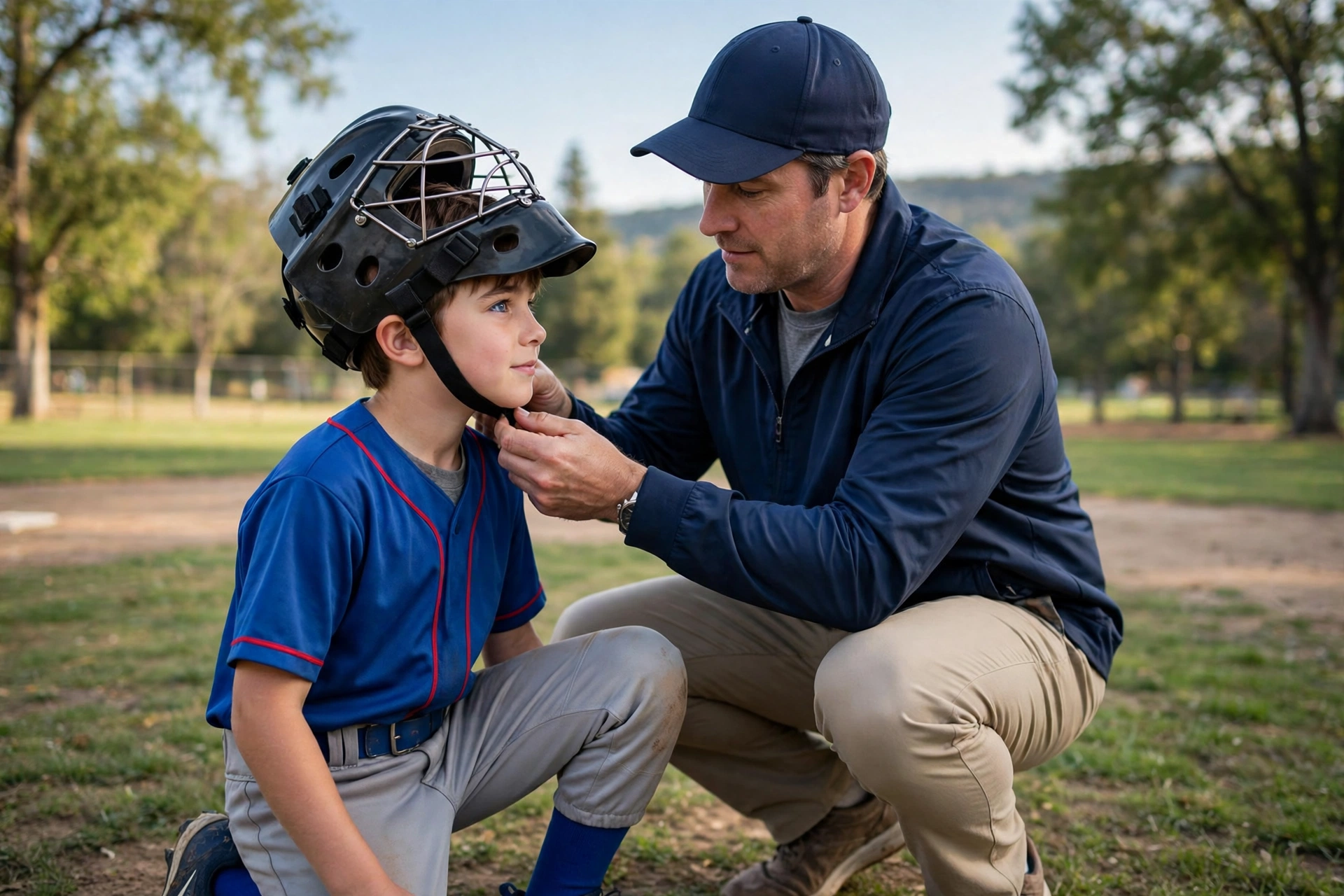
Put the helmet on and fasten everything the way you would for a game. The fit should feel snug and even, like a firm handshake around your whole head. You should not be able to rock the helmet front to back or side to side with your hands, and when you shake your head sharply — as if saying no — the helmet should move with your head, not a half-second behind it.
Check the pressure points. A little uniform snugness is correct, especially when the helmet is new. What is not correct is a sharp hot spot on your forehead or temples, pressure that gives you a headache within a few minutes, or pads that barely touch on one side while digging in on the other. The jaw pads should rest against your cheeks and jaw with real contact, since they keep the mask positioned when a foul tip hits. Finally, crouch down, look up as if tracking a pop-up, and turn your head both ways: the helmet should stay centered through every catching movement without sliding over your eyes.
Where Should the Mask Frame and Chin Cup Sit?
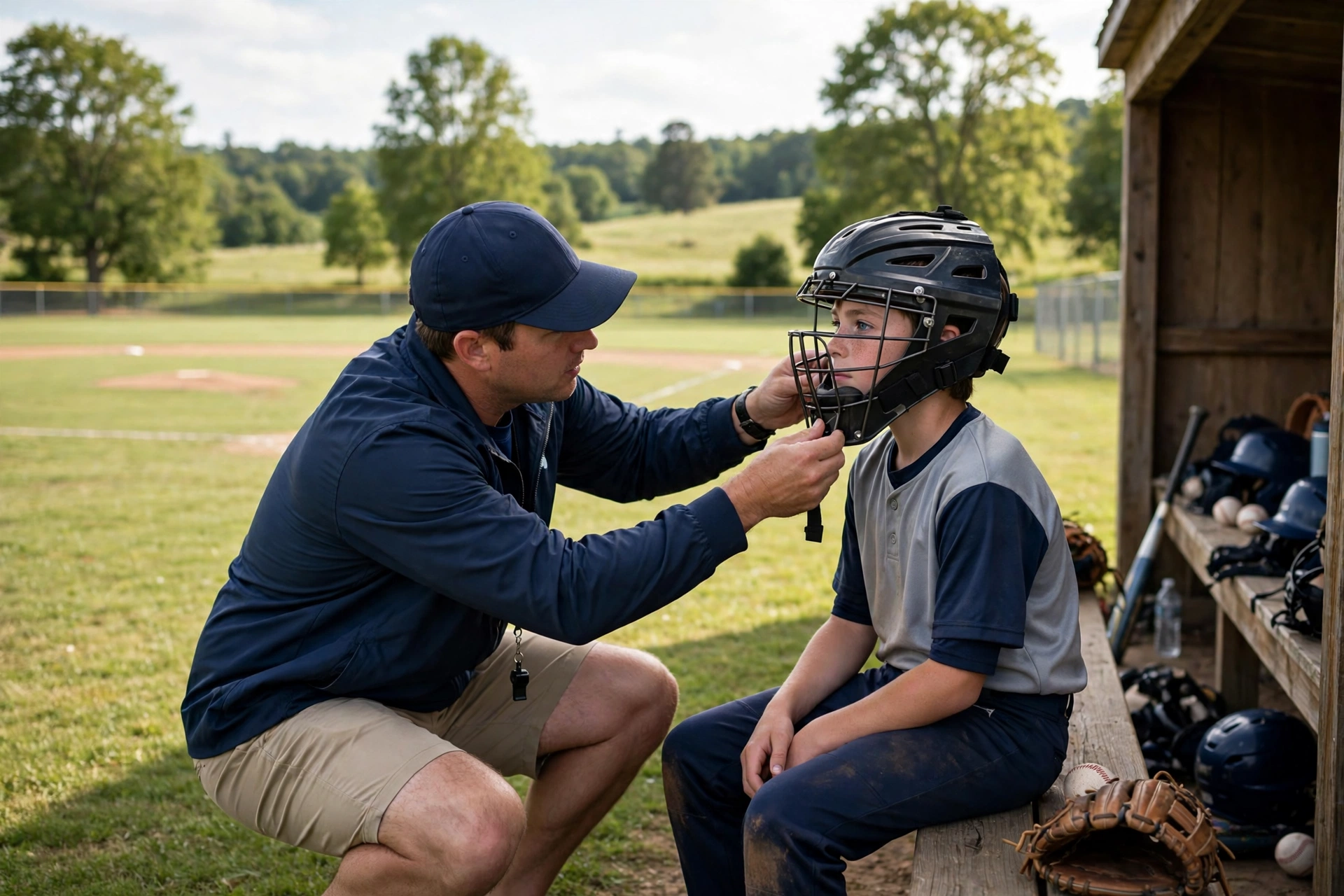
Your eyes should look out through the center of the mask opening, with a clear, unobstructed view of the pitcher and the strike zone. If you are looking through the top bars or ducking your chin to see, the helmet is sitting too high or is the wrong size. The frame itself should sit close to the face without painfully pressing your nose or cheekbones — light contact through the pads is fine, hard pressure on bone is not.
The chin cup or chin pad is the anchor of the whole system. It should cradle your chin so the mask cannot ride up or tip forward when you move, and it should hold the frame steady on impact. Adjust the harness straps evenly on both sides until the mask stays centered, then recheck: if the chin cup floats loose or the mask tilts to one side, keep adjusting before you judge the size. Many “bad fit” complaints are really just uneven strap tension.
What Fit Mistakes Should You Avoid?
The most common mistake is wearing a baseball cap underneath the helmet. A cap changes your head size and shape, lifts the helmet, and lets it shift on impact — catcher’s helmets are designed to be worn directly on the head. Ponytails are the related issue for softball and baseball players with long hair: wear the hair low and flat, below the shell’s edge, rather than bunched inside where it creates a pressure point and changes the fit.
Other mistakes to skip: sizing up so a child can “grow into” the helmet (a too-big helmet is unsafe right now, which is when it will be worn), borrowing a helmet with unknown history and hidden damage, and ignoring the straps. A correctly sized helmet with a loose harness fits like a wrong-sized helmet. Also, never mix parts between brands or models — shells, masks, and pads are designed and tested as a unit.
How Is Youth Sizing Different, and When Should You Replace the Helmet?
Youth catcher’s helmets use smaller, lighter shells shaped for smaller heads, so resist putting a small player in an adult helmet even if the tape measurement seems close. For growing players, recheck the fit at the start of every season: look for new gaps at the temples, a chin cup that no longer reaches, or a helmet that suddenly rides high. Kids outgrow gear mid-season more often than parents expect.
Replacement is not only about growth. Replace a catcher’s helmet after any significant impact that cracks the shell, bends the mask frame, or visibly damages the padding, and follow the manufacturer’s guidance on inspection and service life. This matters because the inside of a helmet does the protecting — modern shells and foams manage energy, including some designs that add low-friction layers for rotational forces, a concept covered in our guide to what MIPS means in helmet design. Once that internal structure is crushed or cracked, it cannot do the same job twice.
Frequently Asked Questions
Q: Should a catcher’s helmet be tight?
A: It should be snug, not painful. Expect firm, even pressure all around with no wobble when you shake your head. Sharp hot spots, headaches, or pressure on the nose and cheekbones mean the size or adjustment is wrong.
Q: Can I wear a cap under a catcher’s helmet?
A: No. A cap changes the size and shape of your head, lifts the helmet, and lets it shift on impact. Wear the helmet directly on your head, and keep long hair low and flat rather than bunched inside.
Q: How often should a youth catcher’s helmet be rechecked?
A: At least every season, and sooner if it starts to ride high, develop gaps, or the chin cup no longer sits correctly. Also replace it immediately after an impact that cracks the shell or bends the mask.

Olivia
Writer at Helmet Today, covering helmet reviews, fit and riding safety.