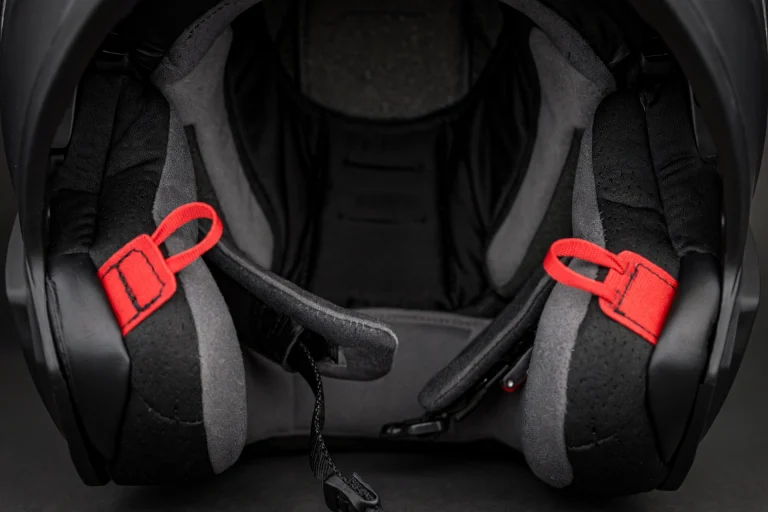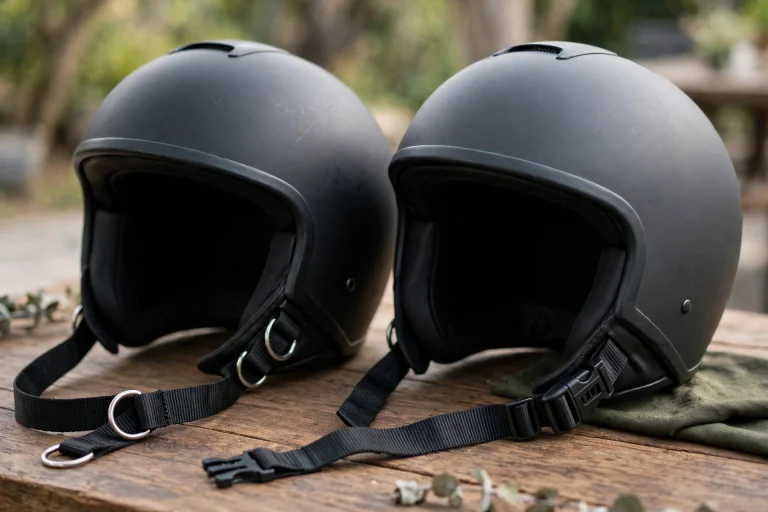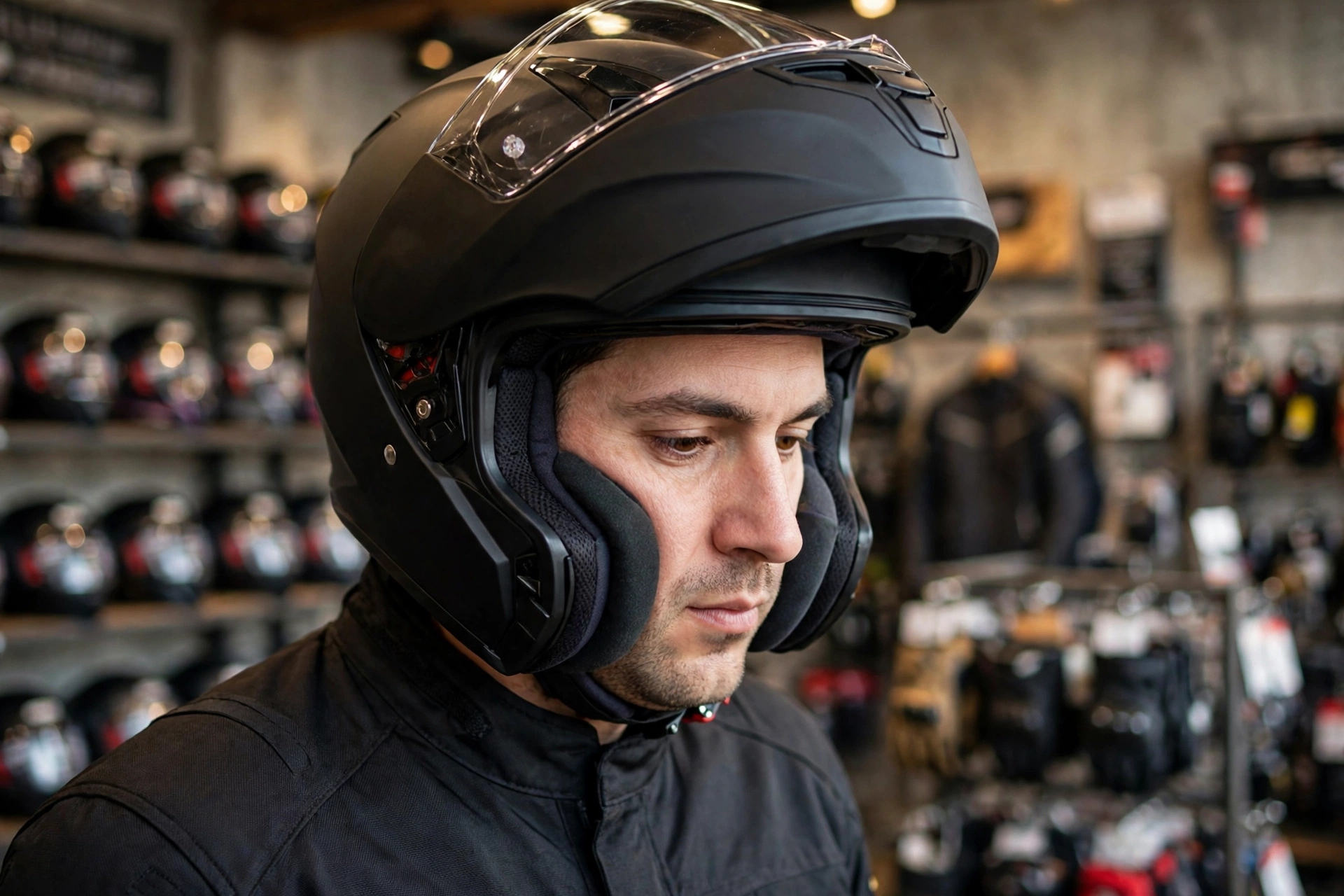
A new motorcycle helmet should feel firm and even around your cheeks — snug enough that the cheek pads gently compress your cheeks and the helmet does not move when you shake your head — while your jaw should be able to open and close without pain, biting your cheeks hard, or the chin bar pressing on your chin. Puffy cheeks on a new helmet are normal; pain, numbness, or a helmet that slides around are not.
This guide explains what correct cheek and jaw fit actually feels like, how much pressure is too much, and how fit changes as a helmet breaks in.
What Should the Cheek Pads Feel Like on a New Helmet?
Cheek pads do more work than most riders realise. They hold the lower half of the helmet steady, stop it rotating or lifting, and help keep the helmet positioned correctly on your crown. On a correctly sized new helmet, the pads press firmly against your cheeks — many fitters describe the result as slightly puffed or “chipmunk” cheeks — and that firmness is expected, not a warning sign.
Try this check in the shop: with the strap fastened, grip the chin bar and try to move the helmet side to side and up and down. Your skin and cheeks should move with the helmet rather than the helmet sliding over them. Open your mouth and talk; your voice will feel a little squeezed, and that is fine. If you can comfortably chew gum or your cheeks are barely touched, the pads are almost certainly too loose for the long term.
Remember that cheek pad firmness varies between brands and models. Some helmets ship with thinner pads in the box or sell different thicknesses, so a helmet that is perfect on the crown can often be fine-tuned at the cheeks rather than rejected.
How Should a Helmet Fit Around Your Jaw and Chin?
Your jaw should sit comfortably inside the chin bar with the strap snug under your chin, not on your throat and not loose enough to slip forward. You should be able to open your mouth fully, talk, and yawn without the chin bar digging into your chin or the strap cutting in. A slight contact between chin and chin curtain is common; hard pressure is not.
Watch for two opposite problems. If the helmet is too big, the chin bar sits far from your face, the helmet tips forward when you push the chin bar up, and wind noise and movement increase at speed. If the helmet or its pads are too tight at the jaw, you may get an aching jaw, sore spots along the jawline, or a headache that builds from the sides of the head.
Helmet shape matters here as much as size. Head shapes differ — some riders have wider jaws and narrower crowns, others the reverse — and brands cut their shells and pads differently. A jaw ache in one model at your size often disappears in another model at the same size, which is why trying several shapes beats simply going up a size.
How Much Cheek Pressure Is Too Much?
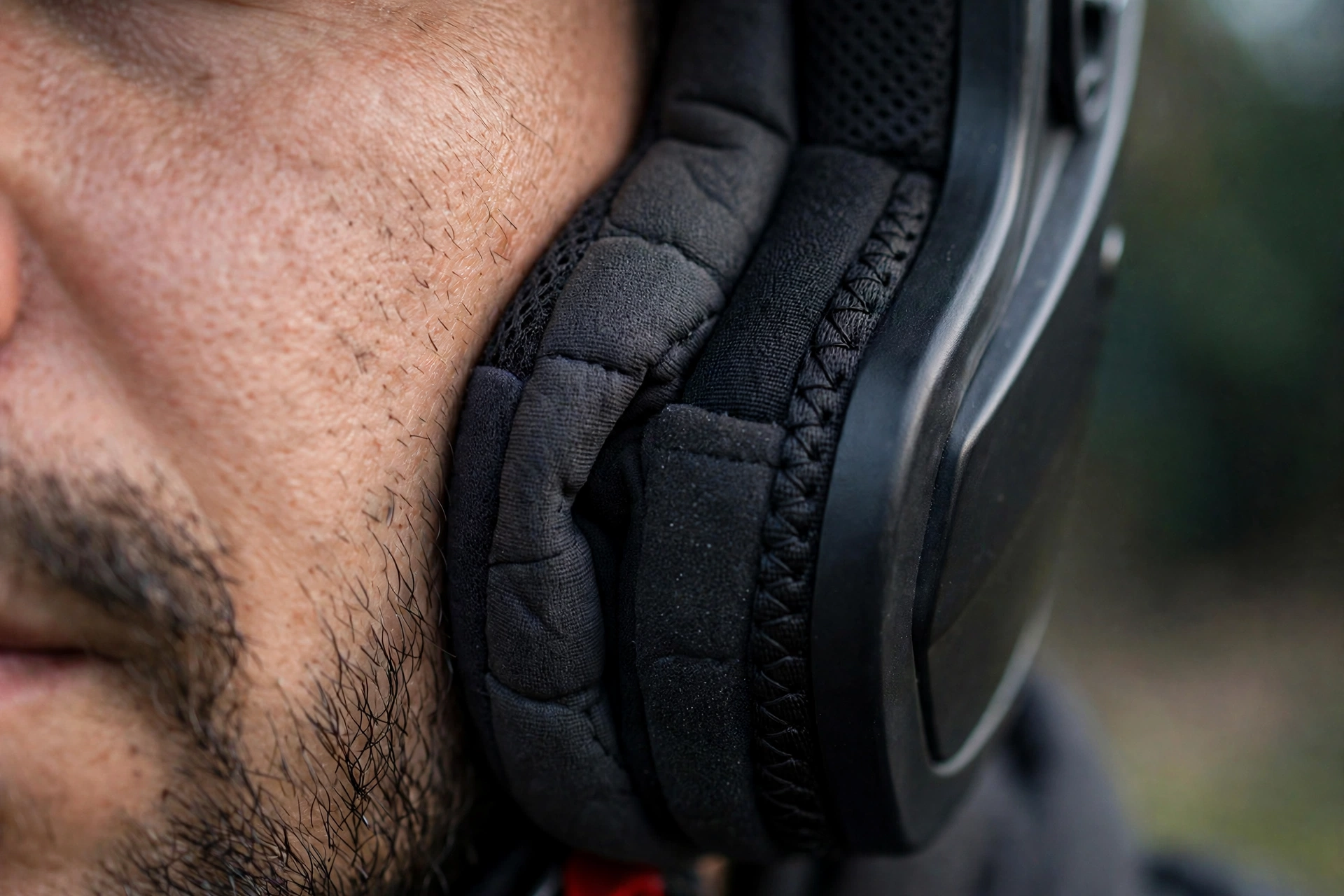
Pressure becomes too much when it turns into pain or creates side effects. Warning signs include sharp soreness on the cheekbones, numb or tingling cheeks, pain in the jaw joint near your ears, biting the inside of your cheeks every time you close your mouth, or a headache that starts within fifteen to twenty minutes of wearing the helmet indoors.
Do the fifteen-minute test before you commit. Wear the helmet around the shop or at home for at least fifteen minutes with the strap done up. Correct firmness stays an even, background pressure you stop noticing. Incorrect pressure builds, localises into a hot spot, or starts to throb — and that will only get worse on a two-hour ride with wind pressure added.
- Normal: even squeeze, puffed cheeks, slightly muffled speech, no pain after fifteen minutes
- Too tight: jaw ache, cheekbone pain, numbness, headaches, constant urge to take it off
- Too loose: helmet rotates or lifts easily, cheeks barely touched, chin bar far from the chin
If only the cheeks are wrong but the crown fits perfectly, ask about different cheek pad thicknesses before changing helmet size. Going up a size to fix cheek pressure usually ruins the crown fit, which is the part that matters most.
How Does Fit Change as Cheek Pads Break In?
New cheek pads soften and compress with use, moulding to your face over the first weeks of riding. In general terms, a helmet that feels very firm when new will feel noticeably easier after some hours of wear, as the foam settles. That break-in is exactly why a new helmet should start on the firm side — a helmet that feels perfect and soft in the shop often becomes loose within a season.
Break-in has limits, though. Foam softening eases general pressure; it does not fix a wrong head shape, a pressure point on one bone, or a jaw that aches because the shell is the wrong shape for you. If a specific spot hurts on day one in the same place every time, do not rely on break-in to save it.
Over years, pads compress permanently and the fit loosens further. Many helmets have removable, washable, and replaceable cheek pads, so refreshing the pads can restore an older helmet’s snugness — but pads cannot rescue a helmet whose liner has aged or that has taken a hard impact, and replacement after a significant crash remains the rule.
Why Do Cheeks and Jaw Fit Matter for Safety, Not Just Comfort?
A helmet protects as a system, and the lower padding is part of how it stays in the right place. In a crash the helmet must not rotate forward over your face, lift at the back, or shift so that the liner is no longer where the impact arrives. Firm, even cheek contact plus a snug strap is what keeps the helmet positioned through the messy, multi-direction forces of a real fall.
Angled impacts add twisting forces, which is why rotational protection has become a major design topic. Reading about what MIPS is for helmets explains how low-friction liners try to reduce that twisting — and those systems can only do their job if the helmet fits closely and stays put, which comes back to correct size, crown fit, and yes, cheek pads that actually grip.
Comfort is a safety feature in its own right too. A rider whose jaw aches and whose cheeks throb is a distracted rider, and a helmet left loose or unfastened because it hurts protects nobody. The goal is a fit you forget about: firm, even, and stable from the first mile to the last.
Frequently Asked Questions
Q: Should a new motorcycle helmet feel tight on the cheeks?
A: Yes, firm is correct. New cheek pads should press evenly and make your cheeks look slightly puffed, without pain, numbness, or jaw ache. They will soften with use, so a new helmet that already feels loose will become too loose.
Q: Can I change cheek pads instead of changing helmet size?
A: Often, yes. Many makers offer cheek pads in several thicknesses for the same shell, so you can fine-tune the lower fit while keeping the crown size that fits your head. Ask the retailer or check the maker’s parts list for your model.
Q: Why does my jaw hurt when I wear my helmet?
A: Common causes are a helmet shape that is too narrow for your jaw, cheek pads that are too thick, or a size too small overall. Try different pad thicknesses and other models with a wider jaw area, and do a fifteen-minute wear test before buying.

Olivia
Writer at Helmet Today, covering helmet reviews, fit and riding safety.