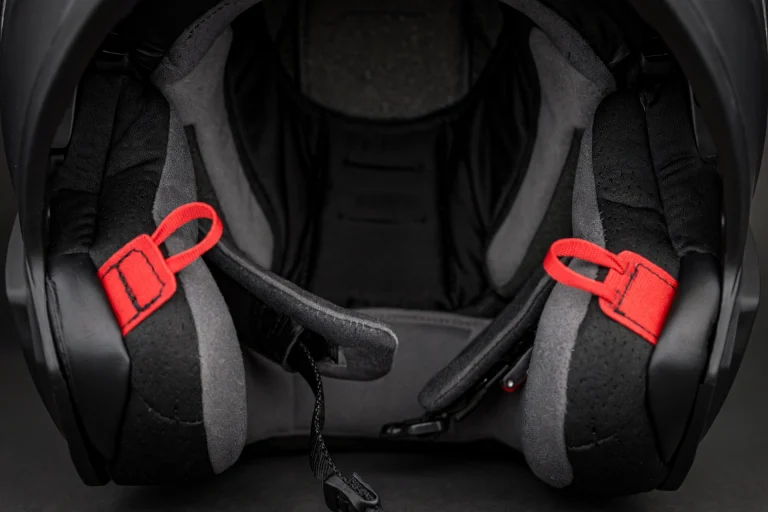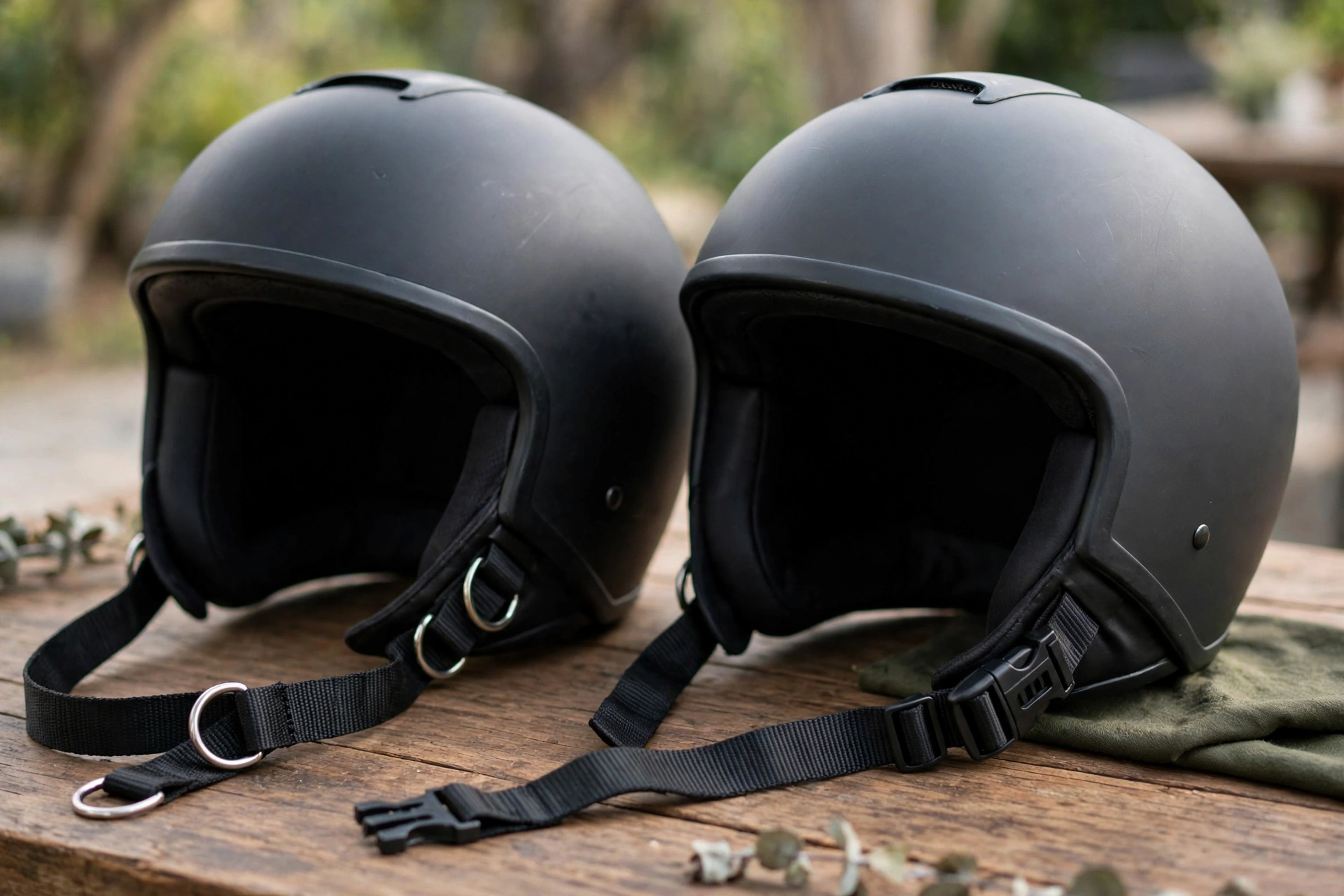
The difference between a double D-ring and a ratchet buckle helmet strap is how you fasten and tension it: a double D-ring threads the strap through two metal rings for a precise, infinitely adjustable fit that racing has trusted for decades, while a ratchet (micrometric) buckle clicks the strap into a toothed ladder for fast one-handed fastening that is far easier with gloves on. Both are safe when used correctly — the best choice depends on your riding and your habits.
This guide explains how each system works, where each one wins, and the mistakes that make either system unsafe.
How Does a Double D-Ring Helmet Strap Work?
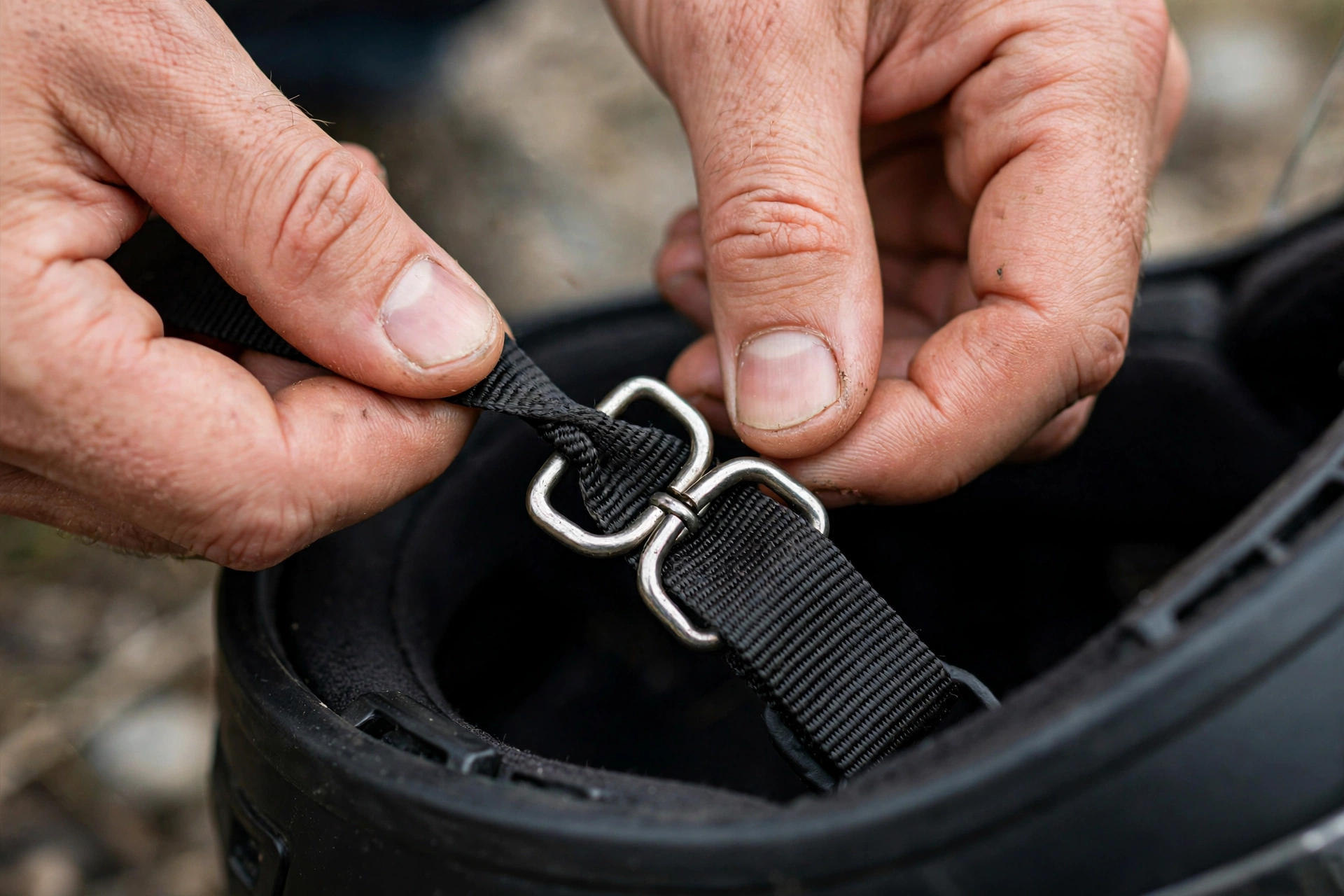
The double D-ring is the oldest and simplest fastening in motorcycling. One side of the chin strap carries two metal D-shaped rings; the other side is a plain strap end. You pass the strap end up through both rings, loop it back over the first ring and down through the second, then pull to tension it. Friction and the loop geometry lock it, and the harder the pull, the tighter it holds.
Its great strength is infinite adjustment. There are no preset steps, so the strap tightens to exactly your tension every time, whatever you wear underneath — a thin summer neck tube or a thick winter balaclava changes nothing about how precisely it can be set. That is one reason D-rings remain the standard in racing, where many series specify or strongly favour them.
The weakness is convenience. A D-ring needs two hands and a little practice, and it is fiddly with thick winter gloves. Many riders develop a routine — gloves off first, one glove held in the teeth — but a strap left loosely threaded because you were in a hurry is a strap that is not doing its job.
How Does a Ratchet Buckle Helmet Strap Work?
A ratchet buckle — also called a micrometric or quick-release buckle — replaces the rings with a toothed strap and a locking housing. You push the ladder-style strap end into the buckle and it clicks through a series of fine teeth until snug; a release lever or tab lets the strap out again when you take the helmet off. Most designs also include some coarse length adjustment so the fine ratchet range sits in the right place for your chin.
The strength is speed and ease. A ratchet can be fastened and released one-handed, with gloves on, in seconds, which is why it dominates commuter, touring, and scooter helmets. When a system is this easy, riders actually use it properly every single ride, including for a two-minute trip to the shops — and a strap that is always fastened correctly beats a theoretically better strap worn loose.
The trade-offs are steps and hardware. The teeth give fixed increments rather than truly infinite adjustment, so the perfect tension sometimes sits between two clicks. There is also more mechanism to keep clean: grit, fluff, and winter road grime in the buckle can affect the click, so it deserves a rinse and a check now and then.
Which Strap Is Safer: Double D-Ring or Ratchet Buckle?
In general terms, both systems are safe when the helmet meets the safety standard required where you ride and the strap is fastened snugly. Helmets are tested with their fitted fastening system as part of the certified design, so a ratchet helmet that passed its standard is not a lesser helmet, and a D-ring is not automatically superior in a crash.
What actually creates danger is misuse, and each system has its own version. D-ring misuse is threading it wrongly or leaving it slack — a strap should sit snug under the chin with roughly no more slack than a finger or two. Ratchet misuse is clicking it to a comfortable-but-loose notch, or failing to set the coarse adjustment so the fine range can reach proper tightness.
Either strap also has to keep the helmet positioned for the whole event of a crash, which usually involves more than one impact and plenty of rotation. That positioning role is why fit and retention sit alongside liner technology — including rotational systems such as the one explained in this guide to what MIPS is for helmets — as the real foundations of protection. The strap is not a detail; it is the part that keeps every other part in place.
- Double D-ring: infinite adjustment, racing favourite, needs two hands and practice
- Ratchet buckle: fast, gloved-hand friendly, stepped adjustment, keep the mechanism clean
- Either system: snug under the chin every ride — a loose strap is the unsafe option
Which Strap Suits Your Riding Best?
Choose the D-ring if you ride on track, wear the helmet for long stretches without removing it, or simply value the precise, set-and-forget tension once it is threaded. Riders who have used D-rings for years fasten them by muscle memory in seconds, and there is almost nothing to wear out or break.
Choose the ratchet if your riding is stop-start: commuting, delivery work, touring with frequent photo and fuel stops, or any riding where the helmet comes off ten times a day. The easier a strap is, the more honestly it gets used — and for riders with limited hand strength or mobility, a ratchet’s simple push-and-click can be the difference between a strap that is always snug and one that quietly is not.
Gloves are the everyday test. Try fastening both systems in the shop while wearing your thickest riding gloves. Whichever you can fasten correctly, snugly, and without frustration while wearing them is very likely the right strap for your real life, whatever the theory says.
How Should You Check and Care for Your Helmet Strap?
Whichever system you own, check it as part of your routine. Look for fraying, cuts, or stiffness in the webbing, and check stitching where the strap anchors to the shell. A strap that has been in a crash, or webbing that is damaged, is a reason to retire the helmet — straps are not a rider-serviceable safety part.
For a D-ring, keep the rings clean and confirm they move freely; grit between ring and strap makes tensioning uneven. Thread it the same correct way every time, and use the snap or tab provided to secure the loose end so it cannot flap or work free. For a ratchet, rinse grit out of the housing, confirm every tooth clicks and holds, and test the release lever — a buckle that does not click positively is telling you something.
Finally, build the habit that makes both systems equal: strap snug, every ride, no exceptions for short trips. Most helmet separations in accidents trace back not to which fastener was fitted, but to a strap left loose or undone. Pick the system you will always use properly, and then always use it properly.
Frequently Asked Questions
Q: Why do racing helmets use double D-rings?
A: Because the D-ring gives precise, stepless tension, is mechanically simple, and has a long record of staying fastened in severe crashes. Many race and track-day rules specify or prefer it, which keeps it standard on race helmets.
Q: Are ratchet buckle helmets allowed on track days?
A: It depends on the organiser and the rules where you ride — some accept any certified fastening, others require a double D-ring. Check the event’s rules before booking, and if you ride track often, a D-ring helmet removes the doubt.
Q: How tight should a helmet strap be?
A: Snug under the chin so the helmet cannot roll forward or lift off, with roughly a finger or two of slack at most. You should be able to talk and open your mouth, but the strap should feel firmly set — not resting loosely against your skin.

Olivia
Writer at Helmet Today, covering helmet reviews, fit and riding safety.