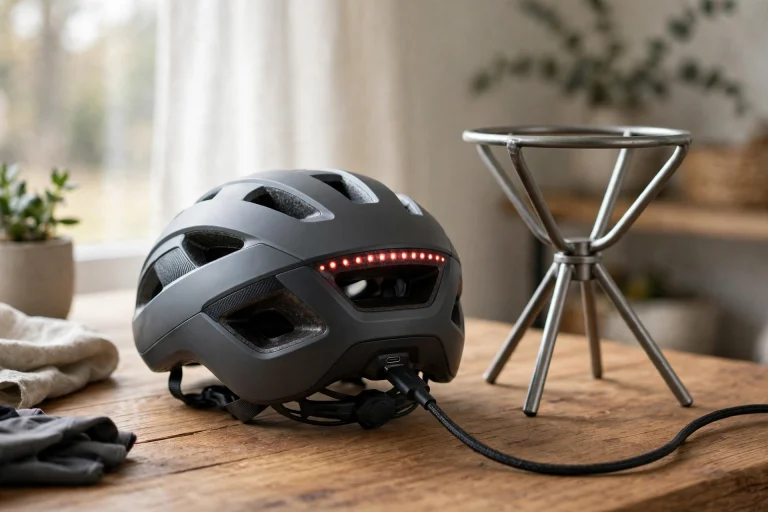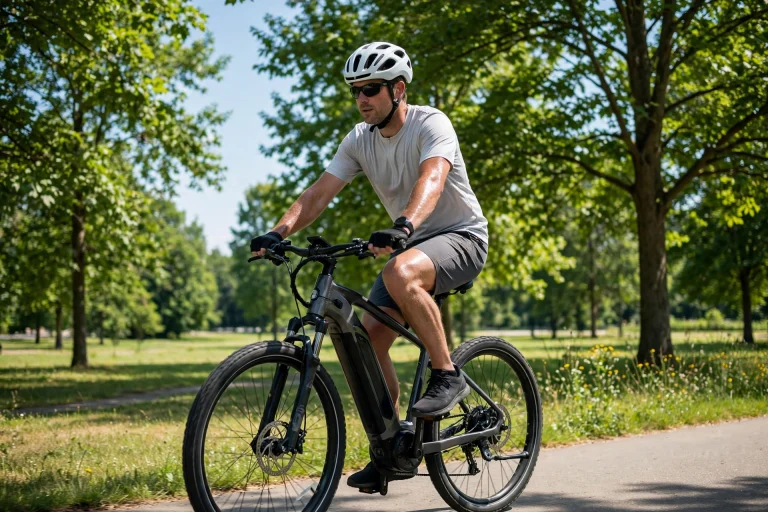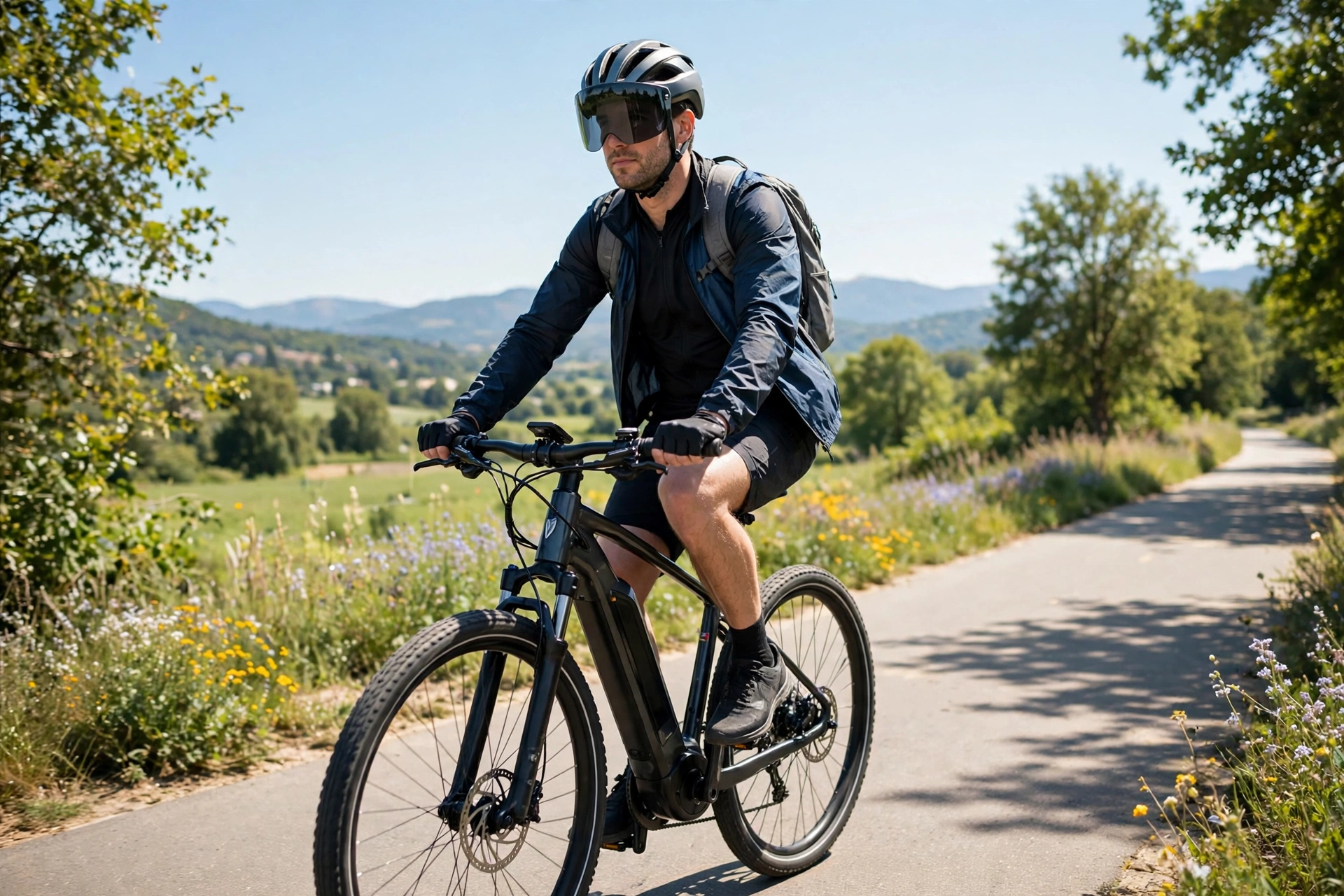
A drop-down sun shield is a tinted inner visor built into an e-bike helmet that flips down over your eyes with a lever or slider when the sun hits, and flips back up instantly when the light drops — giving you sunglasses on demand without ever taking your hands off the bars for long. It solves the oldest visor problem for commuters: a fixed tinted visor is wrong half the ride, and sunglasses under a helmet are fiddly to put on and take off while moving.
This guide explains how drop-down sun shields work, who they suit, and what to check before buying a helmet that has one.
How Does a Drop-Down Sun Shield Actually Work?
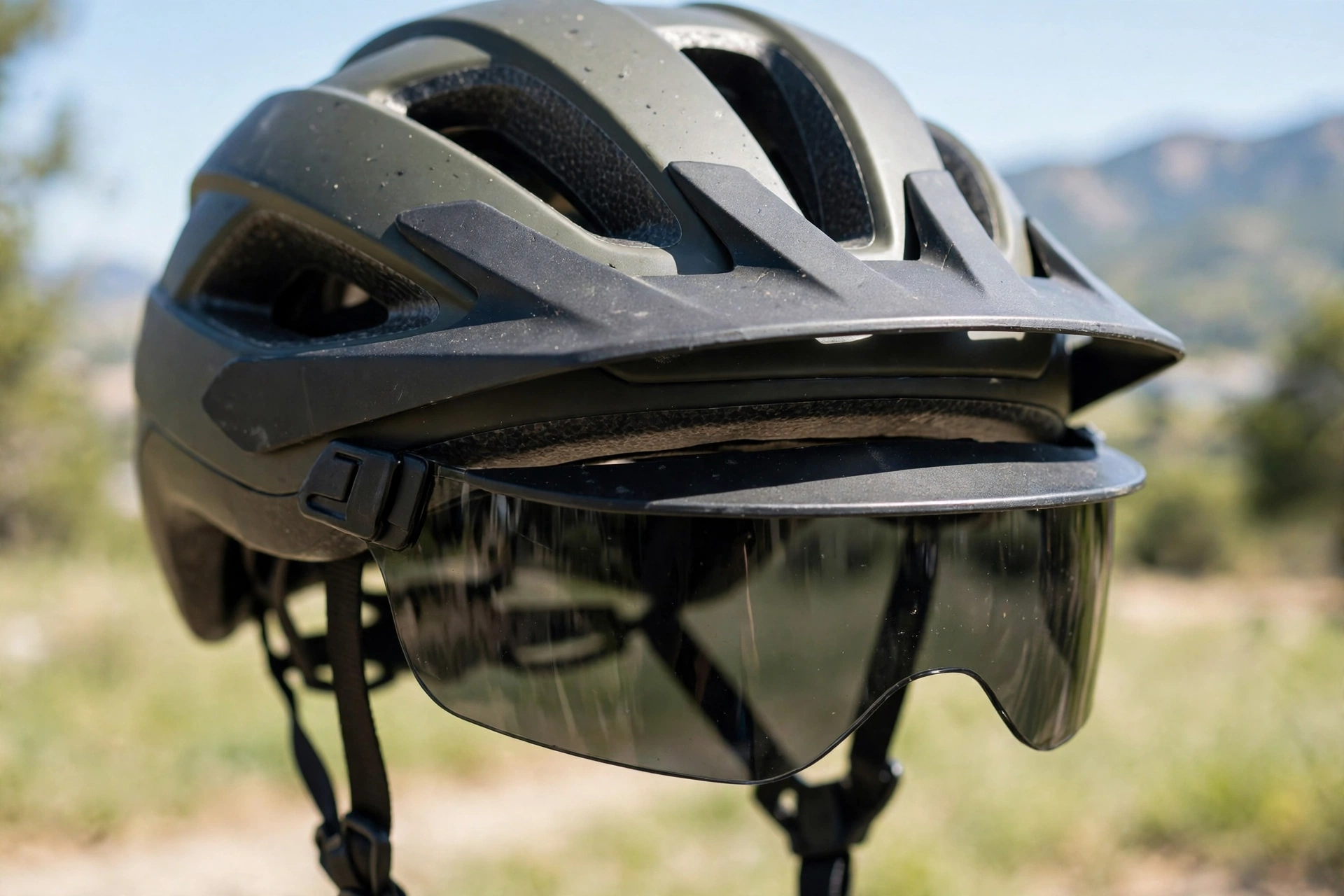
Inside the helmet shell, above and behind the main visor or eye opening, sits a second, smaller tinted lens. A lever or slider on the side or top of the helmet — designed to be operated with one hand, often with gloves on — lowers that lens in front of your eyes and raises it again just as quickly. The mechanism is usually spring-loaded or detented, so the shield stays firmly where you put it and does not drift down or rattle at speed.
The shield itself is a short tinted lens, not a full visor. It covers your eyes and the area just around them, cutting glare and bright sunlight, while the rest of your face stays open to the air. That is a deliberate trade-off: you get sun protection exactly where you need it, without the heat buildup and fogging that a full sealed visor can bring on a warm day.
Shield tints vary. Some are lightly tinted for general brightness, some are darker for strong sun, and a few are photochromic, darkening as the light grows. In general terms, a medium tint suits most commuters best — dark enough to cut glare, light enough that a sudden shaded stretch does not leave you peering through darkness.
Who Benefits Most From a Drop-Down Sun Shield?
Commuters whose routes mix sun and shade benefit most. If your ride runs from open roads into tree-lined paths, through tunnels or underpasses, or from bright streets into shaded cycle lanes, a fixed tinted visor is wrong for part of every ride — but a drop-down shield adapts in a second, with one hand, without stopping. That adaptability is the whole point of the design.
Riders who wear prescription glasses benefit too. Fitting sunglasses over or behind prescription lenses is awkward, and switching between two pairs of glasses mid-ride is impractical. A drop-down shield sits in front of your normal glasses and gives you sun protection without a second pair of lenses — just check that the shield clears your glasses frames comfortably, since depths vary between helmets.
The shield also suits riders who dislike carrying extras. No sunglasses to lose, scratch, or forget, and nothing to swap at the start of a ride. For a daily commuter, removing one small daily decision — and one more thing to remember — is a genuine quality-of-life improvement, not just a gadget.
What Are the Downsides to Watch For?
The mechanism is the first thing to check, because it is the part that wears. A cheap lever can loosen, rattle, or stop holding the shield firmly in position, and a shield that drops unexpectedly or vibrates at speed is a distraction you do not need. Try the lever repeatedly in the shop, with gloves on, and look for a solid, positive click in both positions rather than a vague slide.
Optical quality matters too. A poor shield distorts your view, adds reflections, or has an uneven tint, and you will notice it most when you most need clear vision — riding toward low sun. Look through the shield at a distant object and check for distortion, and check the edges of the shield for reflections that could distract you in bright light.
Coverage is the third limitation. A drop-down shield protects your eyes, not your whole face, so it does not block wind, rain, or insects the way a full visor does. If you ride in heavy rain or cold wind, you may still want a full clear visor or glasses alongside the shield.
How Do You Choose a Helmet With a Good Sun Shield?
Start with the helmet itself, not the shield. Fit, certification, ventilation, and weight matter more than any sun feature, and a helmet that fits badly is a bad helmet no matter how clever its shield. The shield is a bonus on top of a good helmet, never a reason to accept a poor one.
Next, test the shield the way you will use it. Operate it with gloves, check it clears your glasses if you wear them, ride with it up and down if the shop allows, and listen for rattles. Check whether the shield is replaceable — shields scratch like any lens, and a helmet whose shield cannot be replaced has a built-in expiry date on its sun protection.
Also check how the shield interacts with the helmet’s other features. Does it work with the peak, if there is one? Does it interfere with the retention system or the vents? Does it fog in cold weather, and is there an anti-fog coating? These details separate a well-designed system from a feature added as an afterthought. And as with any helmet purchase, the protective technology inside counts: many modern helmets include a low-friction layer to reduce rotational forces, explained in this guide to what MIPS is for helmets.
How Do You Look After a Drop-Down Sun Shield?
Treat it like a good pair of sunglasses. Clean it only with a soft microfibre cloth and mild soap or a lens cleaner made for coated lenses — paper towels and harsh cleaners scratch the surface and strip coatings, and a scratched shield scatters sunlight exactly when you need a clear view. Store the helmet with the shield raised, so nothing presses against it in a bag.
Keep the mechanism clean. Dust and grit from the road work into sliders and levers over time, so wipe the mechanism occasionally and check that it still clicks firmly into both positions. If the lever starts to feel loose or gritty, clean it before it wears further — a small problem caught early stays small.
Finally, know when to replace the shield. Deep scratches, a cloudy coating, or a mechanism that no longer holds position all mean the shield is no longer doing its job safely. Replacements are usually available from the helmet maker, and fitting one is normally a simple job.
Frequently Asked Questions
Q: Can I use a drop-down sun shield at night?
A: No — raise it fully at night. Like any tinted lens, the shield reduces the light reaching your eyes, which is dangerous after dark. The advantage of the design is that raising it takes one second, so switching between day and night modes is effortless.
Q: Does a drop-down sun shield replace sunglasses?
A: In general terms, yes for cycling, since it gives you sun protection without a separate pair of glasses. Some riders still prefer sunglasses for walking around off the bike, but on the ride itself the shield does the same job more conveniently.
Q: Will a drop-down shield fit over my prescription glasses?
A: Usually yes, but check before buying. Shield depth and glasses frame size vary, so try the combination in the shop with your own glasses on, and make sure the shield lowers fully without pressing on the frames.

Olivia
Writer at Helmet Today, covering helmet reviews, fit and riding safety.