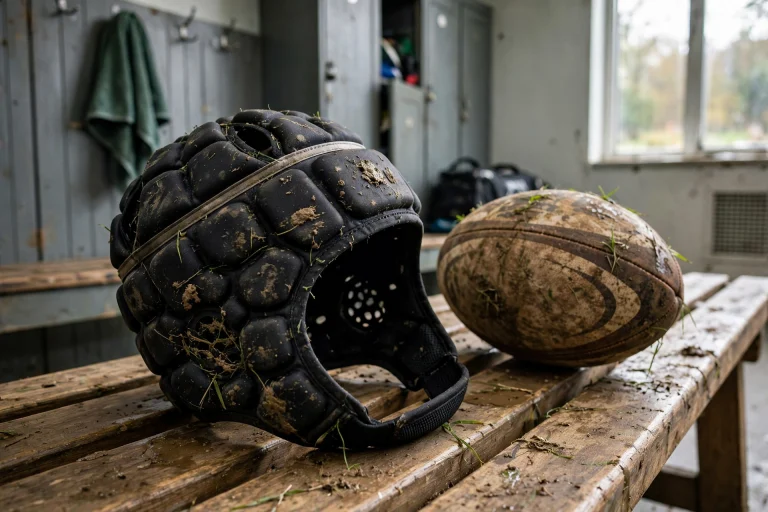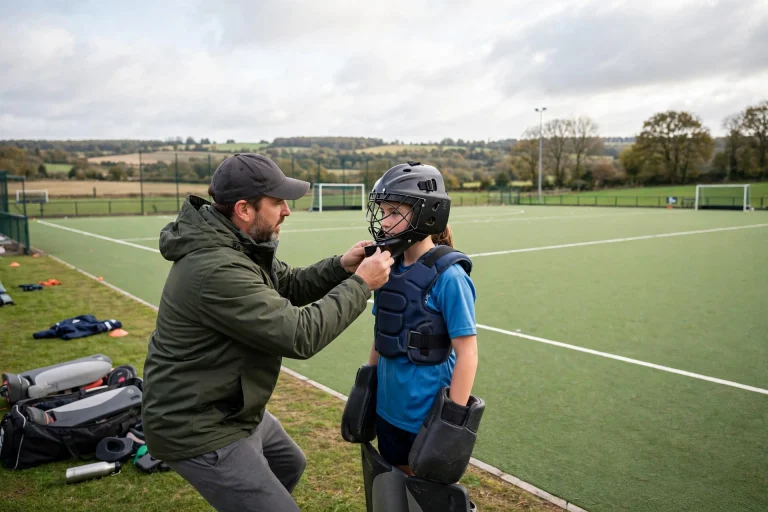
In general terms, a hurling helmet and a camogie helmet are closely related, but they are not identical: the main differences lie in the faceguard design and the fit, because hurling and camogie are different games with different players. Both are hard helmets with a faceguard, worn to protect the head and face from a fast-moving sliotar and a swinging hurley. A camogie helmet’s faceguard is generally shaped differently from a hurling one, and the two types are usually sized and fitted with their own players in mind.
If you are buying for a player, the safest rule is simple: buy the helmet made for the game being played. A hurling helmet is made for hurling, and a camogie helmet is made for camogie. This guide explains what each helmet is, how the faceguards differ, and what to check before you buy, so you can choose with confidence.
What Is a Hurling Helmet?
A hurling helmet is a hard protective helmet worn by hurling players, with a metal faceguard that covers the front of the face. Hurling is a fast field game played with a hurley, a wooden stick, and a small hard ball called a sliotar. The ball can travel quickly, and hurleys swing close to players’ heads, so head and face protection matters. In general terms, the helmet is designed to guard against impacts from the ball, the hurley, and collisions with other players.
The helmet has a hard outer shell, padding on the inside, and a faceguard fixed to the front. The faceguard is made of metal bars arranged to shield the eyes, nose, mouth, and jaw while still letting the player see the ball and breathe freely. A chin strap holds the helmet in place, and the padding inside helps the helmet sit snugly so it does not shift during play.
What Is a Camogie Helmet?
A camogie helmet is the equivalent protective helmet worn by camogie players. Camogie is the women’s version of hurling, played with similar skills, a hurley, and a sliotar, but with its own rules and traditions. Like a hurling helmet, a camogie helmet has a hard shell, internal padding, a faceguard, and a chin strap. Its job is the same: to protect the head and face during a fast, physical game.
Where camogie helmets differ, in general terms, is in the shape of the faceguard and in the way the helmet is fitted for the players who wear it. The faceguard on a camogie helmet is generally designed with a different bar arrangement from the one used on a hurling helmet. The overall fit may also be shaped differently, because the helmets are made for a different group of players.
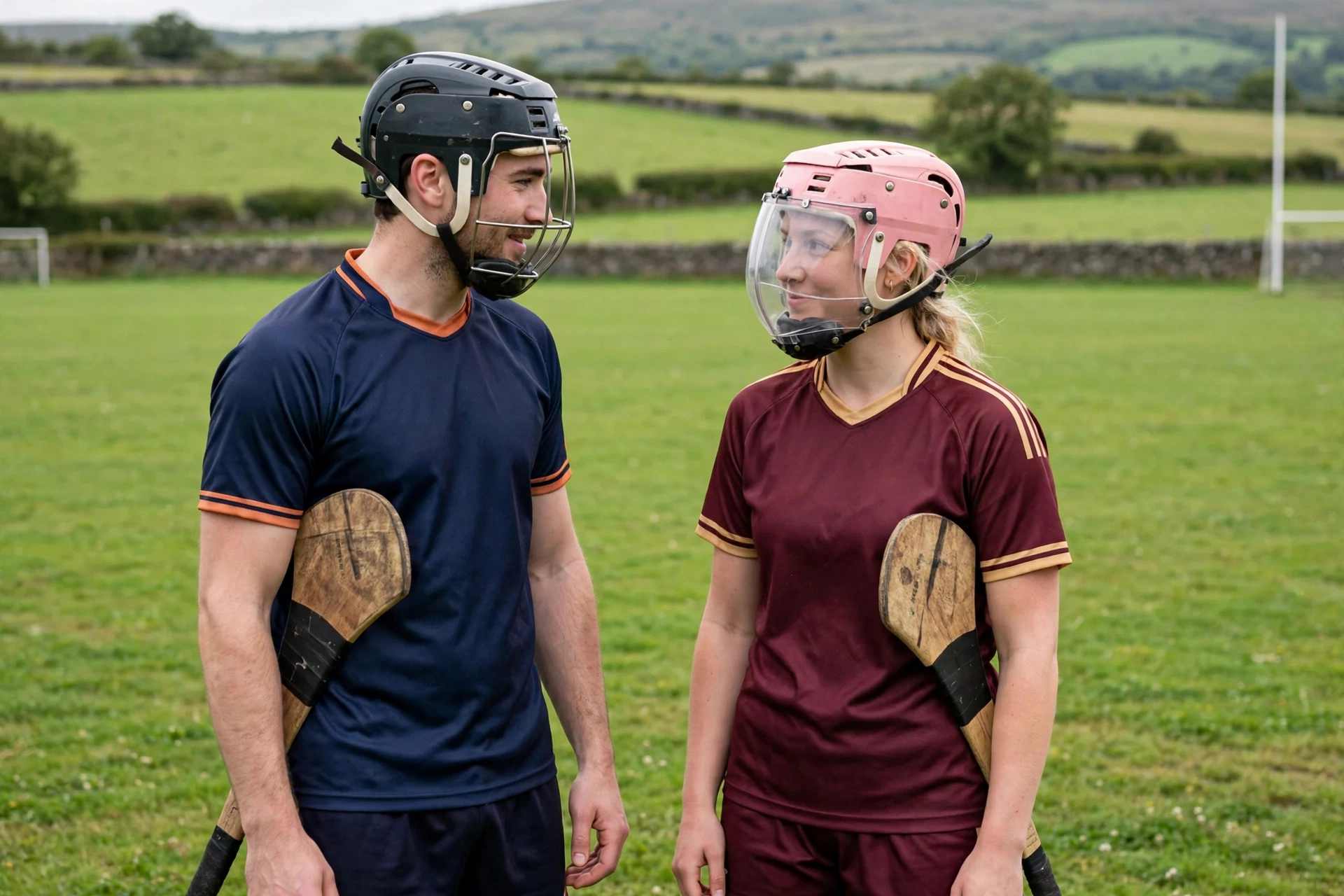
How Do Hurling and Camogie Faceguards Differ?
The faceguard is where the difference between the two helmets is most visible. A hurling faceguard and a camogie faceguard both use metal bars to protect the face, but the bars are arranged differently. In general terms, the camogie faceguard has a different pattern of bars across the front of the face, while the hurling faceguard follows its own arrangement. The difference is easy to see when the two helmets are placed side by side.
It is worth remembering that a faceguard does not make a player invulnerable. It reduces the risk of injury to the face, but it does not remove it entirely. Players should still keep their heads up, be aware of players around them, and play within the rules of the game. Good technique and good awareness matter as much as good equipment.
Can You Wear a Hurling Helmet for Camogie, or Vice Versa?
In general terms, the two helmets are not interchangeable, and players should wear the helmet made for their game. The rules and expectations of each sport cover the equipment players wear, and a helmet designed for one game may not meet the expectations of the other. If you are unsure what is expected, the club, the coach, or the competition organisers can confirm what players should wear.
For young players, the question often comes up when kit is handed down from an older sibling or bought second-hand. A helmet that has been passed down can be a sensible saving, but only if it is the right type for the game, the right size, and in good condition. If any of those are in doubt, it is better to ask the coach than to guess.
How Should a Hurling or Camogie Helmet Fit?
Fit matters as much as the type of helmet. A helmet should sit level on the head, low enough to cover the forehead, without tilting forward or back. It should feel snug all around, with no pressure points that ache after a few minutes, and it should not rock from side to side or slide forward when the player shakes their head.
The faceguard should sit in front of the face without pressing against the nose or chin, and the player should be able to see clearly in all directions, including downwards at the ball. The chin strap should be done up snugly, so the helmet stays in place when the player runs, jumps, and changes direction. A helmet with a loose strap can shift at exactly the wrong moment.
Try the helmet on with the player wearing anything else they normally wear for the game, and check the fit after a few minutes of movement rather than only standing still. A helmet that feels fine in the shop may feel different once the player is running. If the helmet has adjustable padding, use it to fine-tune the fit rather than settling for a size that is close but not quite right.
What Should You Look for When Buying a Hurling or Camogie Helmet?
Start by confirming the helmet is made for the right game, then check the size range and the way it fastens. Look for a sturdy faceguard with bars that are firmly fixed, padding that can be removed and cleaned, and a chin strap that is easy to adjust but holds firmly once done up. The shell should feel solid, with no cracks or weak spots, and the inside should be comfortable against the head.
Finally, remember that a helmet is only one part of staying safe in Gaelic games. Warming up properly, learning good technique, and listening to the coach all matter too. If you want to understand more about the technology inside modern helmets, reading about what MIPS is for helmets is a useful starting point, although not every hurling or camogie helmet uses this system.
Frequently Asked Questions
Q: What is the main difference between a hurling helmet and a camogie helmet?
A: In general terms, the main difference is the faceguard: a camogie helmet’s faceguard has a different bar arrangement from a hurling helmet’s faceguard, and the helmets are fitted for different groups of players. Both have a hard shell, padding, and a chin strap.
Q: Can a hurling player wear a camogie helmet?
A: In general terms, no. Players should wear the helmet made for their game, because the rules and expectations of each sport cover the equipment used, and the fit is shaped for the players of that game. Ask your coach or club if you are unsure.
Q: How do I know if a hurling or camogie helmet fits properly?
A: It should sit level and snug, covering the forehead, without rocking or sliding when the player shakes their head. The faceguard should not press on the nose or chin, the view should be clear, and the chin strap should be done up snugly.

Olivia
Writer at Helmet Today, covering helmet reviews, fit and riding safety.