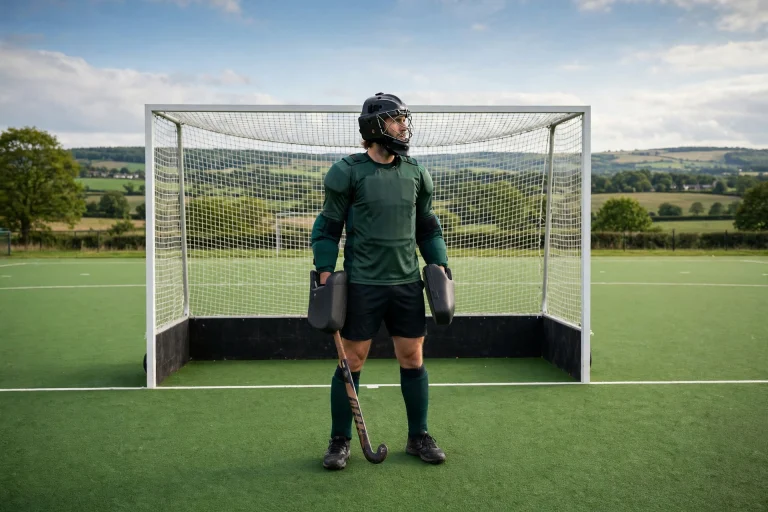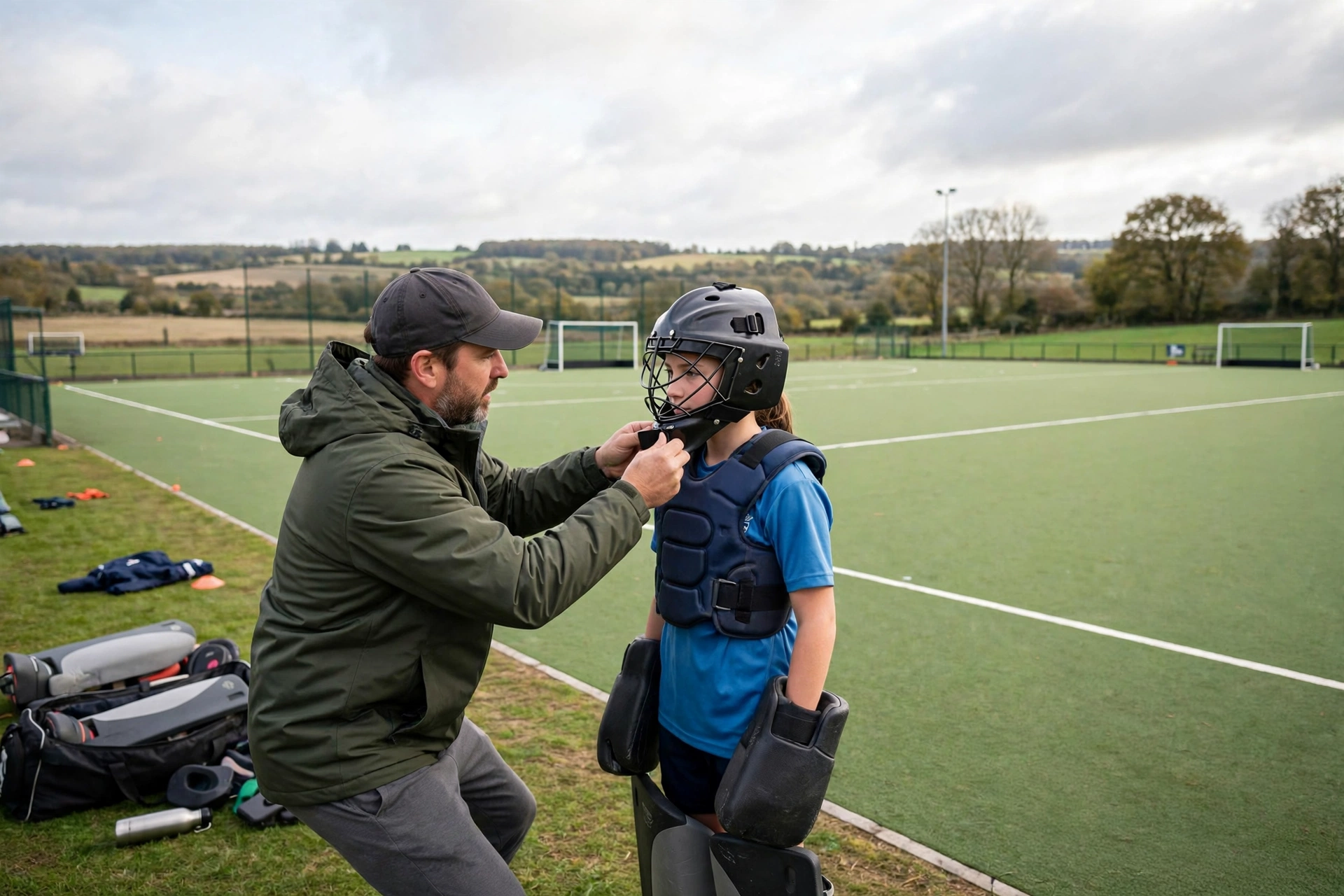
To fit a field hockey goalkeeper helmet, start by measuring the head, choose the size that matches the measurement, then put the helmet on and check that it sits level, feels snug all around, and stays in place when you move. The chin strap should be done up snugly, the faceguard should sit clear of the nose and chin, and the goalkeeper should be able to see clearly in every direction. A well-fitted helmet protects the head without distracting the goalkeeper from the game.
Fit is not a detail you can leave to chance. A helmet that is too loose can shift when the goalkeeper dives, and one that is too tight becomes a distraction that the goalkeeper will want to take off. This guide walks through the fitting process step by step.
Why Does Goalkeeper Helmet Fit Matter So Much?
A goalkeeper helmet has to do two things at once: protect the head and stay out of the way. If it fits well, the goalkeeper forgets about it and concentrates on the ball. If it fits badly, it becomes a constant irritation, and an irritated goalkeeper is a distracted goalkeeper.
Fit also decides how much protection the helmet actually gives. A helmet that sits too high leaves the forehead and the top of the face exposed. A helmet that rocks from side to side can move at the moment of impact, so the padding and the faceguard are no longer where they should be. A helmet that is too small may not cover the back of the head properly.
How Do You Measure for the Right Size?
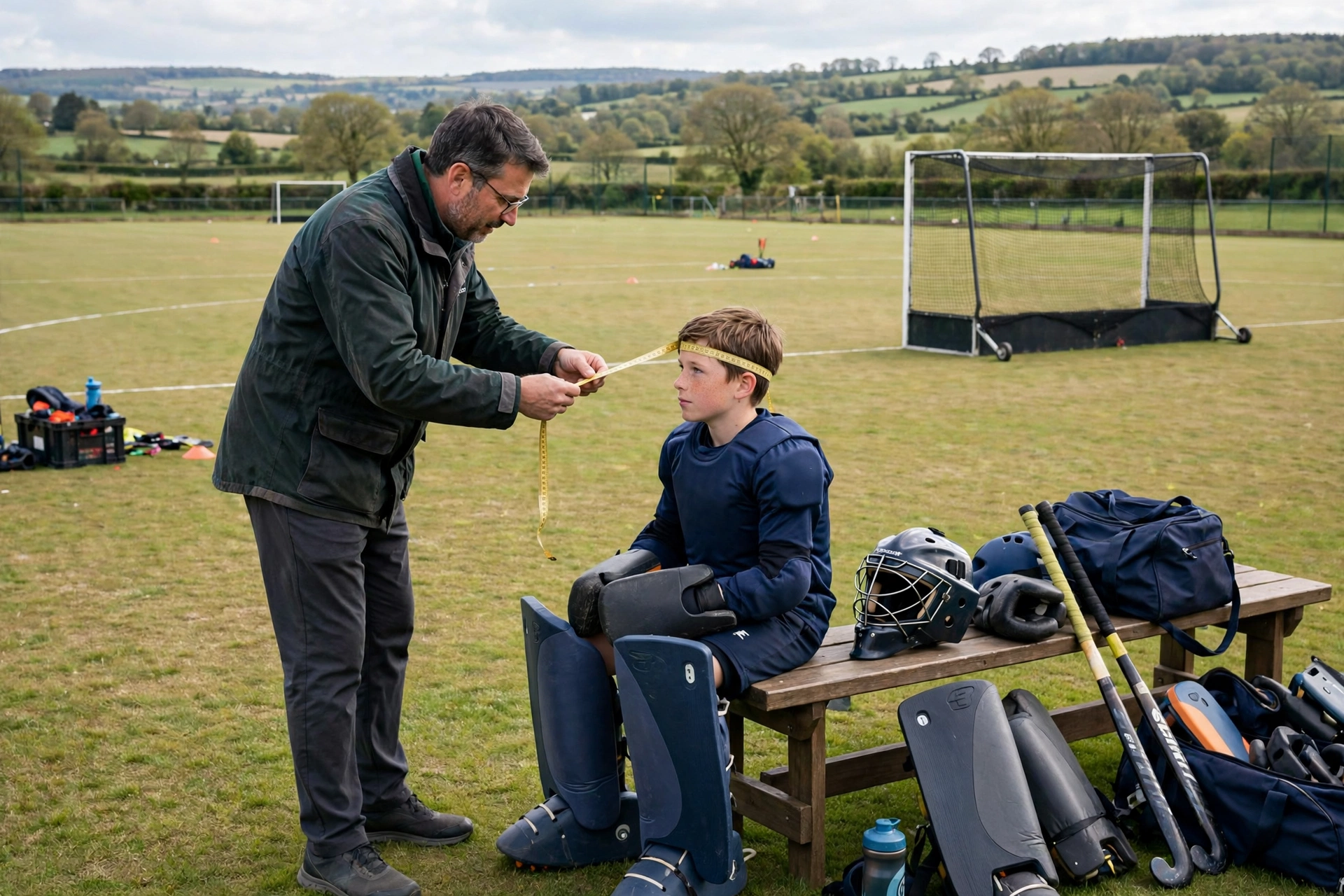
Measuring the head is the first step, and it is simple. Use a soft tape measure, the kind used for sewing, and wrap it around the head just above the eyebrows and above the ears, at the widest point. Keep the tape level, not tilted, and take the measurement in centimetres. Write the number down, and repeat the measurement once to be sure.
Compare that number with the maker’s size chart for the helmet you are considering. Size charts differ between makers, so a measurement that means a medium in one brand may mean a large in another. Never assume that the size on the label of a previous helmet will match a new one.
How Should the Helmet Sit on Your Head?
Once the helmet is on, it should sit level on the head, low enough to cover the forehead, without tilting forward or back. The bottom edge at the front should sit just above the eyebrows, and the helmet should cover the top of the ears and the back of the head. If the helmet tilts back, the forehead is exposed; if it tilts forward, the view is blocked.
The helmet should feel snug all around, with the padding touching the head evenly and no gaps at the sides. It should not press hard in one spot while leaving a gap in another, and it should not cause a headache after a few minutes. A little snugness is normal, especially with a new helmet, but pain is a sign the fit is wrong.
How Do You Adjust the Straps and Padding?
The chin strap is the part that holds the helmet on, so it needs to be adjusted properly. Do the strap up under the chin so it feels snug but not tight. You should be able to fit a finger between the strap and the chin, but not much more. A strap that hangs loose is not doing its job, and a strap that cuts into the chin will be loosened or undone in play, which is worse.
Many helmets have a chin cup, a small padded cup that sits under the chin. This should sit centrally and comfortably, and the straps on each side should be adjusted evenly so the helmet does not pull to one side. If the straps are uneven, the helmet will sit crooked, and the faceguard will not be where it should be.
Padding is the other adjustment. Some helmets have removable pads of different thicknesses, or pads that can be moved to different positions inside the shell. Use these to fine-tune the fit: thicker pads where there is a gap, thinner ones where there is pressure. Take your time with this, because small changes to padding can make a large difference to comfort over a full match.
How Do You Check the Fit With a Mask or Throat Guard?
The helmet should be checked together with the throat guard and any other kit, not on its own. Put the throat guard on with the helmet and check that the two meet without a gap at the throat. The throat guard should not push the helmet up, and the helmet should not push the throat guard down or out of place.
Check the view as well. With the helmet and throat guard on, look up, down, left, and right, and check that the ball is visible at every angle, including on the ground close to the feet. The faceguard bars should not block the view of the ball, and the throat guard should not block the view downwards. A goalkeeper who cannot see the ball at their feet is at a disadvantage.
What Are the Signs the Fit Is Wrong?
There are a few clear signs that a helmet does not fit. The most obvious is movement: if the helmet slides, rocks, or lifts when the goalkeeper moves, it is too loose or the wrong shape. Another sign is pain: pressure points on the forehead, the temples, or the back of the head that ache after a few minutes mean the helmet is pressing where it should not.
Blocked vision is another warning sign. If the faceguard bars cut across the view of the ball, or the helmet sits so low that the goalkeeper has to tilt their head back to see, the fit is wrong. The same applies if the throat guard pushes the helmet up or the helmet pushes the throat guard down: the two pieces should work together, not fight each other.
The simplest test is the training test. Wear the helmet in a full training session, with all the other kit, and see how it feels after an hour. If the goalkeeper forgets they are wearing it, the fit is right. If they are still thinking about it at the end of the session, something needs adjusting, and if adjustment does not fix it, the size or the model may need to change. If you want to understand more about what is inside a modern helmet, reading about what MIPS is for helmets explains one system you may see listed on the box.
Frequently Asked Questions
Q: How tight should a field hockey goalkeeper helmet be?
A: Snug, but not painful. It should touch the head evenly all around, stay in place when you shake your head, and not cause pressure points or headaches. You should be able to fit about one finger between the chin strap and your chin.
Q: Can a goalkeeper helmet be adjusted, or is the size fixed?
A: Many helmets can be adjusted, through the chin strap, the back fitting, and removable padding of different thicknesses. Use these adjustments to fine-tune the fit, but if the helmet is the wrong size, adjustment alone will not fix it.
Q: How often should a goalkeeper helmet’s fit be checked?
A: At the start of every season, and after any growth spurt for young players. Check the fit again after replacing padding or a faceguard, and any time the helmet starts to move, press, or distract the goalkeeper during play.

Olivia
Writer at Helmet Today, covering helmet reviews, fit and riding safety.