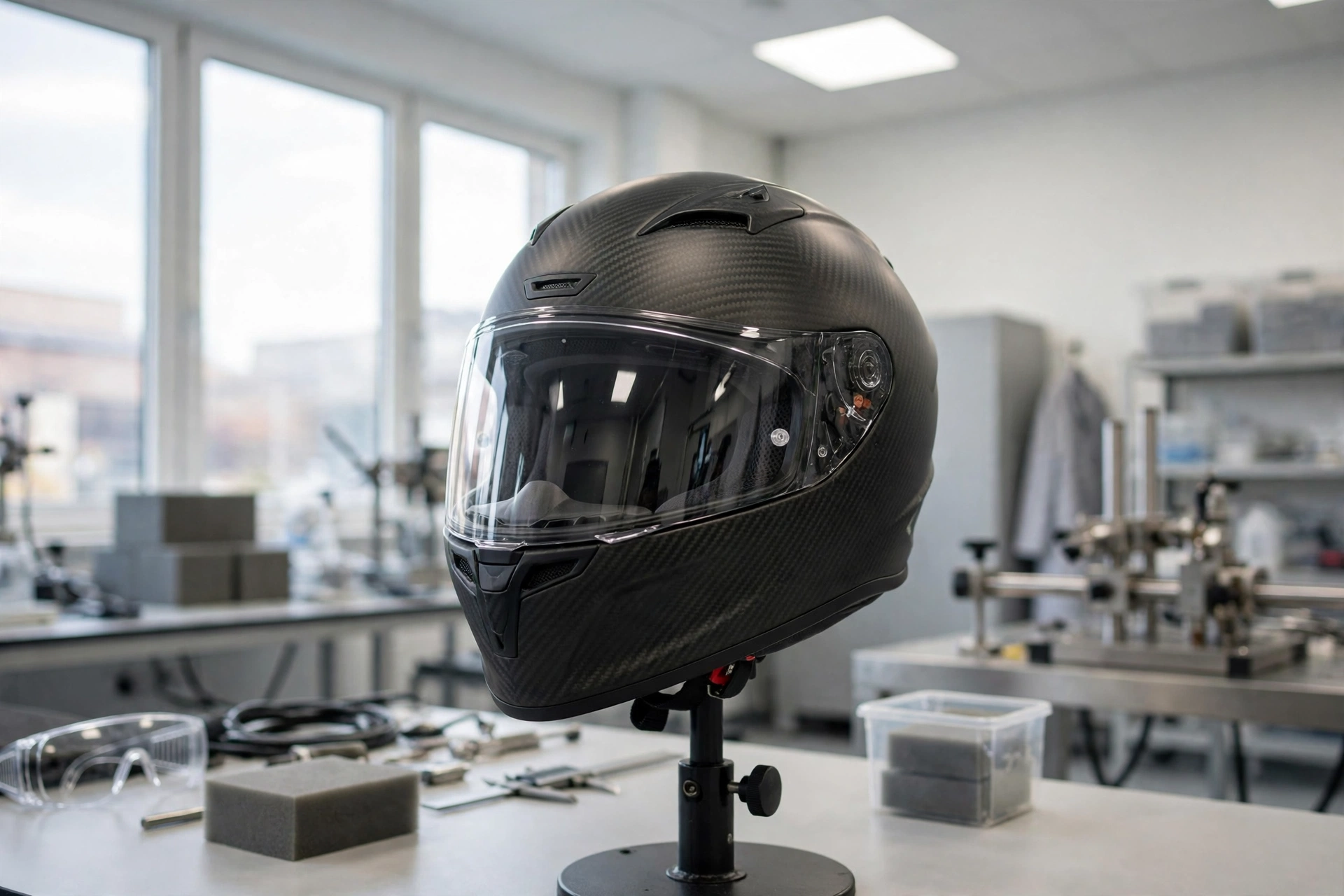
Helmet shells are tested before sale by being put through a series of controlled impact, penetration and strap-strength checks in a laboratory, in general terms, to make sure they meet the safety standard they claim. The exact tests depend on the standard and the type of helmet, but the idea is the same everywhere: the helmet is fitted to a head-shaped test form, struck or dropped in a controlled way, and the forces recorded are compared with limits set by the standard.
Testing does not happen on a single helmet. Makers and test laboratories test samples from production, and the tests are repeated across different sizes, temperatures and impact points. This guide explains, in general terms, how the main checks work and what they are meant to prove.
What Happens in an Impact Test?
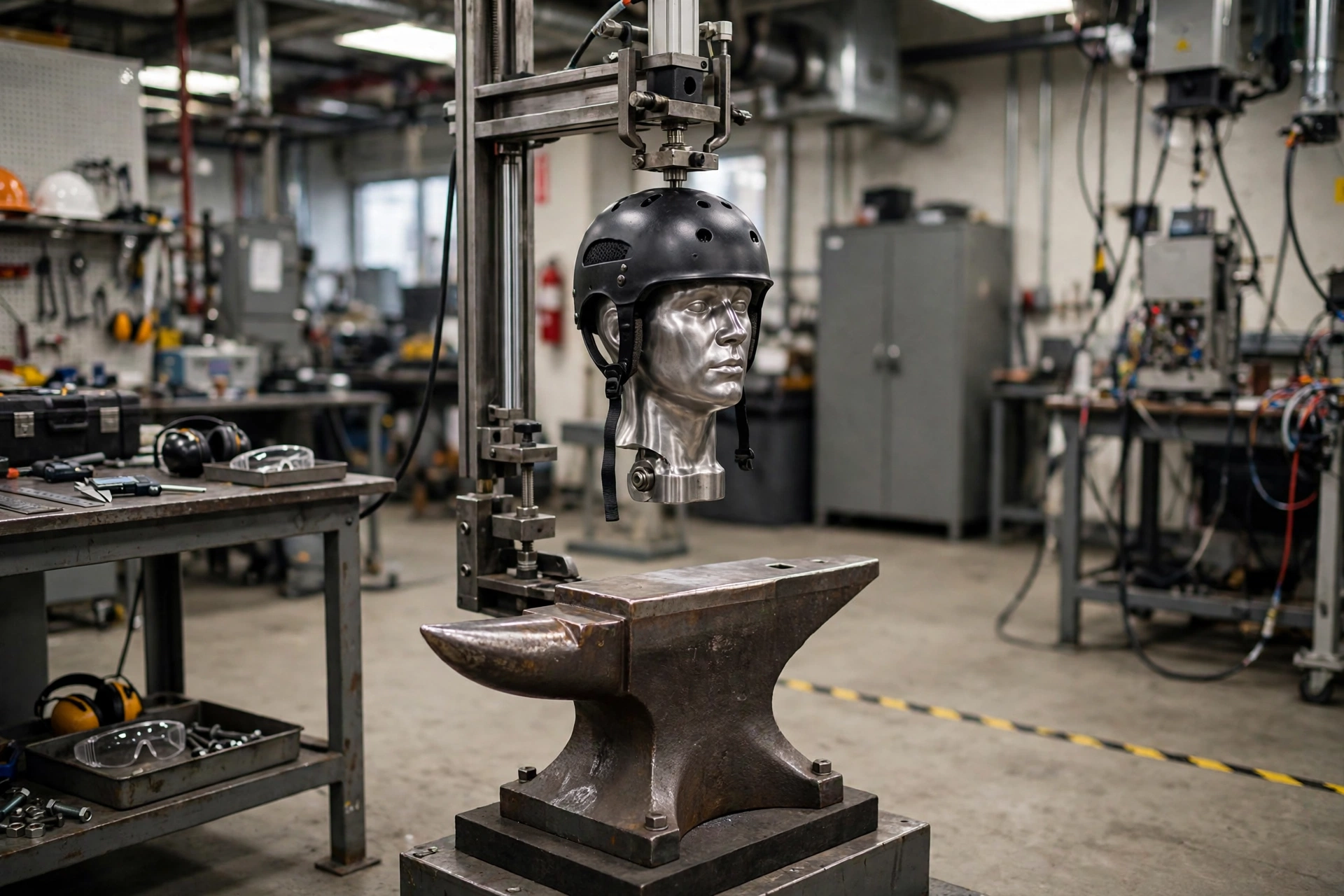
In an impact test, the helmet is fitted onto a headform, a solid metal or plastic shape made to the size and weight of a human head. The headform and helmet are then dropped onto a hard surface, or a weight is dropped onto the helmet, at a set speed and from a set height. Sensors inside the headform record how much force reaches it.
The helmet is tested at several points: the crown, the sides, the front and the back. Each point is struck separately, because a helmet that protects well at the crown may behave differently at the side. The forces recorded must stay below the limit set by the standard for the helmet to pass.
The test is often repeated in different conditions. Helmets may be tested when they are cold, hot, wet or after being stored at a set temperature, because a shell and foam can behave differently in different conditions. A helmet that passes only at room temperature would not be much use in winter or summer.
How Are Shells Checked for Penetration?
As well as impact tests, many standards include a penetration check. A pointed weight, sometimes called a striker, is dropped onto the helmet from a set height to see whether it can pierce the shell and reach the headform inside. The shell must stop the striker, or the striker must not reach a set depth.
This test matters because a shell needs to do more than cushion a blunt impact: it also needs to stop sharp objects from reaching the head. A shell that is strong in a flat impact but weak against a point could fail this check even if it passes the impact test.
Not every standard includes a penetration test for every type of helmet. Some cycling standards, for example, focus on impact and retention, while motorcycle and industrial standards often include penetration checks. The tests a helmet must pass depend on the risks it is designed for.
What Other Checks Do Helmets Go Through?
Impact and penetration are the best-known tests, but they are not the only ones. The retention system, the straps and buckle that hold the helmet on, is tested by pulling on it with a set force to make sure it does not slip off or break. A helmet that comes off in a crash cannot protect you, so this check matters as much as the impact test.
Some standards also check how far the helmet can roll off the headform when it is pulled from the front or the back. This is sometimes called a roll-off test, and it checks that the helmet stays in place when it is tugged in the direction it might be pulled during a fall.
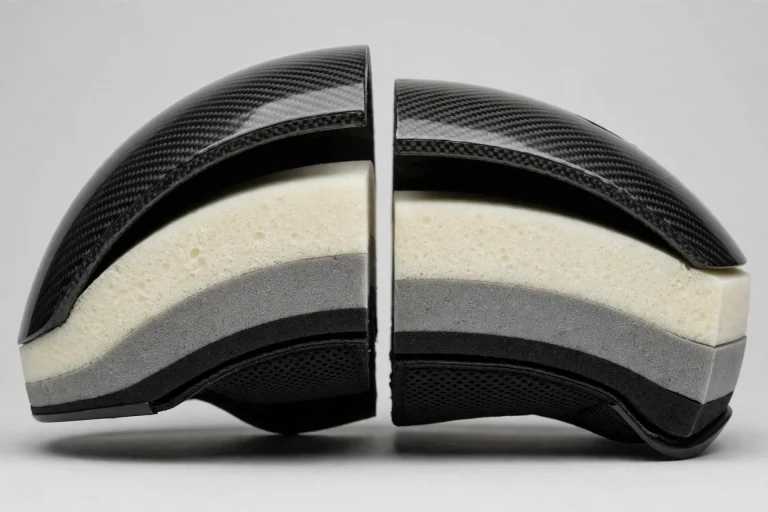
Other checks look at the helmet’s coverage, the field of vision it allows, and the durability of its materials. The shell may be checked for cracks after the impact tests, and the liner may be inspected to see how it deformed. Together, these checks build a picture of how the helmet behaves, not just a single number.
Who Does the Testing and How Is It Verified?
Testing is carried out in laboratories that are set up for the purpose, either by the maker, by an independent test house, or by both. In many cases, a helmet must be tested by an independent laboratory before it can carry a certification mark, while in other cases the maker tests its own helmets and declares that they meet the standard.
The rules vary by country and by standard. Some standards require third-party certification, where an outside body checks the test results and audits the factory. Others allow the maker to self-declare. Either way, the helmet should carry a label inside stating which standard it meets, and that label is the buyer’s main way of knowing the helmet was tested.
Testing is not a one-off event. Makers are expected to test samples from production, not just the first helmets off the line, so that quality stays consistent. If a production change affects the shell or the liner, the helmet may need to be tested again.
What Should You Look for as a Buyer?
As a buyer, you do not need to know the details of every test. What matters is the label inside the helmet. Check that the helmet meets a recognised safety standard for your country and your activity, and that the label is present and legible. A helmet without a clear standard label is a warning sign.
Check the fit too, because a tested helmet only protects you if it stays on your head and sits in the right place. Try the helmet on, do the straps up snugly, and shake your head to see if it moves. If you are learning about helmet technology, reading about what MIPS is for helmets can help you understand a feature that may be listed alongside the standard on the box.
Finally, remember that testing is done under laboratory conditions. A pass means the helmet met the standard in those tests, not that it will protect you in every possible crash. Riding within your limits and replacing a helmet after an impact matter just as much as the label.
Frequently Asked Questions
Q: Does every helmet get tested before it is sold?
A: In general terms, helmets sold under a recognised standard are tested as part of certification, but the testing is done on samples, not on every single helmet. The label inside is your evidence that the model was tested.
Q: What does the label inside my helmet mean?
A: It states which safety standard the helmet meets, and sometimes the size and date of manufacture. It is the main way to check that the helmet was tested to a recognised standard.
Q: Can a helmet pass the tests and still be a poor choice?
A: Yes, if it does not fit you. A helmet that is too loose or too tight will not protect you as well as one that fits, whatever its test results were.

Olivia
Writer at Helmet Today, covering helmet reviews, fit and riding safety.