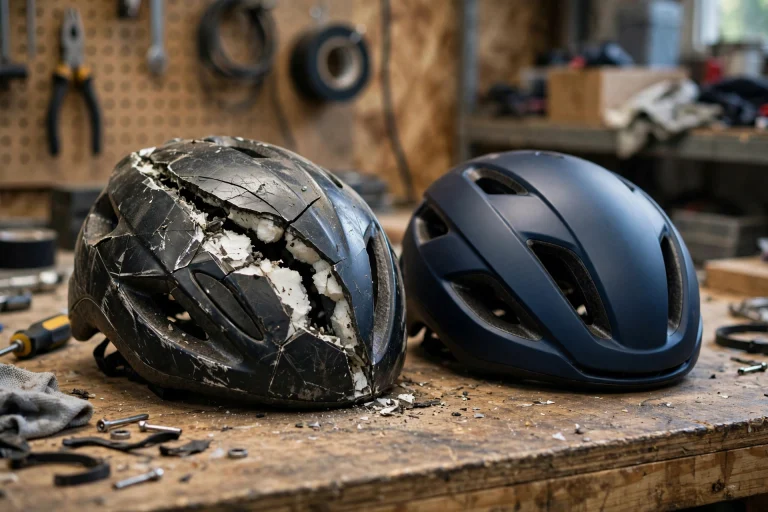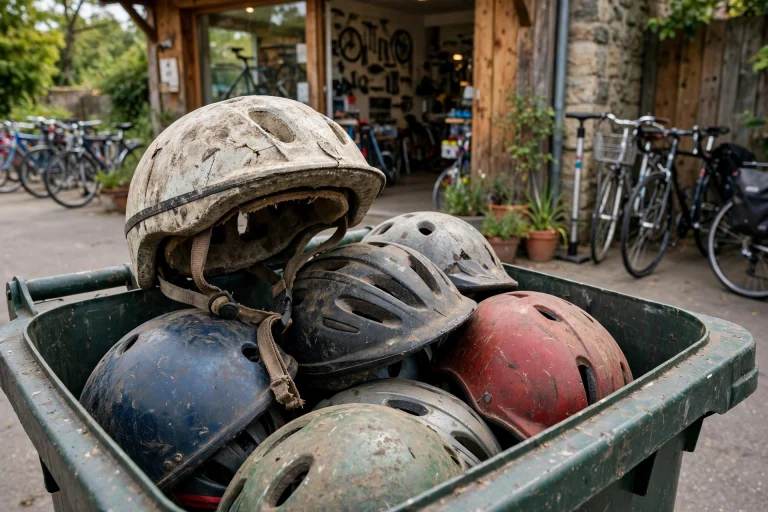
After a helmet is recycled, its parts go separate ways: the foam is usually compacted, melted, and made into new plastic products; the hard shell is recycled as plastic; and the straps, buckles, and padding are either recycled, reused as spares, or disposed of responsibly. A recycled helmet does not come back as a new helmet. Instead, its materials become something else — and understanding that journey helps explain why recycling a helmet is worth doing, and why it is not as simple as putting it in a bin.
This guide follows each part of a helmet after recycling, and explains what it can become.
What Happens to the Foam?
The foam liner — usually EPS, expanded polystyrene — is the largest part of a helmet by volume. After the helmet is dismantled, the foam is sorted, cleaned, and compacted to squeeze out the air trapped inside it. Compaction reduces a bulky pile of foam to a dense block that is economical to transport and store.
The compacted foam is then melted and extruded into small pellets, which are the raw material for new plastic products. Those pellets are sold to manufacturers, who use them to make items such as picture frames, coat hangers, plant pots, insulation boards, and packaging. The foam from your old helmet could end up as any of these.
It is not usually made back into helmet foam. Helmet foam must meet strict safety standards, and it is harder to certify recycled material for that use than to use new material. That does not mean the recycling is wasted — the foam is still kept out of landfill and turned into a useful product — but it does mean the loop is not closed, and a new helmet still needs new foam.
What Happens to the Shell?
The hard outer shell is usually made from a single type of plastic, such as polycarbonate or ABS. Because it is one material, it is easier to recycle than the foam: it is shredded, washed, melted, and made into pellets in the same way as other hard plastics. Those pellets can be used for a wide range of products, from plastic components to construction materials.
Some shells are made from composite materials — layers of fibre and resin — which are harder to recycle. A carbon fibre or fibreglass shell cannot be melted and reformed like a thermoplastic, so it is usually shredded and used as a filler, or disposed of. That is one reason composite shells are a challenge for recyclers, even though they are light and strong.
Paint and finishes complicate shell recycling too. A shell coated in paint, decals, or a glossy finish must be cleaned before it can be recycled, and heavily decorated shells may be rejected. Helmets with a plain, single-colour shell are the easiest to recycle — a small detail that makers are beginning to think about when they design for recyclability.

What Happens to the Straps, Buckles, and Padding?
The straps are usually nylon webbing, and the buckle is plastic or metal. Nylon can be recycled, but the volumes from helmets are small, and the webbing is often mixed with other fibres or stitching, which makes it harder to process. In practice, straps are often removed and disposed of, or sent for energy recovery — burned in a controlled plant that generates electricity.
Metal buckles are the easiest of the small parts to recycle, because metal recycling is well established and the material is valuable. A steel or aluminium buckle can be melted down and made into new metal products without losing quality. Plastic buckles are recycled with other hard plastics where the scheme allows it.
The comfort padding — the soft fabric and foam that sits against your head — is usually not recyclable. It is made from mixed materials, it absorbs sweat and skin oils over its life, and there is no established recycling route for it. Most schemes dispose of the padding, which is a small part of the helmet by weight but a reminder that not every part can be saved.
How Much of a Helmet Actually Gets Recycled?
In general terms, a good take-back scheme can recycle most of a helmet by weight. The foam and the shell together make up the large majority of the helmet’s weight, and both have established recycling routes. The small parts — straps, buckles, padding — make up the rest, and their fate depends on the scheme and on local recycling facilities.
The exact share varies. A scheme that dismantles helmets by hand and sorts every part will recycle more than one that shreds whole helmets and sorts the output by machine. A helmet with a simple design — one plastic shell, one foam liner, and few glued parts — will recycle better than a complex one with many materials bonded together.
It is worth asking a scheme what it achieves. Some publish figures for the share of material they recycle, and those figures are a useful guide to whether the scheme is effective. A scheme that recycles most of the helmet by weight is doing a good job; one that cannot say what happens to the helmets it collects is worth questioning. If you are choosing a replacement helmet, reading about what MIPS is for helmets can help you understand one of the liner systems fitted inside it.
What Can You Do to Help?
The most useful thing you can do is use a take-back scheme when your helmet reaches the end of its life, rather than putting it in general waste. A helmet in a landfill will not break down, and its materials are lost. A helmet handed to a scheme has a chance of becoming something useful.
When you buy a replacement, consider how easy it will be to recycle. A helmet with fewer glued parts, a single-material shell, and removable pads is easier to dismantle than one with many bonded layers. Makers are beginning to design with this in mind, and buyers who ask about it encourage them to do more.
Finally, look after your helmet so it lasts as long as it safely can. A helmet that is stored properly, kept out of extreme heat, and replaced only when it needs to be — after a crash, when damaged, or when its maker recommends — uses fewer resources than one replaced early. Recycling is the last step; using a helmet well is the first.
Frequently Asked Questions
Q: Does my old helmet become a new helmet after recycling?
A: No. The foam and shell are made into other plastic products, such as plant pots, picture frames, and insulation. Helmet foam must meet strict safety standards, so new helmets are made from new foam.
Q: What part of a helmet is hardest to recycle?
A: The comfort padding and the straps are the hardest, because they mix materials and come in small volumes. The foam and the hard shell make up most of the helmet by weight and have established recycling routes.
Q: Is it worth recycling a helmet if only part of it is reused?
A: Yes. The foam and shell are the largest parts by weight, and keeping them out of landfill and turning them into useful products is a genuine gain — even if the small parts cannot all be saved.

Olivia
Writer at Helmet Today, covering helmet reviews, fit and riding safety.