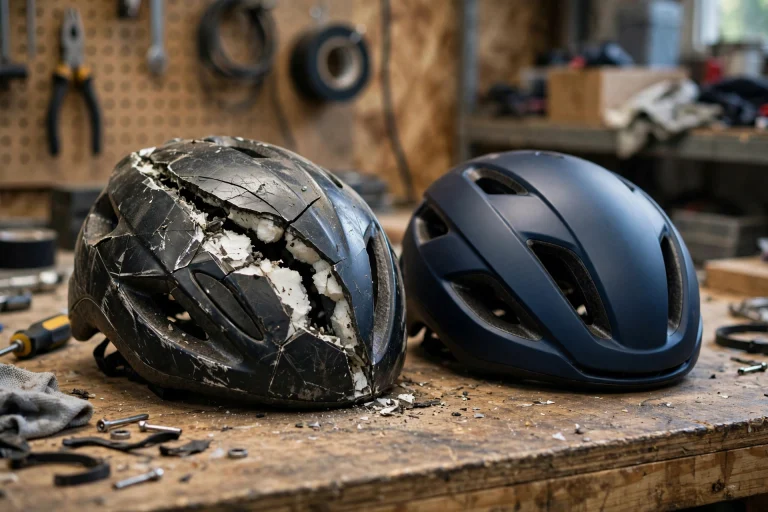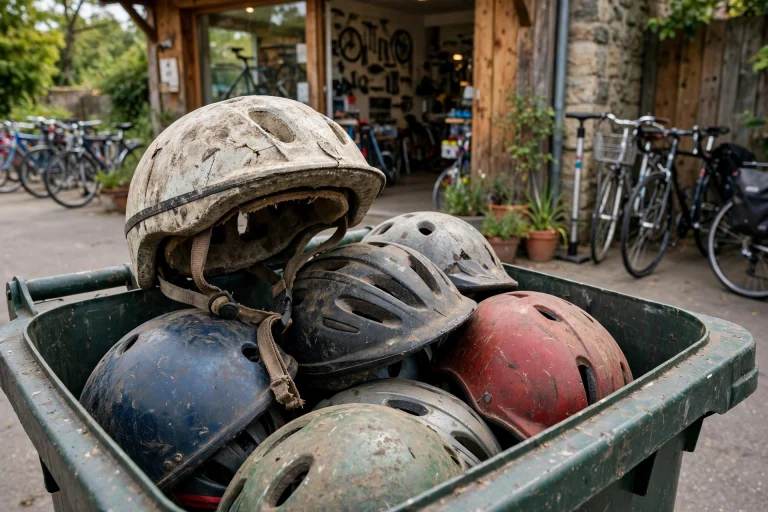
A helmet take-back scheme is a programme run by a helmet maker, a retailer, or a recycling organisation that collects old helmets and makes sure they are dismantled, recycled, or disposed of responsibly — instead of going to landfill. You hand in your old helmet, and the scheme takes care of the rest: sorting the materials, sending the foam and shell for recycling, and disposing of anything that cannot be reused. In general terms, it is the easiest way for a rider to do something useful with a helmet that has reached the end of its life.
Take-back schemes are still relatively new, and they work differently from place to place. This guide explains how they work, what happens to your helmet, and how to find one.
How Does a Helmet Take-Back Scheme Work?
Most schemes start with a drop-off point. That might be a bike shop, a ski shop, a maker’s own store, or a collection point at an event. You bring your old helmet — any brand, in most schemes — and leave it there. Some schemes accept helmets by post, with a freepost label or a returns bag, which suits riders who do not live near a drop-off point.
Once collected, the helmets are sorted. Usable parts, such as straps or buckles in good condition, may be kept as spares. The rest are dismantled: the shell is separated from the foam, the straps and pads are removed, and each material goes to its own recycling route. Anything that cannot be recycled is disposed of responsibly, rather than being sent to landfill with the rest.
Some schemes offer an incentive, such as a discount on a new helmet when you hand in an old one. That is not only a marketing tool — it is a practical way to make sure old helmets come back instead of sitting in a garage or going in the bin. A discount also gives the rider a reason to replace a helmet that is past its best, which is good for safety as well as for recycling.
Why Do Take-Back Schemes Exist?
They exist because a helmet is hard to recycle through normal routes. A helmet mixes several materials — foam, hard plastic, nylon webbing, metal buckles, fabric padding — and most household recycling programmes cannot handle that mix. Without a specialist scheme, an old helmet almost always ends up in general waste.
Makers also face pressure to take responsibility for their products. In some countries, regulations are moving towards extended producer responsibility, where the maker of a product is responsible for what happens to it at the end of its life. A take-back scheme is one way for a maker to meet that responsibility, and to show riders that it takes sustainability seriously.
There is a safety reason too. A take-back scheme gives riders a clear, easy way to get rid of an old helmet, which makes them more likely to replace it when it is damaged or out of date. A helmet sitting in a garage because its owner does not know what to do with it is a helmet that might be used again when it should not be.

What Happens to a Helmet After You Hand It In?
The helmet is first checked. If it is in good condition, some schemes pass it on for reuse — though that is rare, because a used helmet’s history is unknown, and a helmet that has been in a crash should not be reused. Most helmets go straight to dismantling, where the parts are separated by hand or by machine.
The foam is the largest part by volume. EPS foam can be compacted, melted, and made into new plastic products, though it is not usually made back into helmet foam. The hard shell is usually a single type of plastic, which makes it easier to recycle. The straps and buckles are harder to recycle, because the volumes are small and the materials are mixed, so they are often disposed of or used for energy recovery.
Some schemes publish what happens to the helmets they collect, including how much material is recycled and how much is disposed of. That transparency is worth looking for, because it shows whether the scheme is genuinely recycling or simply collecting. A scheme that reports its results is usually a scheme that takes the process seriously.
How Do You Find a Take-Back Scheme?
Start with the maker of your helmet. Check the maker’s website for a recycling or take-back page — larger makers are the most likely to run a scheme, and some accept helmets of any brand. If the maker has no scheme, check with a local bike shop, ski shop, or outdoor retailer, which may collect helmets on behalf of a maker or a recycling organisation.
Local recycling centres are the next place to check. Some accept EPS foam and hard plastics separately, which means you can dismantle the helmet yourself and take the parts to the right bins. Ask the centre what it accepts before you go, because the rules vary widely from place to place.
If there is no scheme near you, consider posting the helmet to a national scheme, if one exists in your country. The postage cost is a real barrier, which is why drop-off points at shops are the most common model — but a posted helmet is still better than a helmet in landfill. If you are comparing helmet features while choosing a replacement, reading about what MIPS is for helmets can help you understand one of the liner systems you may see listed.
What Should You Do Before Handing a Helmet In?
Check that the helmet is genuinely at the end of its life. A helmet that has been in a crash, is cracked or damaged, or is past the age its maker recommends should be replaced. A helmet in good condition that simply does not fit any more might be better passed to someone who needs it — though only if its history is known and it has never been crashed.
Clean the helmet before you hand it in. Remove any accessories, such as lights, mounts, or stickers that are not part of the helmet, and wipe off loose dirt. A clean helmet is easier and safer for the people who dismantle it, and some schemes will not accept a dirty one.
Keep a note of the scheme and the date, especially if the scheme offers a discount on a replacement. And remember that handing in a helmet is not a substitute for replacing it promptly — if your helmet is damaged or out of date, buy the replacement first, and hand in the old one when the new one arrives.
Frequently Asked Questions
Q: Do take-back schemes accept helmets of any brand?
A: Many do, especially schemes run by retailers or recycling organisations. Schemes run by a single maker sometimes accept only their own helmets, so check the scheme’s terms before you go.
Q: Will my old helmet be reused by someone else?
A: In general terms, no. Most schemes dismantle helmets for recycling rather than passing them on, because a used helmet’s history is unknown and a crashed helmet should not be reused.
Q: Is there a charge to use a take-back scheme?
A: Most drop-off schemes are free, and some offer a discount on a new helmet. Postal schemes may charge for postage, so check the cost before sending a helmet by post.

Olivia
Writer at Helmet Today, covering helmet reviews, fit and riding safety.