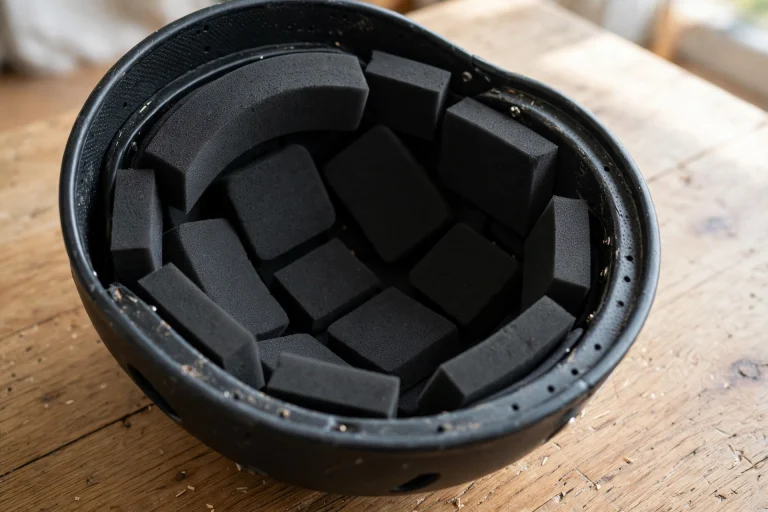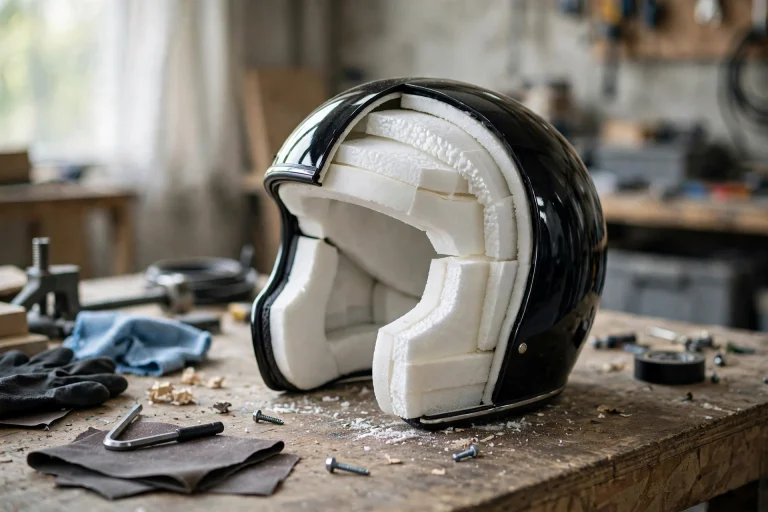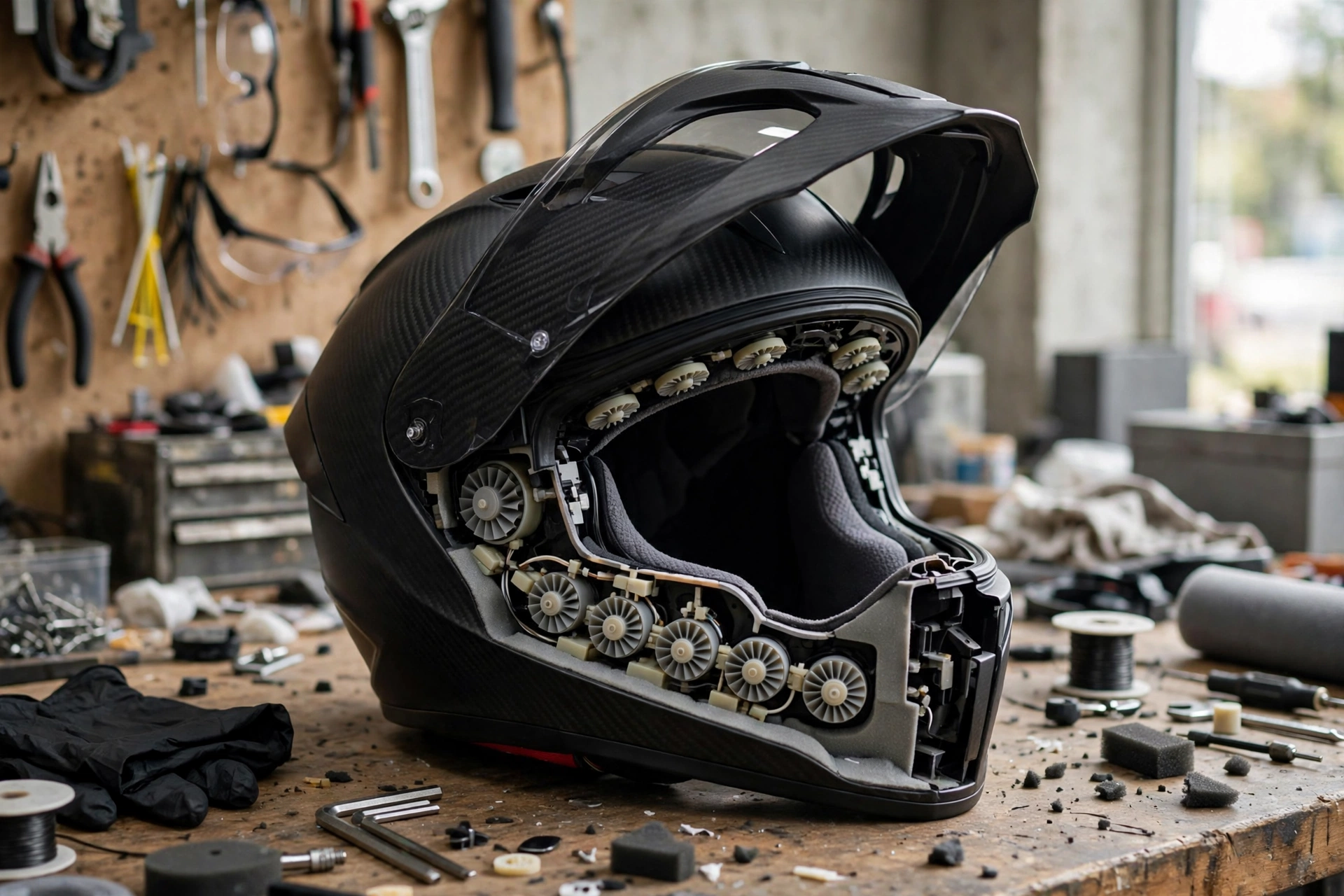
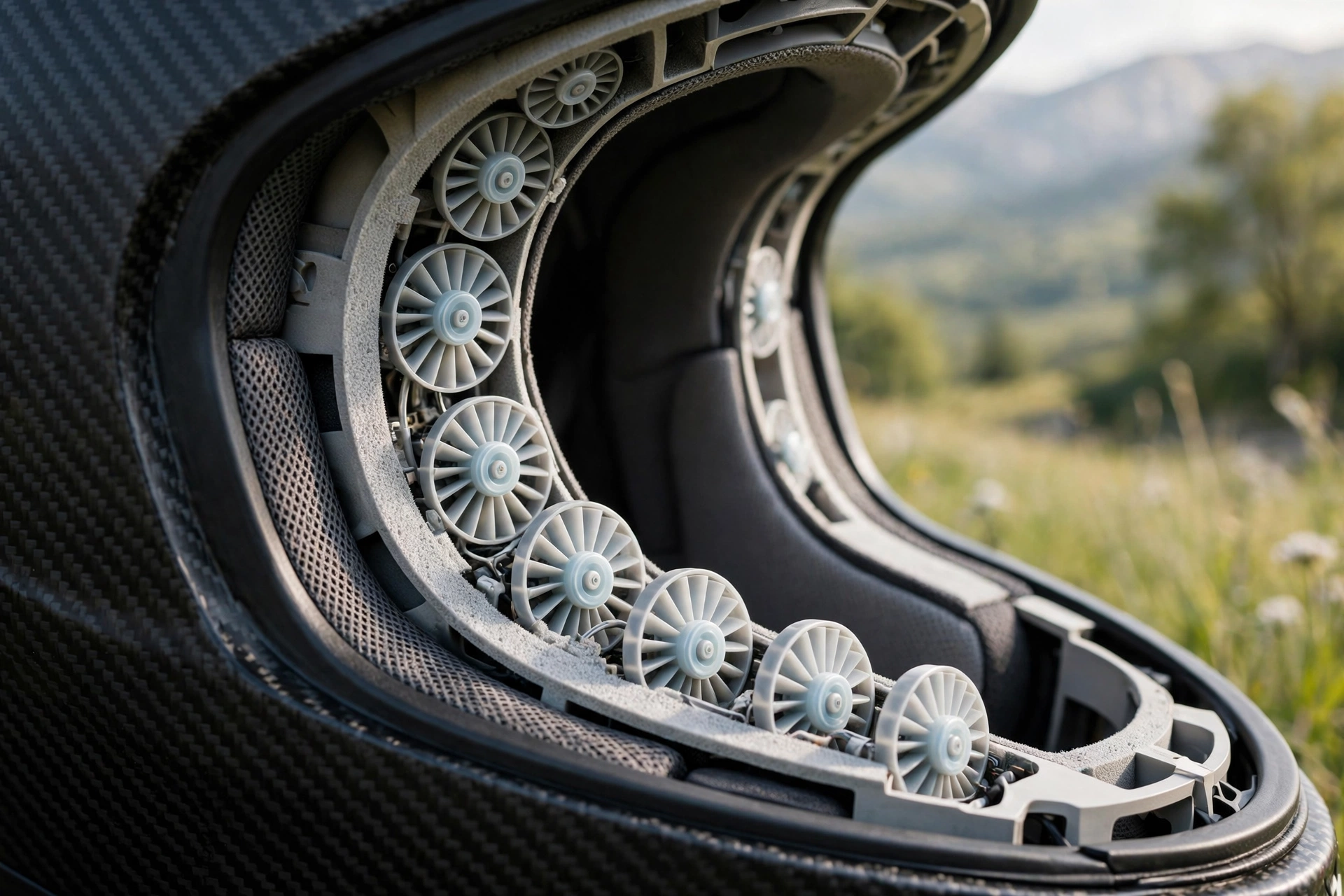
Turbine technology in a helmet is a rotational-impact system that uses small, soft, deformable discs — often called turbines — built into the helmet’s liner to absorb some of the twisting force that reaches the head in an angled crash. Rather than sitting as a single rigid layer, the turbines are designed to deform and shear slightly when the helmet is hit at an angle, so less of that rotational energy is passed on to the wearer. In general terms, the idea is to manage the kind of glancing impact that happens when a rider hits the ground at an angle, which is how many real crashes occur.
The technology is most closely associated with the South African helmet maker Leatt, which developed its Turbine 360 system for motorcycle, bicycle and downhill helmets. The name “turbine” comes from the shape of the small discs, which look a little like tiny turbine wheels. This guide explains what turbine technology is in general terms, how it works, how it compares with other rotational-impact systems, and what to look for if you are considering a helmet that uses it.
How Does Turbine Technology Work?
When a helmet strikes the ground, the impact is rarely a straight, head-on hit. In most falls, the head arrives at an angle, and that angled force creates a twisting or rotational movement. Rotational forces are a concern because the brain is sensitive to twisting motion inside the skull, and reducing that twist is one of the main aims of modern helmet design. Turbine technology tackles the problem by placing small, soft discs between the helmet’s outer shell and the inner liner, or within the liner itself.
Each turbine is a small disc made from a soft, energy-absorbing material, shaped with arms or vanes that can flex. When the helmet is hit at an angle, the turbines deform and move slightly, absorbing some of the impact energy before it reaches the head. The deformation is designed to happen in the first moments of the impact, when forces are at their highest. In general terms, the turbines act like a crumple zone in miniature, giving the impact somewhere to go instead of passing straight through to the wearer.
What Are the Turbines Made Of and Where Do They Sit?
The turbines are made from a soft, flexible material that is designed to deform under load and then return to its shape after a minor knock, although like any helmet component they are not intended to survive a serious crash undamaged. The discs are usually arranged in a ring or a pattern around the inside of the helmet, positioned where the liner meets the shell, so that they sit between the hard outer layer and the wearer’s head.
The number of turbines varies between helmet models, and they are typically placed in the areas most likely to take an impact, such as the sides and the back of the head. Because they are small and sit inside the helmet, they add very little weight and do not change the fit much. Riders usually cannot feel them when the helmet is on, and the comfort padding sits over them, so the inside of the helmet feels much like any other helmet.
How Is Turbine Technology Different from MIPS?
Turbine technology and MIPS are both designed to deal with rotational forces, but they work in different ways. MIPS, which stands for Multi-directional Impact Protection System, uses a thin, low-friction layer inside the helmet that allows the shell to slide a small distance relative to the head during an angled impact. The sliding movement absorbs some of the rotational energy. Turbine technology, by contrast, uses soft discs that deform and shear to absorb the same kind of energy.
The practical difference for a rider is small. Both systems aim at the same problem, and both are fitted inside helmets that also rely on a hard shell and a foam liner for direct impact protection. Neither system changes how the helmet fits or how it should be worn, and neither makes a helmet suitable for a crash it was not designed for. If you are learning about how helmets handle different kinds of impact, reading about what MIPS is for helmets can help you compare the two approaches and understand which one a given helmet uses.
What Kind of Riding Benefits Most from Turbine Technology?
Turbine technology was first developed with off-road and downhill riding in mind, where falls are common and impacts often happen at an angle on uneven ground. A mountain biker coming off on a rocky trail, or a motocross rider sliding out on a berm, is very likely to hit the ground at an angle rather than straight on. That is exactly the kind of impact the turbines are designed to help with.
The technology has since spread to road cycling and motorcycle helmets as well, because angled impacts happen on the road too. A rider who falls from a motorcycle at speed, or a road cyclist who is knocked sideways, will often strike the ground at an angle. In general terms, any rider who faces a realistic chance of an angled impact can benefit from a helmet that manages rotational forces, whatever the discipline.
What Should You Look for When Buying a Helmet with Turbine Technology?
The first thing to check is the fit. Try the helmet on, fasten the strap, and move your head from side to side. The helmet should sit level, feel snug without pressing painfully anywhere, and should not rock or slide around. A helmet with turbine technology fits in the same way as any other helmet, and the usual fitting checks still apply. If it does not fit, the turbines will not make up for it.
Next, check which safety standard the helmet meets. Turbine technology is an additional feature, not a standard in itself, so the helmet should still carry a recognised certification for the type of riding you do. Look at the label inside the helmet or the product description, and make sure the standard matches your needs, whether that is road cycling, mountain biking or motorcycling.
It is also worth checking how the helmet is described by the maker. Some models use the full Turbine 360 system, while others use fewer turbines or a related design. Be wary of vague claims about rotational protection that do not name the system or explain how it works. In general terms, a clear description from a reputable maker is a good sign.
Frequently Asked Questions
Q: What is turbine technology in a helmet?
A: In general terms, it is a rotational-impact system that uses small, soft, deformable discs fitted into the helmet’s liner. The discs deform during an angled impact to absorb some of the twisting force before it reaches the head.
Q: Is turbine technology the same as MIPS?
A: No. Both systems aim to reduce rotational forces, but MIPS uses a low-friction layer that lets the shell slide slightly, while turbine technology uses soft discs that deform and shear. They are different approaches to the same problem.
Q: Do I need a helmet with turbine technology?
A: Not necessarily. It is a useful extra feature, especially for off-road and downhill riding where angled impacts are common, but fit, comfort and a recognised safety standard matter more. Choose a helmet that fits well first, and treat the turbine system as a bonus.

Olivia
Writer at Helmet Today, covering helmet reviews, fit and riding safety.