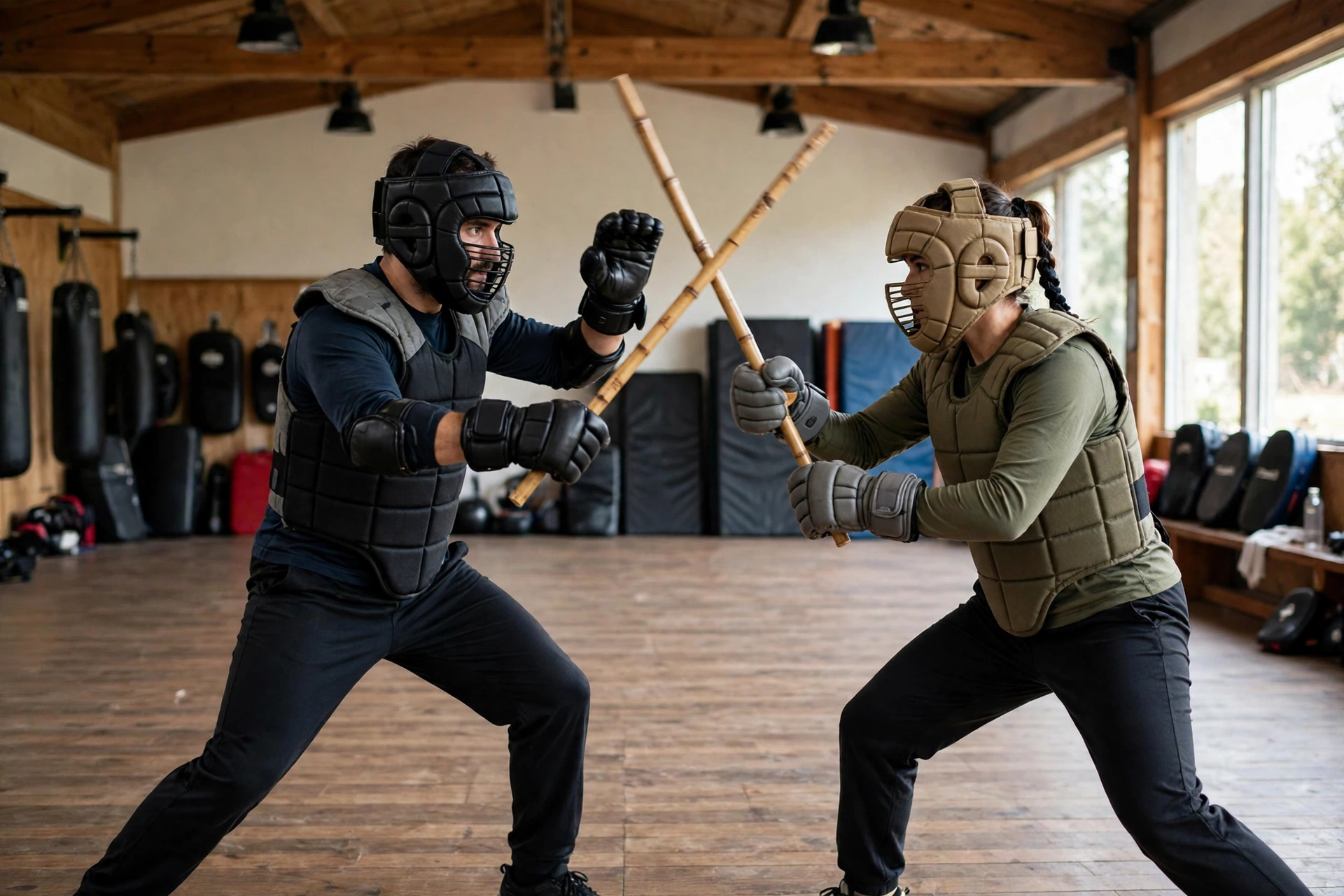
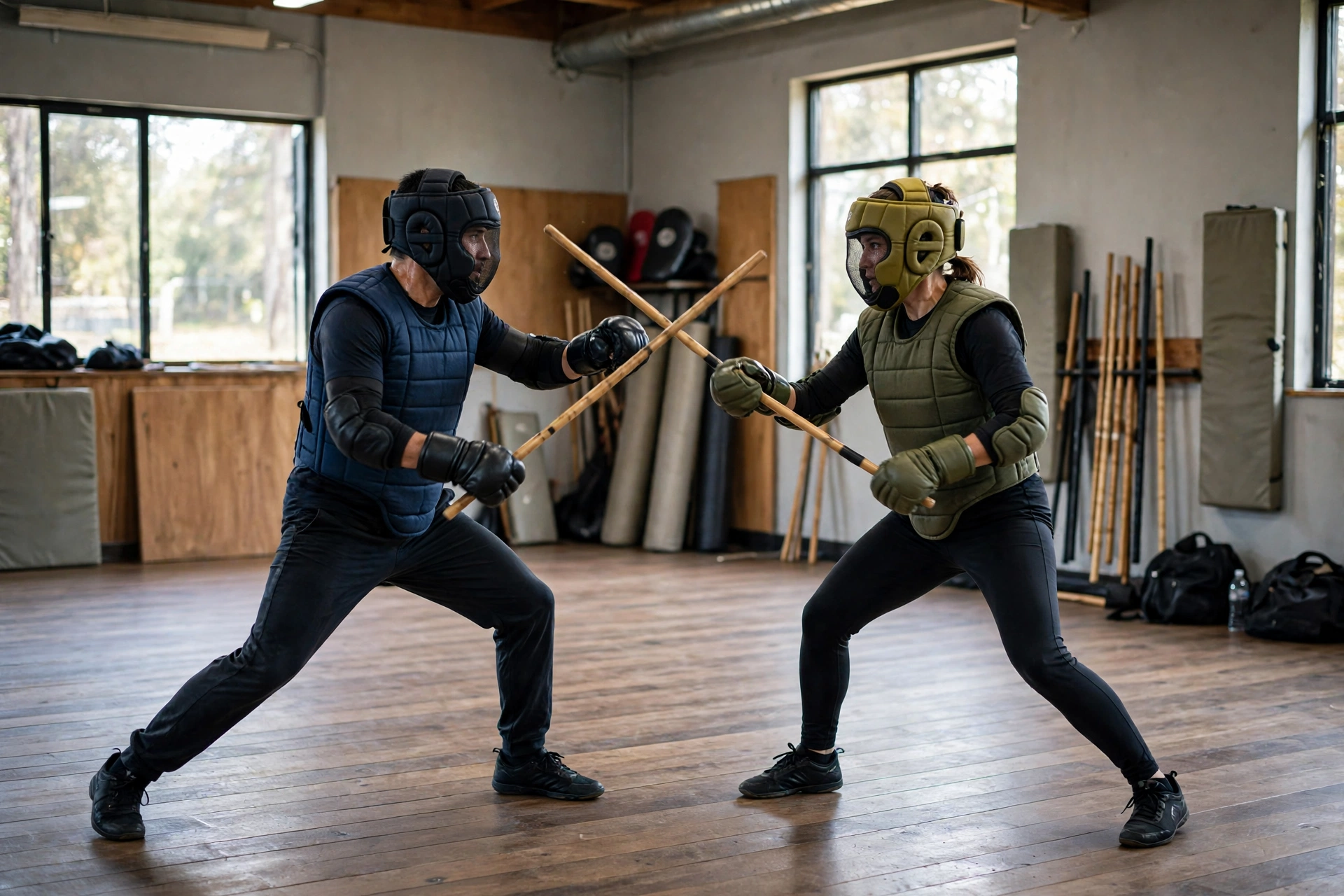
Escrima headgear is padded protective headgear worn during sparring in escrima, the Filipino martial art also known as arnis or kali, and in general terms it is designed to protect the head from stick strikes, which can cause cuts and bruising even at controlled speed. Escrima is practised with rattan sticks, and while many drills are done slowly and without contact, sparring brings the sticks into play at speed. Headgear, along with hand protection, a body protector and sometimes a fencing-style mask, is what lets practitioners spar with sticks in a way that is challenging but still repeatable.
What Is Escrima?
Escrima is a Filipino martial art built around weapons, especially the single stick and the double stick, although it also includes empty-hand techniques, joint locks and disarms. Practitioners learn angles of attack, footwork, blocks and counters, and they practise with a partner so they can feel timing and distance in a realistic way. The art is known for its flowing, fast exchanges, where one stick attack follows another and the defender has to respond in fractions of a second.
Training usually starts with slow, cooperative drills, where partners take turns attacking and defending, and it builds up to faster drills and then to sparring. Because the weapon is a hard stick, even a light touch can sting, and a mistimed block can let a strike through to the head or the hands. That is why protective gear is introduced as soon as contact speeds rise, and why headgear is one of the first items a sparring student is asked to buy. The art also has sporting forms, where rules in general terms require protective equipment, although the exact requirements vary between organisations.
Why Is Headgear Important for Stick Sparring?
Headgear is important for stick sparring because a stick strike to the head is very different from a punch. A rattan stick is hard and narrow, so its force is concentrated on a small area, and even a controlled strike can cut skin or raise a painful bruise. Without headgear, sparring would have to be done so slowly and so lightly that it would lose much of its value, and fighters would still risk a serious injury from a single mistake. Headgear spreads the force of a strike, protects the skin and lets partners spar at a useful pace.
It also protects the ears, temples and the back of the head, which are all vulnerable during fast stick exchanges. A strike that is blocked high can glance off and land on the side of the head, and a strike aimed at the body can rise if the defender moves. Headgear gives a margin of safety for those moments, and it gives beginners the confidence to commit to their techniques rather than flinching away from every attack. That confidence matters, because escrima is learned by doing, and a student who is afraid of being hit will not move freely enough to learn.
What Kind of Headgear Is Used in Escrima?
Escrima headgear comes in a few different styles, and the choice depends on the kind of sparring a school does. Padded headgear, similar to boxing headgear, is common for lighter sparring, where sticks are used at controlled speed and the focus is on technique and timing. It covers the forehead, temples, cheeks and back of the head, and it leaves the face open so the wearer can see and breathe clearly. That style works well for many club sessions, especially for beginners.
For heavier sparring, some schools use a fencing-style mask, or a padded headgear with a face guard, because the face is more exposed to a stick strike than it is to a punch. A mask with a mesh front protects the eyes and the face while still allowing vision, although it can feel hot and can limit hearing. In general terms, the heavier the contact, the more protection is needed, and the instructor should say which style is required for each session. A student should never spar with sticks at speed in headgear that was designed only for light contact.
How Should Escrima Headgear Fit?
Escrima headgear should fit snugly and stay in place during fast head movement, because stick sparring involves a lot of ducking, weaving and turning. The chin strap should be fastened firmly, and the headgear should not slide forward over the eyes or twist to one side when the wearer moves sharply. A good test is to shake the head gently, turn quickly in both directions and open the mouth wide: if the headgear stays put, the fit is probably right. For background on how helmet technology manages impact forces, see what MIPS is for helmets.
Vision is especially important in escrima, because a stick can arrive from many angles and the defender needs to see it early. Headgear that narrows the field of view, or that sits too low on the forehead, makes defence harder and can actually increase risk. The wearer should be able to see clearly to the sides and upwards, and should be able to breathe freely through a mouthguard. Trying headgear on and moving in it, rather than just standing still in front of a mirror, is the best way to judge whether it will work in a real exchange.
How Do You Care for Escrima Headgear?
Stick sparring is sweaty work, and headgear picks up that sweat every session, so regular cleaning matters. After training, wipe the inside and outside with a clean damp cloth and leave the headgear in a place with good airflow until it is fully dry. Do not pack it away damp in a kit bag, because that encourages odour and can weaken the materials. In general terms, mild soap and water are enough, and harsh chemicals should be avoided because they can damage the foam and the outer cover.
Is Headgear Enough for Safe Escrima Sparring?
Headgear helps a great deal, but it is not enough on its own, and it should never be treated as a guarantee of safety. It can soften stick strikes and reduce cuts and bruising, but it cannot stop the brain from moving inside the skull when the head is struck, so it cannot remove the risk of concussion entirely. That is true of all padded headgear, and it is especially worth remembering in a weapon art, where the force of a strike is concentrated on a small area.
Safe escrima sparring depends on control, supervision and good habits as much as on equipment. Partners should agree on the speed and the level of contact before a round, and they should stop if a strike lands harder than intended. A coach should watch the pace and step in when it rises too high, and beginners should start with light, technical sparring and build up gradually. Hand protection, a body protector and a mouthguard all play their part too, and together with headgear and sensible control they make stick sparring a practical way to learn a demanding art.
Do you need headgear for escrima drills?
Not always. Slow, cooperative drills can be done without headgear, but headgear is normally required as soon as sparring or faster contact drills begin, because a stick strike can cut or bruise even at moderate speed.
Is a fencing mask better than padded headgear for escrima?
It depends on the level of contact. A fencing-style mask protects the face and eyes more, which suits heavier sparring, while padded headgear is lighter and gives clearer vision for lighter, technical sparring.
Can beginners spar with sticks without headgear?
No, not in general terms. Beginners are more likely to mistime a block, so headgear is important for them. Most schools require it for any stick sparring, whatever the student’s level.

Olivia
Writer at Helmet Today, covering helmet reviews, fit and riding safety.