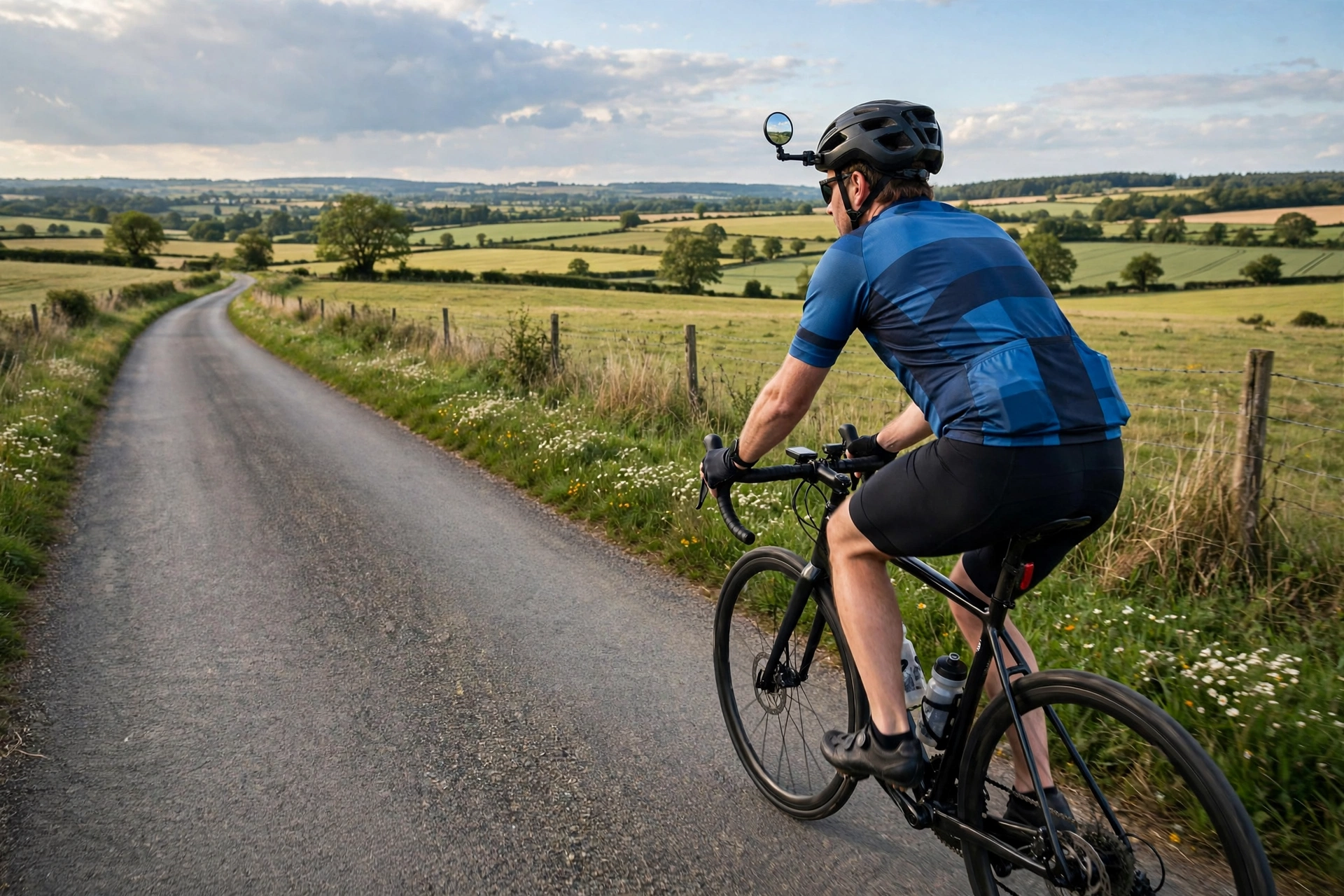
A helmet mirror for cyclists is a small rear-view mirror that attaches to a cycling helmet and lets the rider see traffic behind them without turning their head, and in general terms it is a simple safety accessory that helps a cyclist check what is coming up from behind. It is a small, light mirror on a short arm or stalk, fixed to the side or front of the helmet, and angled so that a quick glance shows the road behind. It does not replace looking over your shoulder, but it gives a rider a fast way to keep track of cars, other cyclists, and anything else approaching from the rear.
Cyclists ride in traffic with vehicles passing close by, and knowing what is behind you matters before you move out, turn, or change lane. Turning your head to look back can make the bike wobble, especially at speed or on a busy road, and it takes your eyes off the road ahead for a moment. A helmet mirror lets you check behind with a small movement of the eyes, so you can keep your hands steady on the bars and your attention mostly forward. In general terms, that is the main reason cyclists use one, whether they are commuting, touring, or riding for leisure on country roads.
What is a helmet mirror for cyclists?
A helmet mirror is a small mirror, usually round or oval and about the size of a coin or a little larger, mounted on a thin arm that clips, sticks, or screws onto a cycling helmet. The arm holds the mirror out to the side of the rider’s face, roughly at eye level, where it can be seen with a glance to the left or right. Some mirrors mount on the left side of the helmet, some on the right, and some can be fitted on either side depending on which side traffic passes on and which eye the rider prefers to use.
Most helmet mirrors are made from light plastic with a reflective surface, so they add very little weight to the helmet. The arm is often bendable or jointed, which lets the rider adjust the angle until the mirror shows the road behind clearly. Some models are designed to clip into a helmet vent, while others use a small adhesive pad or a bracket that screws into a fitting on the helmet. In general terms, the best choice is one that fits your helmet securely and stays put when you ride over bumps.
How does a helmet mirror work?
A helmet mirror works in the same way as the rear-view mirror in a car: it reflects the scene behind you into your eye. The rider glances at the mirror, which is angled backwards, and sees the road behind in miniature. Because the mirror is small, the image is small too, and it takes a little practice to read it quickly. Most riders find that after a few rides they can tell at a glance whether a vehicle is behind them, how far back it is, and whether it is moving up to overtake.
The mirror only shows a narrow slice of the road, so it is best used as an early warning rather than a complete picture. A car in the next lane, a cyclist close behind your shoulder, or a vehicle in your blind spot may not appear in the mirror at all. That is why experienced riders still turn their head to check before making a move. In general terms, the mirror tells you that something is there and roughly where it is, and the shoulder check confirms the detail before you change position on the road.
What types of helmet mirrors are there?
There are a few common types of helmet mirror, and the main differences are in how they mount and how they adjust. Clip-on mirrors fix into a helmet vent or onto the edge of the shell with a small clip, which makes them easy to fit and remove without tools. Adhesive mirrors use a sticky pad to hold a small base on the helmet, with the mirror arm plugged into the base, and these suit helmets with a smooth shell where a clip will not grip well.
How do you fit and adjust a helmet mirror?
Next, angle the mirror until it shows the road behind you. A good starting point is to aim it so you can see the centre of the lane behind you, then ride a short distance and fine-tune it. It helps to have someone stand behind you while you adjust it, or to practise on a quiet road where you can stop safely and tweak the angle. The mirror should show traffic behind you, not the sky, your shoulder, or the side of your own helmet, so take your time getting the angle right.
Are helmet mirrors useful for road cycling?
In general terms, helmet mirrors are most useful for commuting, touring, and leisure riding on roads with traffic, where knowing what is behind you helps you ride with confidence. A commuter who needs to move out around a parked car, or a tourer riding on a busy main road, can use the mirror to check for a gap before moving. A rider on a quiet country lane may use it less often, but it is still handy for spotting a car approaching from behind on a narrow road.
It is worth remembering that a mirror does not make you visible to drivers, and it does not take the place of a proper shoulder check. It is one tool among others, along with a good road position, clear hand signals, and lights and bright clothing in poor light. Used in that way, as part of a careful approach to riding in traffic, a helmet mirror can be a genuinely useful addition to a cyclist’s kit. Some helmets also include a system designed to reduce rotational forces in a fall, such as MIPS, and it is worth asking about that separately when you choose a helmet, as it is a feature of the helmet itself rather than of the mirror.
How do you look after a helmet mirror?
Looking after a helmet mirror is mostly a matter of keeping it clean and checking the fitting. Wipe the mirror surface with a soft cloth and a little clean water, and avoid harsh cleaners that could scratch the reflective coating. A scratched or cloudy mirror is hard to read, so replace the mirror if the surface becomes damaged or the image turns dull.
Do helmet mirrors work well for cyclists?
Yes, in general terms a helmet mirror works well as a quick check of traffic behind you, once you have practised reading the small image. It is best used alongside a shoulder check before you move out or turn, rather than as a replacement for one.
Which side should a helmet mirror go on?
Fit it on the side where traffic usually passes you, so the mirror looks toward overtaking vehicles. Many riders fit it on the left in countries where traffic drives on the left, and on the right where traffic drives on the right.
Can you fit a helmet mirror to any cycling helmet?
Most helmets can take a clip-on or adhesive mirror, but it depends on the shape of the shell and the vents. Check that the fitting suits your helmet before you buy, and make sure the mirror stays secure and does not block your view.

Olivia
Writer at Helmet Today, covering helmet reviews, fit and riding safety.