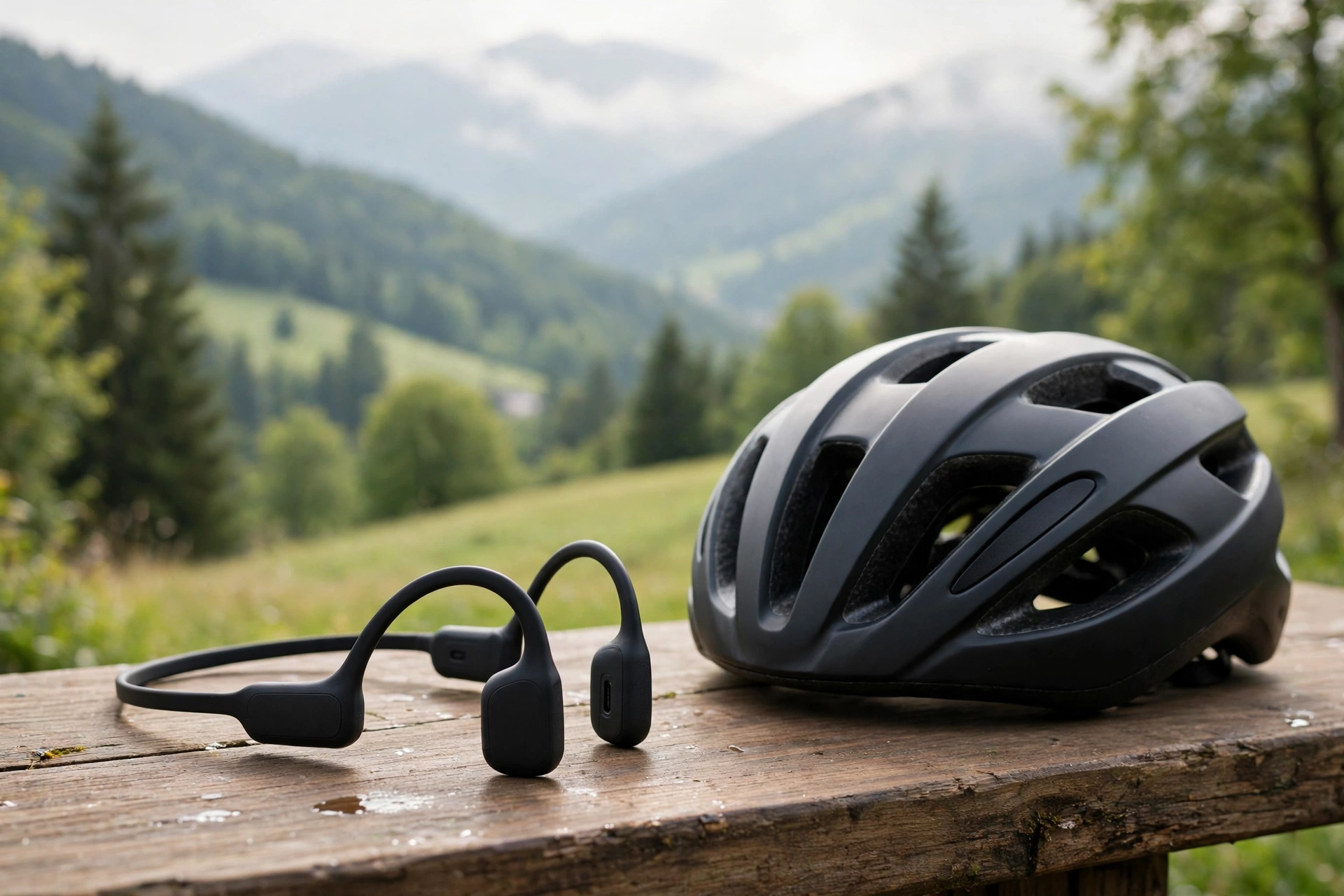
Bone conduction headphones for helmets work by sending sound through the bones of the skull instead of through the ear canal, so the ears stay open to traffic and other sounds around you. Small pads sit against the cheekbones or the temples and vibrate gently, turning those vibrations into sound that the inner ear can hear. For helmet wearers, this means music, calls, and navigation prompts without blocking the ears.
Traditional earbuds sit inside the ear and block out the world, which can be a problem on a bike or a motorcycle, where hearing traffic matters. Bone conduction offers a different approach: the sound reaches you through the bone, while your ears stay free. This guide explains how bone conduction headphones work with helmets in general terms, what they are good at, and what to watch out for.
How Does Bone Conduction Work?
Bone conduction relies on a simple fact: sound can travel through bone as well as through air. When a small transducer presses against the cheekbone, it vibrates, and those vibrations travel through the skull to the inner ear. The inner ear picks them up in much the same way as it picks up sound that arrives through the eardrum, so the listener hears music or speech clearly.
The effect is not new. Bone conduction has been used in hearing aids for many years, and it is also used in some military and professional headsets. What has changed is that the technology has become smaller, lighter, and cheaper, so it now fits into a slim headband or a pair of glasses-style arms that can sit under or alongside a helmet.
In general terms, the sound quality is different from ordinary headphones. Bass is usually lighter, and the sound can feel thinner, because the vibrations are travelling through bone rather than directly into the ear. Most users find the sound perfectly clear for speech, podcasts, and navigation, though music lovers may notice that it does not sound as rich as a good pair of earbuds.
How Do Bone Conduction Headphones Fit with a Helmet?
Most bone conduction headphones are worn as a band that sits around the back of the head, with the transducers resting on the cheekbones just in front of the ears. This design works well with many helmets, because the band sits low and the pads are slim enough to fit under the helmet’s edge. Some models are made to clip onto the helmet itself or to sit inside the liner.
Fit is the key issue. The transducers need to press firmly against the bone to work well, but the helmet must still fit correctly over them. If the helmet presses the pads too hard, they can become uncomfortable; if the helmet pushes them away from the bone, the sound fades. It is worth trying the combination on before you buy, or choosing a model with a return policy so you can test it with your own helmet.
Some helmet makers now offer bone conduction units designed for their own helmets, with mounting points built into the shell or the liner. These tend to fit more neatly than a universal band, and they are less likely to shift around while you ride. If your helmet has this option, it is usually the tidiest solution, though it may cost more than a universal set.

What Are the Advantages for Riders?
The biggest advantage is awareness. Because the ears are not blocked, the rider can still hear traffic, a car horn, or someone calling out, while also hearing music or directions. This matters most on the road, where hearing is part of staying safe, but it is also useful on a trail, where hearing another rider or a walker can prevent a collision.
Comfort is another benefit. Bone conduction headphones do not sit inside the ear canal, so they do not cause the pressure or irritation that some earbuds do on a long ride. They also work well with a helmet, since there is no earbud to be pushed deeper into the ear when the helmet is put on. If you want to learn more about the safety technology inside modern helmets, reading about what MIPS is for helmets is a useful background read.
What Are the Limitations?
The main limitation is sound quality. Bone conduction is clear for speech, but it does not deliver the deep bass or the full detail of a good pair of earbuds. In a noisy environment, such as a busy road or a fast motorcycle ride, wind noise can also make the sound harder to hear, since the ears are open to everything around you. Some models offer earplugs that can be worn with the headphones to cut wind noise, which can help.
Volume is another consideration. At high volume, the vibrations can cause a slight tingling feeling on the skin, which some people find distracting. Keeping the volume at a moderate level usually avoids this, and it is also better for your hearing in the long run. In general terms, bone conduction headphones are best used at a comfortable volume rather than turned up to maximum.
Battery life and fit can also be issues. Most models offer several hours of use on a charge, which is enough for most rides, but a very long ride may need a recharge or a spare set. Fit varies from person to person, since the shape of the head and the position of the cheekbones differ, so a model that works well for one rider may not suit another. Trying before you buy is the best way to avoid disappointment.
Are Bone Conduction Headphones Safe to Use While Riding?
In general terms, bone conduction headphones are safer than earbuds for riding, because they leave the ears open. That said, they still divide the rider’s attention, and listening to music or taking a call while riding can distract from the road. It is sensible to keep the volume low enough that traffic sounds are still clear, and to avoid long or complex calls while riding.
Some places have rules about wearing headphones while riding or driving, and these rules can differ by location and by the type of vehicle. Before using any headphones on the road, it is worth checking the rules where you ride, since a set that is fine in one place may not be allowed in another. When in doubt, the safest choice is to use the headphones for navigation prompts only, or to leave them off in busy traffic.
Finally, remember that the headphones are an accessory, not a part of the helmet’s safety system. They should never change how the helmet fits or sits on your head. If the headphones push the helmet up, make it unstable, or stop the straps from sitting correctly, they should not be used with that helmet. A helmet that fits properly comes first, every time.
Frequently Asked Questions
Q: Can you hear traffic with bone conduction headphones?
A: Yes. Because the sound travels through the cheekbones and the ears stay open, you can still hear traffic, horns, and other sounds around you. Keeping the volume moderate makes this even clearer.
Q: Do bone conduction headphones work with a full-face helmet?
A: In general terms, they can, but fit depends on the helmet. The pads need to sit against the cheekbones, and the band needs to fit under the helmet without pushing it out of place. Trying the combination before you buy is the best approach.
Q: Is the sound quality as good as earbuds?
A: Not quite. Bone conduction is clear for speech and podcasts, but it usually has less bass and less detail than earbuds. Many riders accept that trade-off for the benefit of keeping their ears open to the road.

Olivia
Writer at Helmet Today, covering helmet reviews, fit and riding safety.