

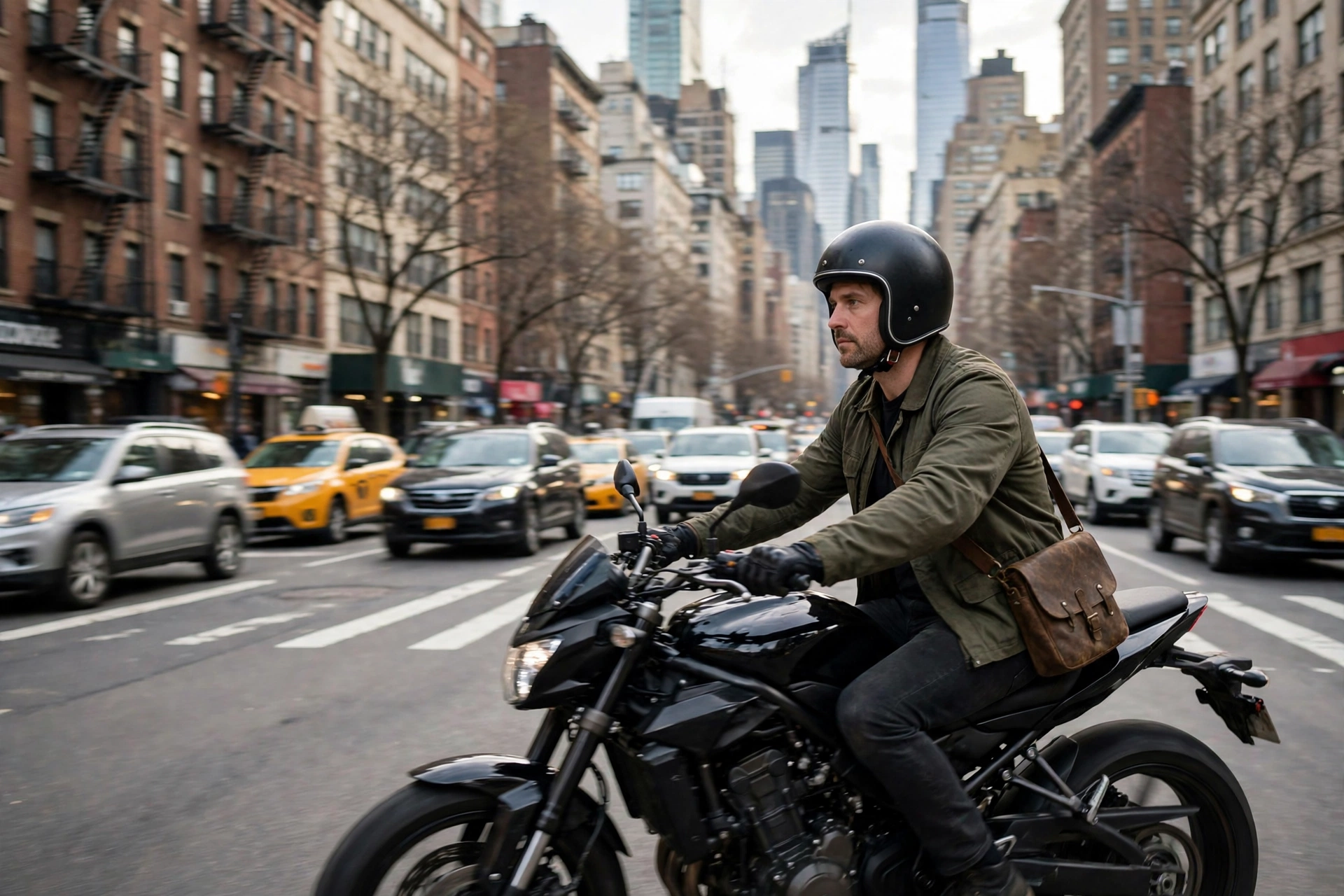
Yes — you can legally wear a half helmet in New York, as long as it is a certified helmet that meets the federal safety standard (FMVSS 218, the standard behind the DOT label). New York requires every motorcycle rider and passenger to wear an approved helmet, and the requirement is about certification, not coverage style. A genuine DOT-certified half helmet qualifies.
What does not qualify is the novelty “beanie” — the ultra-thin shell sold for looks, without real certification. New York riders get ticketed for those, and they offer almost no protection. Add in New York’s separate eye protection rule, and there are a few details every half-helmet rider in the state should know. Here they are.
What Does New York Law Require for Motorcycle Helmets?
New York was the first state in the nation to enact a universal motorcycle helmet law, and it still has one today: every operator and every passenger must wear a helmet that meets the federal standard, FMVSS 218. There are no age exceptions, no experience exemptions, and no short-trip carve-outs. If the motorcycle is moving on a public road in New York, everyone on it wears an approved helmet.
The standard itself tests impact absorption, penetration resistance, and how well the retention system keeps the helmet on the head. A half helmet that was genuinely certified to that standard is an approved helmet under New York law, full stop. The law cares about the labels and the engineering, not whether the helmet has a chin bar.
New York is one of the states where helmet rules are the same in every county and city — there is no patchwork of local exemptions to memorize. Riders touring beyond the state will find different rules, though, and our rundown of helmet laws by state is the quick way to check a route before you cross a border.
Why Do Novelty Beanie Helmets Get Riders Ticketed in New York?
Because they are not helmets in the eyes of the law — they are costume pieces. A novelty beanie typically has a thin plastic or fiberglass shell, minimal comfort padding instead of an energy-absorbing foam liner, and a strap that would not survive a serious pull test. It cannot pass FMVSS 218, so it is almost never genuinely certified, whatever sticker has been applied to it.
Troopers and officers are familiar with them, and an obviously uncertified beanie can be the reason for a stop or an added citation during one. “It has a DOT sticker” does not settle the question if the helmet itself is plainly not a certified model — stickers are sold separately and applied to novelty shells all the time, which officers and judges both know.
The tell-tale signs of a novelty helmet: it feels toy-light, the shell flexes easily, there is no thick firm foam liner inside, and the labels are missing, vague, or state the item is not intended for motorcycle use. If you bought it for a small sum from a novelty listing, assume it will not satisfy New York law — and understand that in a crash it will behave accordingly.

Does New York Require Eye Protection as Well?
Yes. New York requires motorcycle riders to wear eye protection — goggles or a face shield that meets state standards — in addition to the helmet. This matters especially for half-helmet riders, because a half helmet has no shield of its own: you will need proper goggles or approved protective glasses every time you ride, not just on long trips.
Ordinary sunglasses are a gray area and a poor practical choice in any case. Purpose-made riding eyewear uses impact-resistant lenses and stays in place at speed; wrap styles or goggles with a strap keep wind from streaming your eyes on the highway and keep road grit out on city streets. At night or in tunnels, swap to clear lenses so the eyewear does not become a visibility problem of its own.
Passengers are covered by the helmet requirement as well, and anyone you carry should have eye protection too. If you regularly ride two-up in New York, keeping a spare set of goggles with the bike is a small habit that prevents an avoidable citation and a miserable passenger.
How Should a Half Helmet Fit and Fasten in New York?
An approved helmet only counts when it is actually worn correctly — on the head, level, and securely fastened with the chin strap. A certified half helmet carried on your arm, resting unbuckled on top of your head, or dangled from the handlebars satisfies nothing, and riders do get cited for unfastened helmets.
The fit check is quick. The helmet should sit level, low enough to cover the top of the head properly, feel snug all around without painful pressure, and resist rolling forward or sideways when you shake and nod your head with the strap done up. The strap should be snug under the chin — roughly a finger or two of slack at most. Half helmets have less shell gripping the head than other styles, so fit discipline matters more, not less.
Replace any helmet after a crash, and be skeptical of secondhand helmets whose history you cannot verify. The foam liner that does the protective work can be damaged invisibly, and a used half helmet of unknown past is a gamble with the one piece of gear New York insists you wear.
Is a Half Helmet a Good Choice for New York Riding?
That depends on your priorities, and it deserves an honest framing. A certified half helmet is legal and provides real, tested protection for the top of the head. It is also the minimum coverage you can buy: the face, jaw, ears, and lower head are exposed, and those areas are involved in a large share of motorcycle crash injuries. Full-face helmets consistently offer the most complete protection, with three-quarter helmets in between.
New York riding has its own risk profile — dense urban traffic in the city, deer and gravel on rural routes upstate, and fast-changing weather around the lakes and mountains. Many riders who prefer the half helmet around town choose a fuller-coverage helmet for highway touring. Nothing in the law stops you from owning both, and choosing coverage to match the ride is a reasonable middle path.
What is not a middle path is the novelty beanie: all of the exposure of a half helmet, none of the certified protection, and a ticket risk on top. If the open style is what you want, buy the real certified version, fasten it, add goggles, and ride legal and protected in every county in the state.
Frequently Asked Questions
Are half helmets legal in New York?
Yes, if they are genuinely certified to the federal FMVSS 218 (DOT) standard. New York’s universal helmet law requires an approved helmet for all riders and passengers, and certification — not style — is what makes a helmet approved.
Can I get a ticket for wearing a novelty beanie helmet in New York?
Yes. A novelty beanie without real certification does not meet New York’s helmet requirement, sticker or not, so riding in one can draw the same citation as riding with no helmet.
Do I need goggles with a half helmet in New York?
Yes. New York requires eye protection — goggles or a face shield meeting state standards — in addition to a helmet. Since a half helmet has no shield, compliant goggles or protective glasses are a must.

Olivia
Writer at Helmet Today, covering helmet reviews, fit and riding safety.


