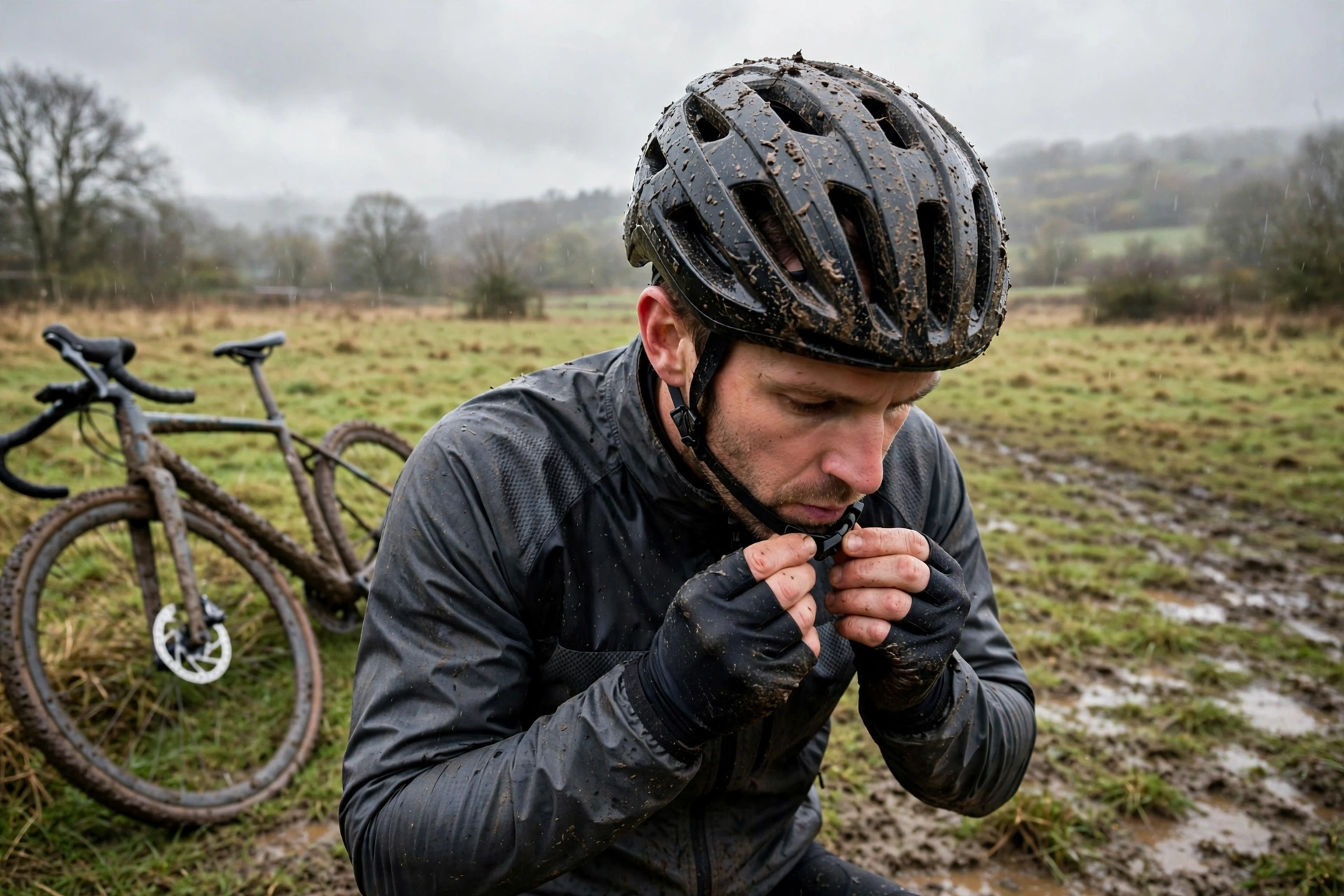
To fit a cyclocross helmet for muddy races, start with the right size, sit the helmet level and low on your forehead, tighten the rear retention dial until it is snug, and adjust the straps so they form a neat V below your ears with the chin strap snug — then test the fit by running, bending, and shaking your head, since a helmet that moves on the run will move in the race. Muddy cyclocross is the hardest test of helmet fit: wet straps slip, mud adds weight, and running sections shake everything loose.
A good fit is not just about comfort. In a muddy race you will dismount, run over barriers, shoulder the bike, remount, and sprint — sometimes several times per lap. A helmet that shifts forward over your eyes or slides back off your forehead at the wrong moment is a distraction at best and a safety problem at worst. This guide covers the fit step by step, with the muddy-race details that make the difference.
How Do You Measure for a Cyclocross Helmet?
Start by measuring around your head with a soft tape, just above your eyebrows and ears, at the widest point. Compare the measurement with the maker’s size chart, but treat the chart as a starting point rather than a promise — sizing varies between makers, and head shapes differ too. Some helmets suit rounder heads, others suit longer, narrower heads, and the only way to know is to try them on.
When you try a helmet on, it should feel snug all around without any single pressure point. Press gently on the front, back, and sides: the skin on your forehead should move with the helmet, which shows it is gripping your head rather than sitting loosely on top. If the helmet rocks side to side or slides forward when you shake your head, it is too big or the wrong shape, whatever the size label says.
Try the helmet with anything you will wear in a muddy race. That includes a thin cycling cap or skull cap if you wear one in cold, wet weather, and the glasses you race in. A cap changes the fit slightly, so if you plan to wear one, fit the helmet with it on — a helmet that fits perfectly bare-headed can feel tight or sit too high once a cap is underneath.
How Should the Helmet Sit on Your Head?
The helmet should sit level on your head, low enough to cover your forehead down to just above your eyebrows. Look in a mirror: the front edge should be roughly two fingers’ width above your eyebrows, and the helmet should not tilt back like a cap or forward over your eyes. A helmet tilted back leaves your forehead exposed, and one tilted forward blocks your vision when you are looking up the course.
The back of the helmet should sit low enough to cover the base of your skull without pressing into your neck when you bend forward to shoulder the bike or look up a steep bank. If the rear presses your neck when you tilt your head back, the helmet may be sitting too low at the back or the shape may not suit you.
Check the fit with your race posture in mind. Lean forward as if you are on the bike, then stand upright and bend as if picking the bike up. The helmet should stay in the same place through all of it.
How Do You Adjust the Straps for Muddy Conditions?
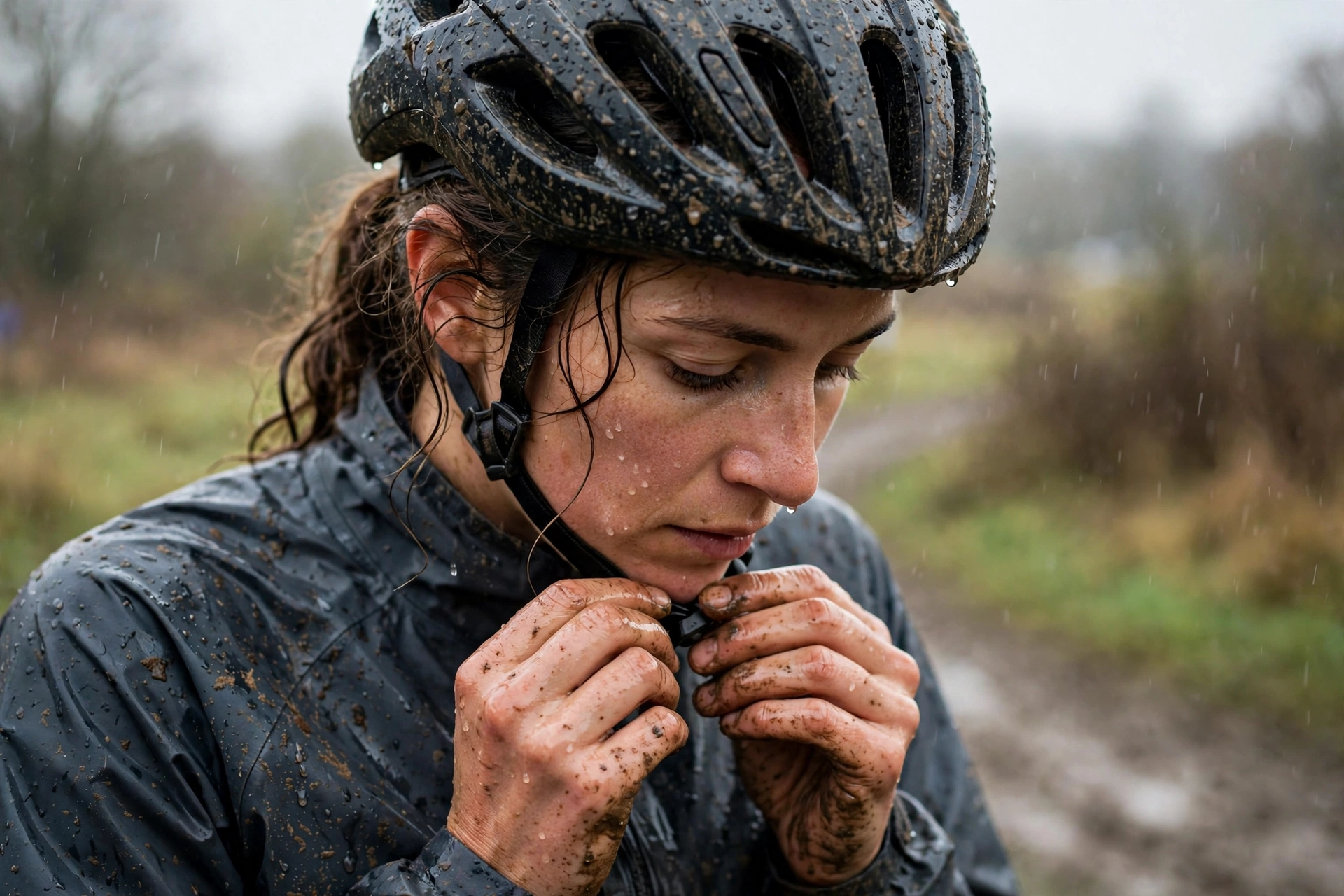
Strap adjustment matters more in mud than on the road, because wet straps stretch slightly and mud makes them slippery. Start with the side straps: adjust them so they meet in a neat V shape just below each ear, with the straps lying flat against your head rather than twisted. Twisted straps are uncomfortable and can slip, so flatten them before you tighten anything.
Next, do the chin strap up snugly. You should be able to fit about two fingers between the strap and your chin, but no more. Open your mouth wide: the helmet should pull down slightly, which shows the strap is holding it in place.
Use the rear retention dial last, after the straps are set. Tighten it until the helmet feels secure without pressing hard on the back of your head. The dial should be easy to reach and turn with cold, muddy gloves on.
What Mud-Specific Fit Problems Should You Watch For?
Mud adds weight to a helmet, and that weight pulls it forward and down, especially on running sections. A helmet that fits well when clean can feel loose once it is caked in mud, so fit it snugly rather than loosely.
Mud in the vents and padding also changes how the helmet feels. Heavy mud on the shell can make the helmet feel top-heavy, and mud-soaked pads can compress and lose their grip. After each race, remove the pads, wash them, and let them dry fully before the next race. Pads that stay damp and compressed will not hold the helmet as securely as clean, dry ones.
Vision is the other mud problem. Mud splashed onto glasses or into your eyes can make you tilt your head or push the helmet back to see, which ruins the fit. A small peak helps keep some mud off your glasses.
How Do You Test the Fit Before Race Day?
Do a full dress rehearsal before race day. Put the helmet on with your cap, glasses, and race kit, then run a short distance, jump over a low obstacle, shoulder the bike, and remount. The helmet should stay put through all of it.
Also test the fit when you are wet. A helmet that fits perfectly when dry can feel different once sweat and rain have soaked the straps and pads, so try a short ride in the rain or after a hard training session.
Finally, inspect the helmet after every muddy race. Mud can hide cracks in the shell, so clean the helmet and check it carefully in good light before the next event. In general terms, a helmet that has taken a hard knock should be replaced, even if the damage is not obvious. If you are comparing helmets, reading about what MIPS is for helmets can help you understand one of the features you may see listed on the box.
Frequently Asked Questions
Q: Should a cyclocross helmet fit tighter than a road helmet?
A: It should fit snugly and securely, with no movement when you shake your head or run, but not so tight that it causes pressure points. Mud and running sections make a loose fit more of a problem in cyclocross than on the road.
Q: How do I stop my helmet straps slipping when they get muddy?
A: Make sure the straps lie flat and are not twisted, tighten the chin strap so only about two fingers fit underneath, and re-check them after your warm-up lap, since wet straps can loosen. Clean, dry straps grip better than muddy ones.
Q: Can I wear a cap under my cyclocross helmet?
A: Yes, a thin cycling cap or skull cap can help with cold and mud, but fit the helmet with the cap on, since it changes the fit. Avoid thick caps that push the helmet up or make it sit too high.

Olivia
Writer at Helmet Today, covering helmet reviews, fit and riding safety.