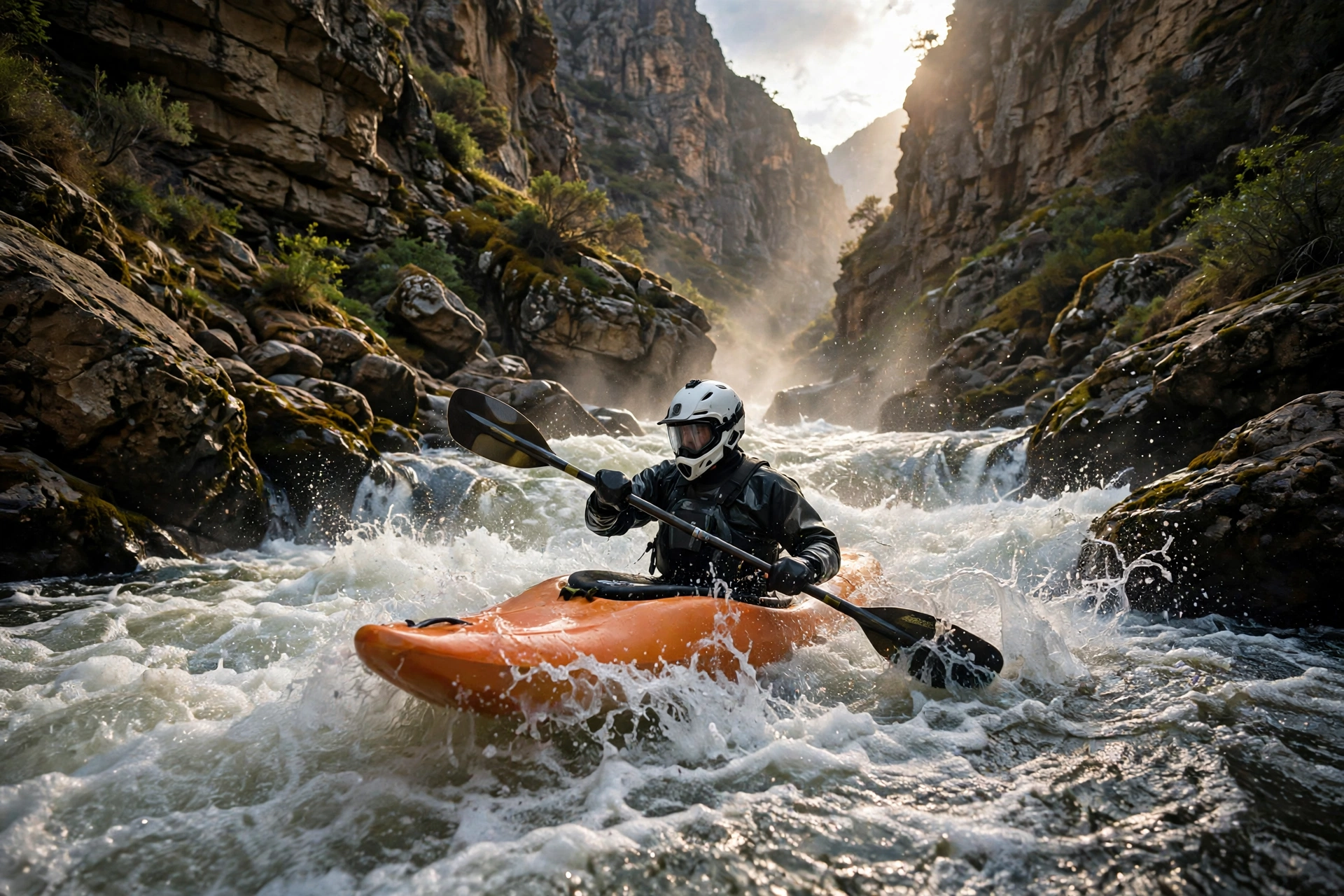
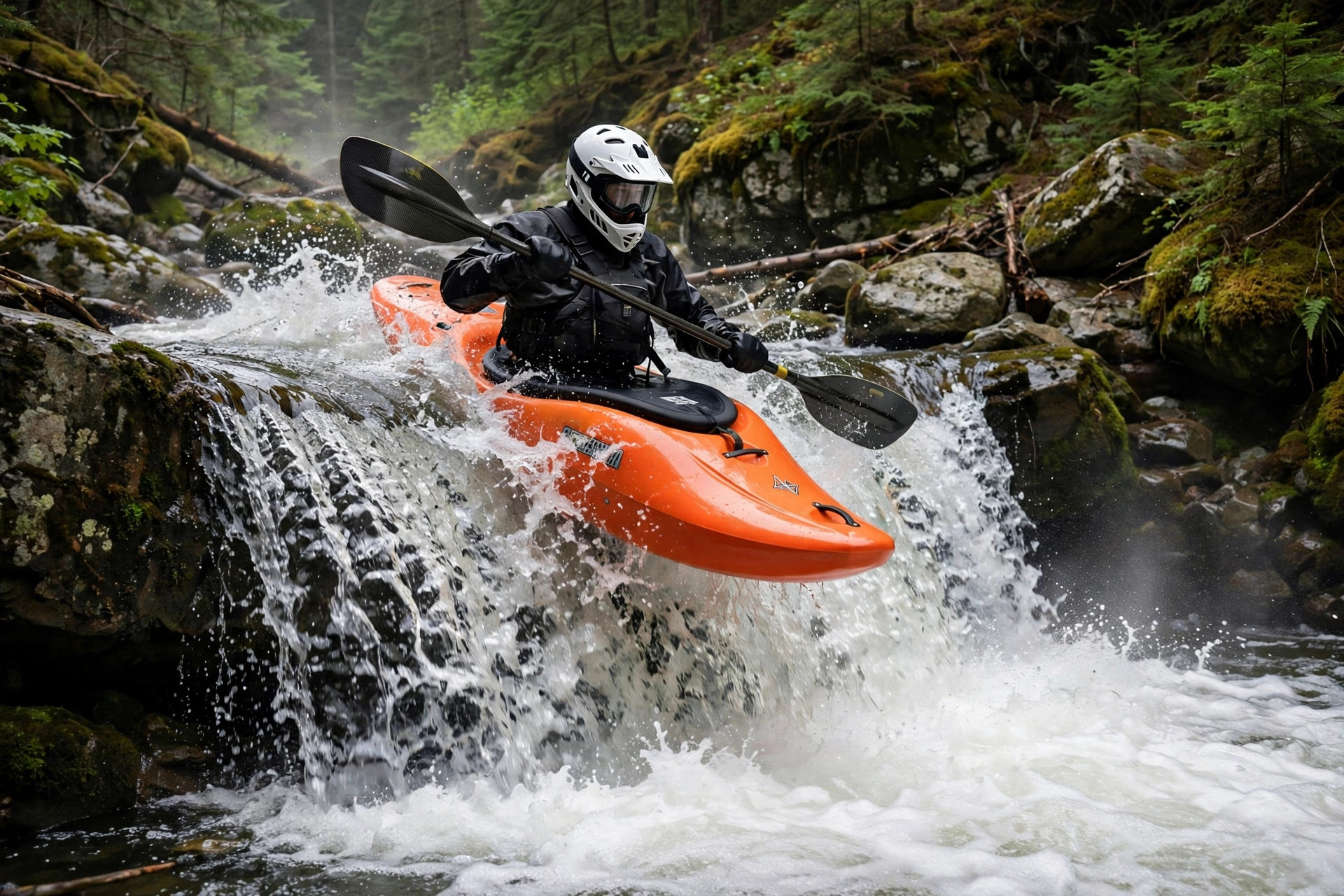
A full face whitewater helmet adds a fixed chin bar or face guard to a normal paddling helmet, and the people who need one are mainly creek boaters, steep-river kayakers, and playboaters running rocky, technical water where a face-first hit on rock is a realistic risk; most recreational paddlers on gentler rivers do not need the extra coverage. It is a tool for specific water, not an upgrade everyone should buy.
This guide explains who benefits and how to decide whether your rivers justify one.
Who Actually Needs a Full Face Whitewater Helmet?
The clearest case is steep creeking. On narrow, rocky, low-volume rivers, a swim or an upside-down moment puts your face close to boulders, ledges, and undercuts, often at very short range. A chin bar puts a structure between your teeth, jaw, and chin and the rock, in exactly the water where a standard helmet leaves the whole face open.
The second case is aggressive playboating in shallow, rocky features, where paddlers invert repeatedly close to the bottom. The third is any paddler who has already taken a face strike, or whose local runs are famous for shallow rock.
By contrast, if your paddling is mostly wide, deep, moderate rivers, rafting, or lake and touring water, the hazards are mainly to the crown, sides, and back of the head. A standard, well-fitting whitewater helmet covers those well, and the face guard adds weight, warmth, and hassle without matching a real risk on your water.
What Extra Protection Does a Full Face Design Give?
A conventional whitewater helmet protects the skull: crown, forehead, sides, ears, and back of the head. The face — nose, teeth, lips, chin, and jaw — is left open so you can breathe, drink, talk, and be heard. A full face helmet extends a rigid or semi-rigid bar across that open area, so a forward impact meets the bar first instead of your mouth and chin.
That matters because facial injuries are disproportionately miserable. Broken teeth, split lips, and jaw injuries are painful and can end a trip or a season, even when the head injury itself was minor. A chin bar will not make a bad hit harmless, but it can spread a direct face-on-rock strike across the helmet structure.
- Protected better: chin, jaw, teeth, and lower face in a forward strike
- Protected the same: crown, sides, and back of the head, as on a standard helmet
- Still exposed: nose and eyes on many designs, and the neck in any design
Judge a full face helmet first as a helmet: the skull protection, fit, and retention must be as good as a standard model before the face bar counts for anything.
What Are the Downsides of a Full Face Helmet?
They are real, and they explain why full face helmets remain a minority choice. The first is communication. A chin bar muffles your voice, and rivers are already loud; calls, whistles, and instructions to other paddlers or a raft crew carry less well, which is a safety trade-off of its own on group trips.
The second is comfort. Full face helmets tend to feel warmer and heavier, hold more water after a roll, and can make eating and drinking awkward. A design that annoys you all day is one you may loosen, push up, or leave behind.
The third is fit complexity. The bar has to sit at the right distance from your chin: too close and it can be driven into the face in a hit or simply rub all day; too far and it looks protective while doing little. That makes trying before buying, with hard head movements and a simulated roll position, even more important than with a standard helmet.
Does a Full Face Helmet Protect Better in Every Impact?
No. Its advantage is specific: forward and downward strikes to the lower face. In impacts to the crown, sides, or back of the head, a full face helmet performs like the standard helmet it is based on — the shell spreads force and the foam liner absorbs energy, and the chin bar plays no part.
Angled impacts add another factor, because they can twist the head as well as strike it. Rotational protection is a wider helmet topic, and designs that manage that twisting, including the low-friction approach explained in this guide to what MIPS is for helmets, address a different mechanism from a chin bar. The two ideas can coexist, but one does not replace the other.
In general terms, watersport helmets are made and tested for watersport impacts, and a full face model should be judged by the same general standard of testing, fit, and condition as any other paddling helmet. The bar is an addition to a sound helmet, not a substitute for one, and it never makes shallow or technical water safe on its own — skill, scouting, and good lines still do most of the work.
How Do You Choose Between Full Face and a Standard Helmet?
Be honest about your water. List your regular runs and ask how often your face is realistically within striking distance of rock while inverted or swimming. If the honest answer is often — steep, shallow, bouldery water is your normal weekend — a full face helmet is a sensible, targeted purchase.
If the answer is rarely, spend the same money on a better-fitting standard helmet, ear coverage if your water is cold or rocky, and the courses or practice that keep you upright in the first place. Many paddlers own one helmet, and the standard design remains the right default for mixed recreational use.
Some paddlers keep both: a standard helmet for everyday rivers and a full face helmet for creek season. That works if both genuinely fit and both are worn fastened and level. What does not work is buying a full face helmet for reassurance and then wearing it pushed back, unstrapped, or only on the easy sections, because protection only counts in the position it was designed to be worn.
Frequently Asked Questions
Q: Can I add a chin bar to my existing whitewater helmet?
A: Only if the maker sells a bar designed and tested for your exact model. A helmet works as a system of shell, foam, straps, and fittings, and a homemade or third-party bar can change how forces reach your head. If you want face protection, buy a helmet designed as a full face model from the start.
Q: Is a full face helmet a good choice for rafting?
A: Usually not. Rafters sit higher, face strikes on rock are less common than in creeking, and guides need to hear and be heard clearly all day. A standard, well-fitting rafting helmet is the normal choice. Outfitter fleets almost always use standard helmets for exactly these practical reasons.
Q: Does a full face helmet make it harder to roll or swim?
A: It can feel different at first. The bar adds some weight at the front and holds a little more water after a roll, and the close fit around the face takes practice to get used to. Most creek boaters adapt quickly, but try the helmet in safe water and practise rolling and swimming in it before committing to a hard run.

Olivia
Writer at Helmet Today, covering helmet reviews, fit and riding safety.