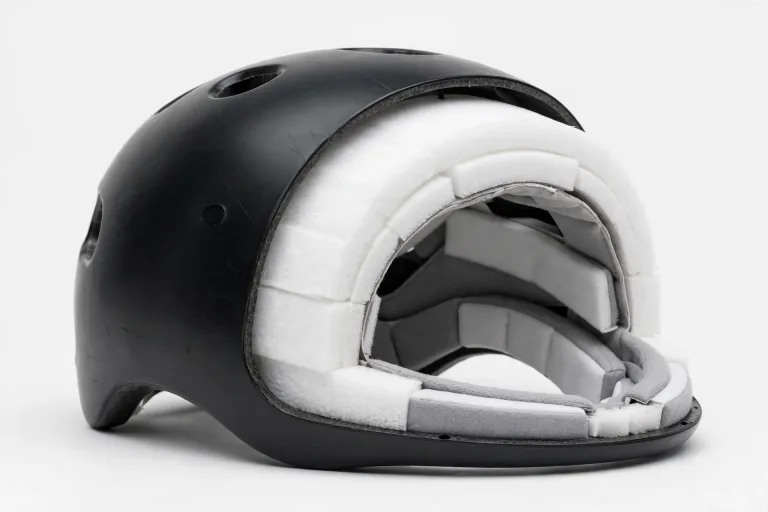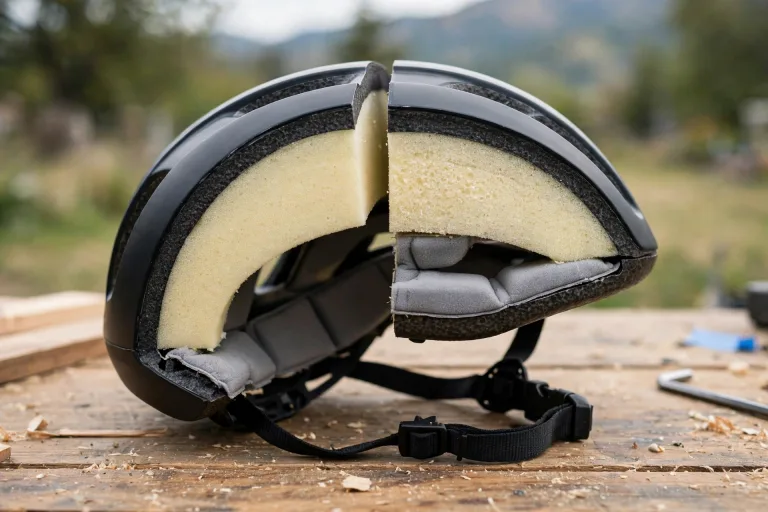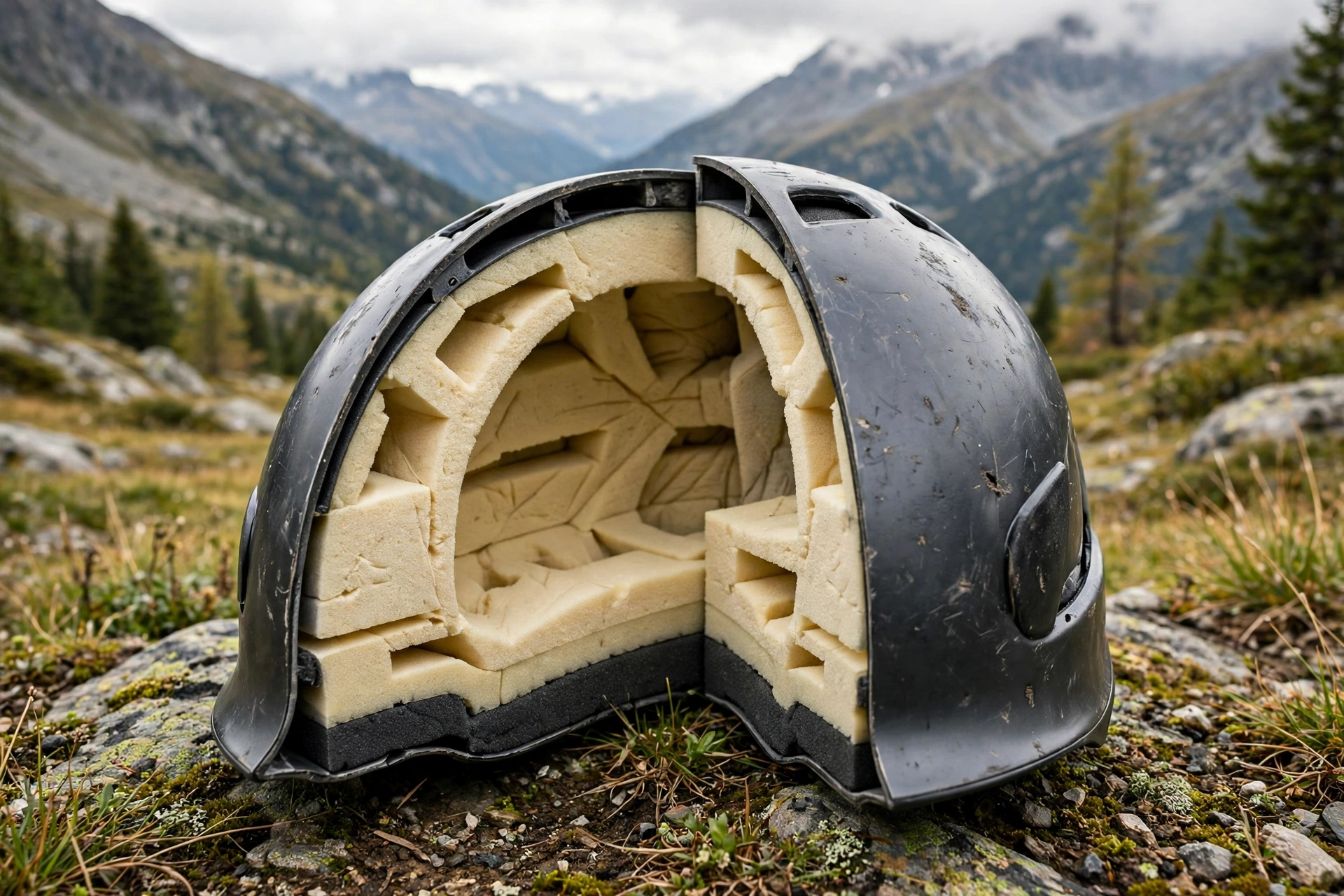
A helmet impact liner is the layer of energy-absorbing foam inside a helmet, between the hard outer shell and the wearer’s head, that crushes slightly in a crash to absorb energy and reduce the force reaching the head. In general terms, the liner is the part of the helmet that does most of the work in an impact. The shell spreads the force over a wider area, but it is the liner that absorbs the energy, and without it the helmet would pass the full force of a blow straight to the skull.
Most riders never see the impact liner, because it is hidden inside the shell and covered by the comfort padding. But it is the most important part of the helmet after the shell, and understanding what it is and how it works helps you understand why a helmet must be replaced after a crash, and why the liner’s condition matters as much as the shell’s.
What is a helmet impact liner made from?
A helmet impact liner is usually made from expanded polystyrene foam, often called EPS, which is a light, stiff foam made up of many tiny beads pressed together. In general terms, EPS is chosen because it is light, it holds its shape, and it crushes in a controlled way when it is hit hard, absorbing energy as it deforms. Some helmets use other foams, such as expanded polypropylene, which can recover after a light impact, but EPS is the most common choice.
The liner is moulded to fit the inside of the shell, and it is usually made in one piece, with channels and vents cut into it to let air flow through the helmet. The thickness of the liner varies around the helmet, and it is often thicker where the head is most at risk. In general terms, the liner is covered by a thin comfort layer that touches the head, but the comfort layer is not the impact liner: the impact liner is the firm foam underneath, and it is the part that absorbs the energy of a crash.
How does a helmet impact liner work?
A helmet impact liner works by crushing slightly when it is hit hard, and that crushing absorbs energy that would otherwise reach the head. In general terms, when the helmet strikes a hard surface, the shell spreads the force, and the liner compresses, turning the energy of the impact into the work of deforming the foam. That slows the head down more gently than a sudden stop would, and it reduces the force that reaches the brain.
The liner can only do this once for a serious impact, because the foam does not spring back to its original shape after it has been crushed. That is why a helmet that has been in a crash should be replaced, even if the shell looks fine: the liner inside may already be compressed, and it will not absorb as much energy in a second impact. Some helmets include a system designed to reduce rotational forces in a fall, such as MIPS, which works alongside the liner, and the two systems together give the head more protection than either one alone.
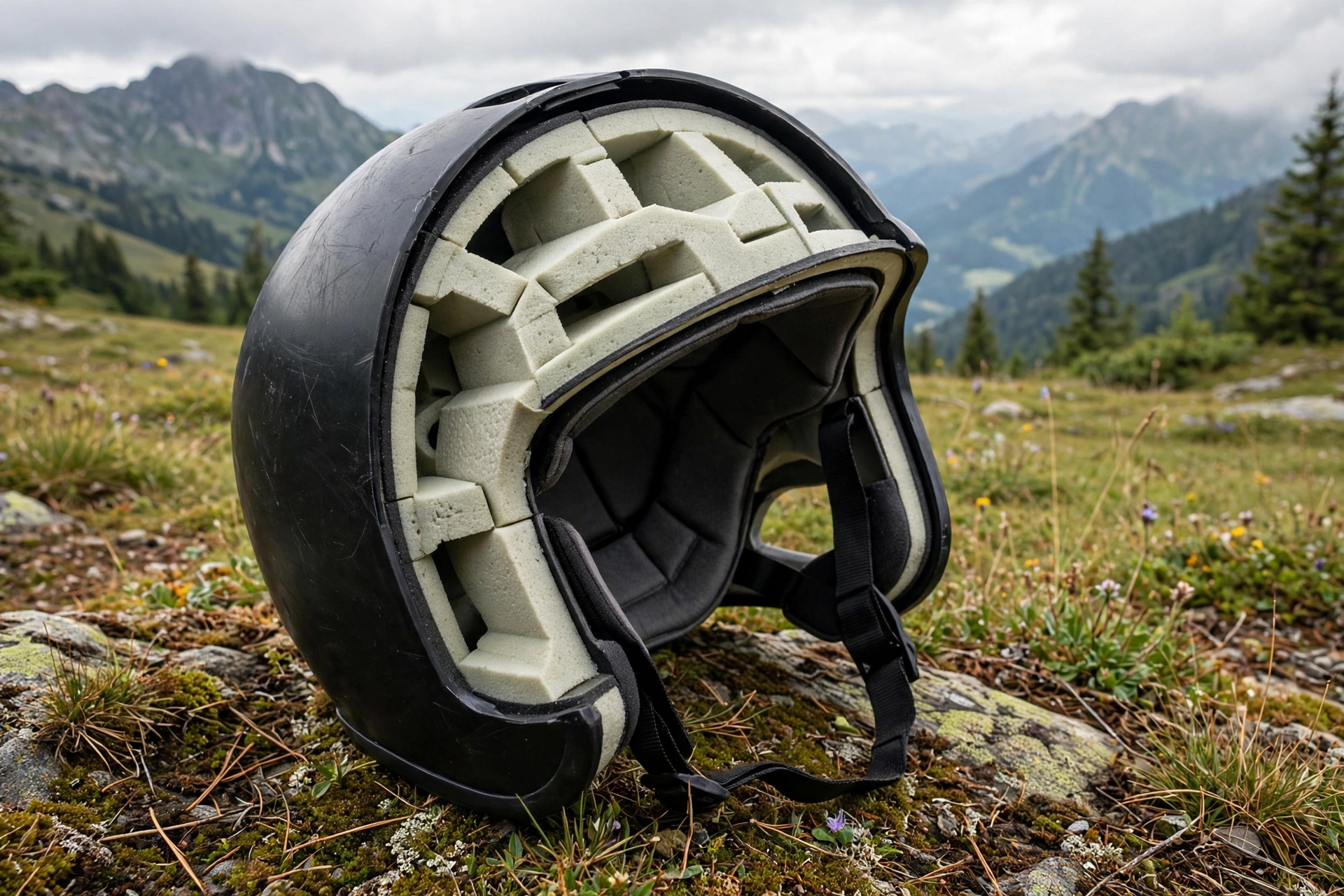
How can I check my helmet’s impact liner?
To check your helmet’s impact liner, take out the comfort padding if it can be removed, and look at the foam underneath for cracks, dents, or crumbling. In general terms, the liner should feel firm and even, with no soft spots, no cracks, and no areas where the foam has been compressed. Run your fingers over the surface and look closely, because a crack or a dent in the liner can be hard to spot at a glance.
If the comfort padding cannot be removed, check the liner through the vents, and look for any foam that is visible and damaged. Smell the inside of the helmet too: a liner that has been soaked in sweat and chemicals can break down over time, and a strong smell can be a sign of wear. If you find any damage, or if the helmet has been in a crash, replace the helmet. The liner is not a part that can be repaired or replaced on its own in most helmets.
What is the difference between an impact liner and comfort padding?
The difference between an impact liner and comfort padding is that the liner absorbs energy in a crash, while the padding makes the helmet comfortable to wear. In general terms, the impact liner is a firm foam layer that sits against the shell, and it is the part that protects the head. The comfort padding is a soft layer that sits against the head, and it is there to make the helmet feel good, to absorb sweat, and to fine-tune the fit.
Comfort padding can usually be removed and washed, and it can often be replaced if it wears out. The impact liner cannot be removed or washed in the same way, and it should not be taken out of the helmet. If the comfort padding is worn, the helmet can feel loose or uncomfortable, but it is still safe as long as the liner is in good condition. If the liner is damaged, the helmet is not safe, however good the padding feels.
When should a helmet impact liner be replaced?
A helmet impact liner should be replaced, which usually means replacing the whole helmet, after any serious crash, or when the liner shows signs of damage or ageing. In general terms, a liner that is cracked, dented, crumbling, or compressed has already done its job or has worn out, and it will not protect the head properly in another impact. A liner that has been exposed to heat, solvents, or years of use may also have lost its ability to absorb energy.
Age matters too: a liner in a helmet that is several years old may have hardened with time, even if the helmet has never been in a crash. In general terms, most makers suggest replacing a helmet after around five years, and the liner is one of the reasons for that guidance. If you are unsure about the condition of your liner, take the helmet to a shop and ask, or replace it. A new helmet is a small cost compared with the protection its liner gives.
Is the impact liner the same as the foam inside my helmet?
In general terms, yes, the firm foam inside the shell is the impact liner. It is the layer that absorbs energy in a crash, and it sits under the soft comfort padding that touches your head.
Can I replace just the impact liner?
No, in general terms the impact liner is moulded into the helmet and cannot be replaced on its own. If the liner is damaged, the whole helmet should be replaced.
Does a thicker liner mean more protection?
Not always. In general terms, a liner must be thick enough to absorb energy, but it must also fit the helmet and the head properly. A well-designed liner of the right thickness, in a helmet that fits, protects better than a thick liner in a poorly fitting helmet.

Olivia
Writer at Helmet Today, covering helmet reviews, fit and riding safety.