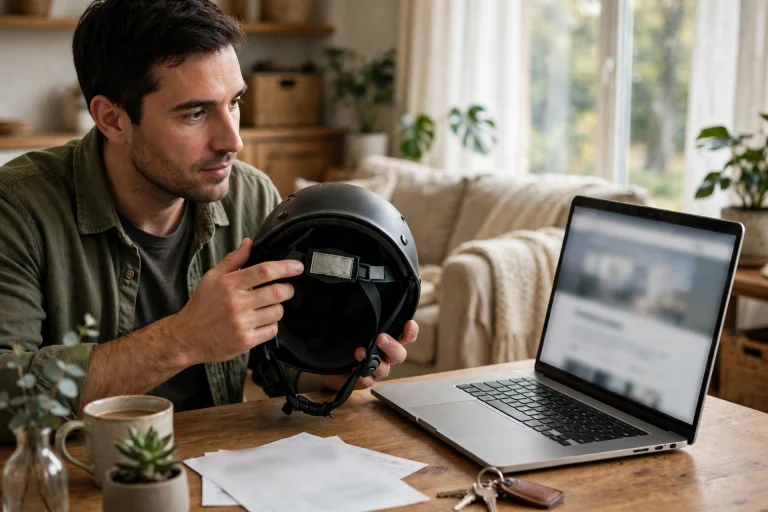
Helmet safety ratings are calculated in general terms by testing helmets in a laboratory, measuring how much force reaches the head in a simulated crash, and then turning those measurements into a score or a pass mark. No rating can promise that a rider will be safe in every crash, because real crashes are messy and unpredictable, but a rating gives buyers a useful way to compare helmets that have been tested in the same way. This guide explains, in general terms, how those ratings are worked out, what the tests look for, and how to read the results without being misled by them.
What Does a Helmet Safety Rating Actually Measure?
In general terms, a helmet safety rating measures how well a helmet reduces the forces that reach the head during an impact. When a helmet hits a hard surface, the outer shell spreads the force over a wider area and the inner liner crushes slightly to slow the head down more gently. A rating tries to capture how effectively that process works, because a sudden stop is what causes most head injuries in a crash.
The most important measurement in most ratings is the acceleration of the head during the impact. Sensors record how quickly the head slows down, and that figure is compared with a limit that is thought to represent a safer level of force. A helmet that keeps the recorded acceleration below that limit is doing its job. Some rating schemes also look at how long the force lasts, because a shorter, sharper shock and a longer, gentler one can feel very different to the head even if the peak force is similar.
How Do Test Labs Measure Impact Protection?
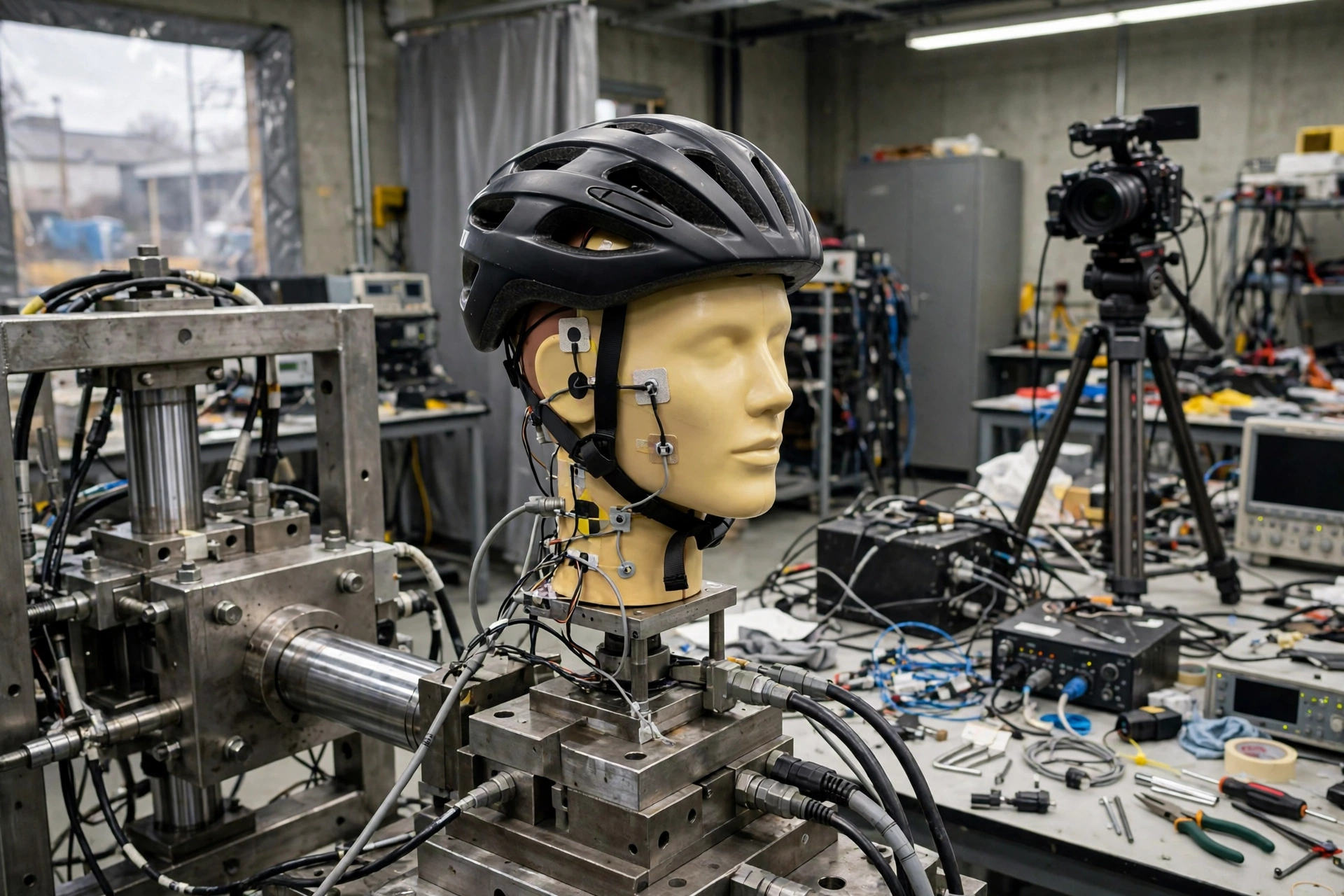
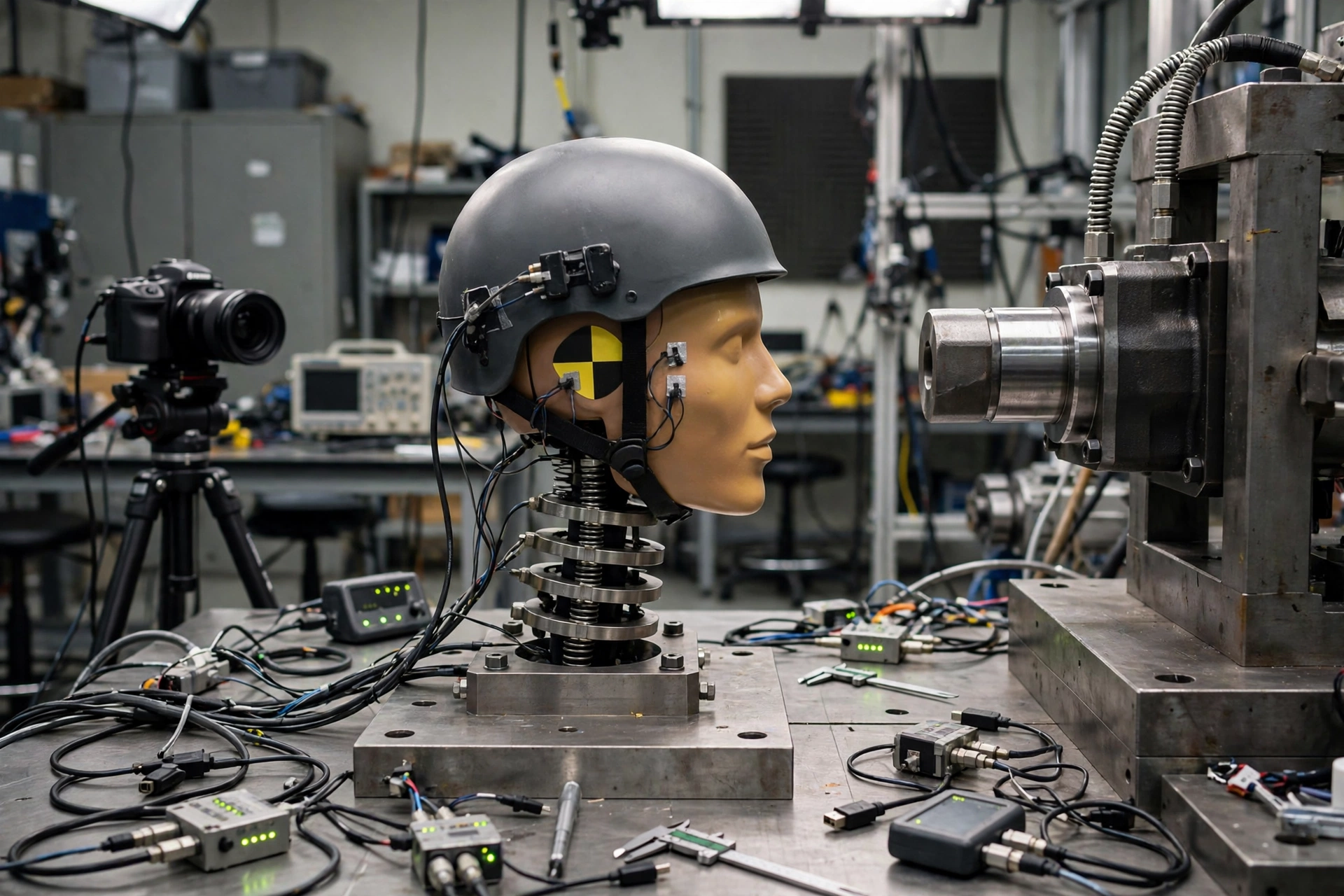
Test labs measure impact protection by dropping a helmet fitted to a dummy head onto a hard surface, or by dropping a heavy object onto the helmet, in a carefully controlled way. The dummy head contains sensors that record the forces at the moment of impact. The height of the drop, the shape of the surface, and the angle of the impact are all set in advance so that every helmet is tested under the same conditions and the results can be compared fairly.
A helmet is usually tested at several points around the shell, not just at the top. The crown, the sides, the front, and the back may each be tested, because a crash can strike the helmet anywhere. Testing several points also checks whether the helmet protects evenly or whether it has a weak spot. In many schemes, several helmets of the same model are tested as well, so that one unusually good or bad sample does not decide the rating on its own.
The liner is a key part of what is being measured. Most helmets use a foam liner that is designed to crush on impact, absorbing energy as it deforms. A good liner spreads the impact over a longer time, which lowers the peak force on the head. If you are learning about how helmets handle different kinds of impact, reading about what MIPS is for helmets can help you understand one of the technologies used in modern helmet design. Test labs also check that the helmet stays in place during the impact, because a helmet that shifts or comes off cannot protect the head properly.
What Other Tests Go Into a Safety Rating?
Impact testing is the centrepiece of most ratings, but it is rarely the only test. A rating scheme may also check the strength of the chin strap and its fastening, because a strap that breaks or slips in a crash lets the helmet move or come off. The test usually involves pulling on the strap with a set force and checking that it holds and that the helmet does not roll off the dummy head.
Why Do Different Rating Systems Give Different Results?
Different rating systems can give different results for the same helmet because they do not all test in the same way. One system may drop the helmet from a greater height, another may test more points on the shell, and another may include rotational testing while a third does not. Because the tests differ, the scores differ too, and a helmet that earns a top score under one scheme might earn a middle score under another.
The way results are presented also varies. Some systems use a simple pass or fail, which tells you whether a helmet meets a minimum standard but not how far above that minimum it sits. Others use stars or a numbered score, which gives more detail but can be harder to compare across systems. A five-star rating from one organisation is not the same thing as a five-star rating from another, because the tests behind the stars are different.
How Should a Buyer Use Safety Ratings When Choosing a Helmet?
A buyer should use safety ratings as one part of the decision, not as the whole decision. A good rating is a useful sign that a helmet has performed well in laboratory tests, and it is sensible to prefer a helmet that meets a recognised standard and, where available, earns a strong rating. But the rating cannot tell you whether the helmet fits your head, whether it is comfortable on a long ride, or whether you will actually wear it every time.
Fit matters just as much as the rating. A helmet that is too loose can shift in a crash, and a helmet that is too tight will be uncomfortable enough that you may be tempted to leave it at home. Try the helmet on, fasten the strap, and check that it sits level and does not rock from side to side. A well-fitting helmet with a solid rating is a far better choice than a top-rated helmet that does not fit you properly.
It also helps to look at what the rating actually covers. Check whether it is based on a recognised standard, whether it includes rotational testing, and when the rating was published, because testing methods change over time. A rating from several years ago may have used an older method. In general terms, a recent rating from an independent scheme, combined with a good fit and a helmet you are happy to wear, is the most practical way to use ratings when you buy.
Frequently Asked Questions
Q: Does a higher safety rating mean a helmet is always safer?
A: In general terms, a higher rating usually means the helmet performed better in that scheme’s laboratory tests. It does not guarantee safety in every real crash, and the rating cannot account for fit, so a top-rated helmet that fits badly is not the safest choice for you.
Q: Can I compare star ratings from different organisations?
A: Not directly. Different organisations use different tests, drop heights, and scoring methods, so a five-star result from one scheme is not equal to a five-star result from another. Compare ratings only within the same scheme.
Q: Does a helmet with no rating mean it is unsafe?
A: Not necessarily. A helmet with no rating from a particular scheme may simply not have been tested by that scheme. Check whether it meets a recognised standard instead, and treat the absence of a rating as missing information rather than proof of a failure.

Olivia
Writer at Helmet Today, covering helmet reviews, fit and riding safety.