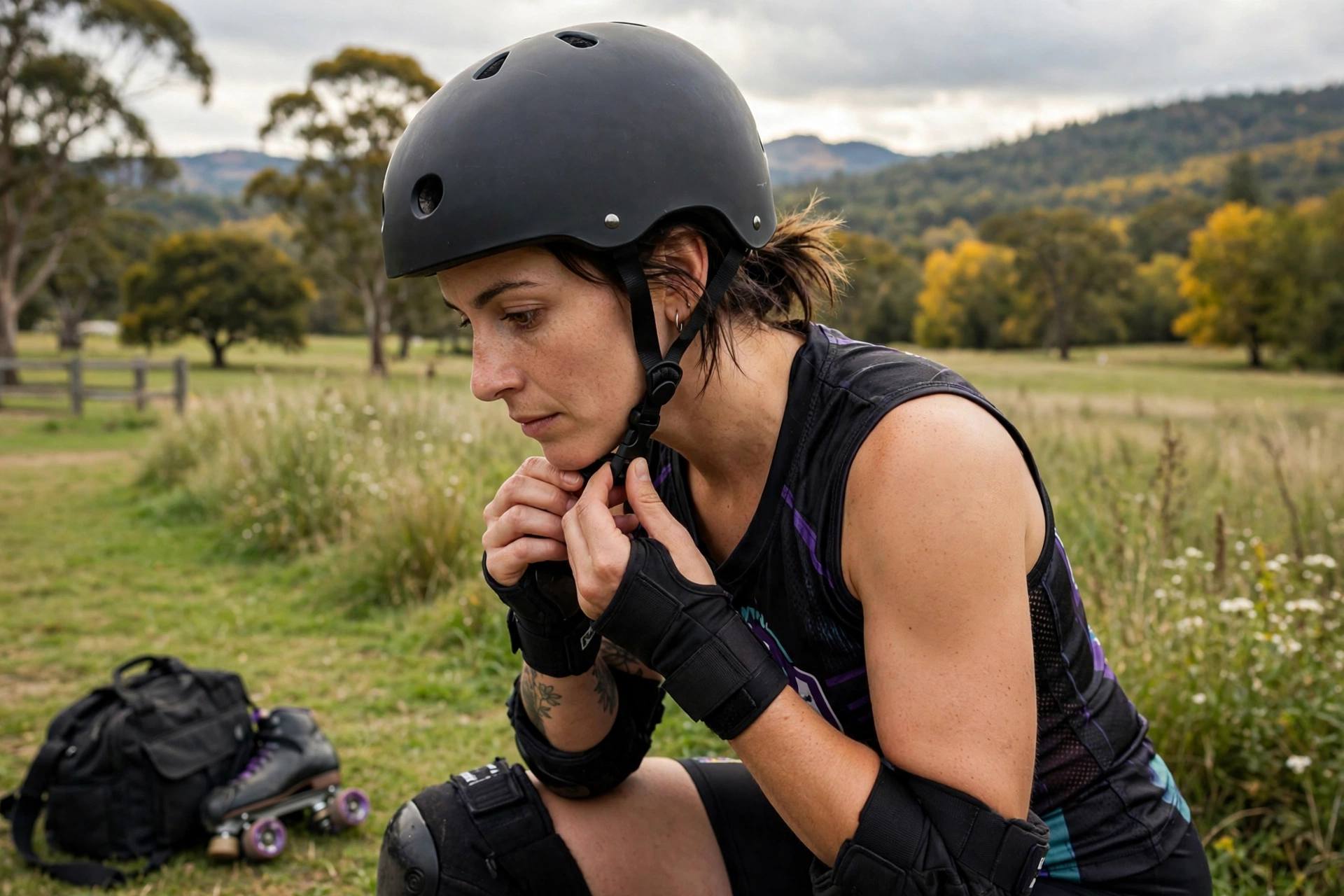
Short answer: A roller derby helmet should fit snug all the way around your head, sit low and level with the front edge about an inch above your eyebrows, and stay put when you shake, tilt, and crouch. The straps should form a “V” under each ear, with the chin strap tight enough to allow just one finger underneath. If it rocks, shifts, or leaves hot spots, it is the wrong size or needs fit-pad adjustments.
Derby is not a gentle sport for helmets. You will sprint, crouch, get hit, fall, and whip your head around to spot the jammer — sometimes all in the same jam. A helmet that fits on the shop floor but shifts during play is not protecting you when it counts. Here is how to measure, fit, and test a derby helmet properly.
How Do You Measure Your Head for a Roller Derby Helmet?
Start with a soft measuring tape (or a string and a ruler). Wrap it around the widest part of your head — across the middle of your forehead, just above your eyebrows and ears, and around the bump at the back of your skull. Keep the tape level and snug, but not tight. That circumference, in centimeters or inches, is your helmet size.
Match the measurement to the size chart of the specific brand you are buying. Derby helmet sizing is not universal: one brand’s medium may fit like another’s large, and shell shapes differ — some run rounder, some more oval. If you land between sizes, most skaters do better sizing down and fine-tuning with thicker fit pads than swimming in a too-big shell with thin pads.
If you can, try the helmet on in person with your hair worn the way you will actually play — more on that below — and wear it for at least ten minutes. A fit that feels fine for thirty seconds can reveal pressure points by minute five.
How Snug Should a Roller Derby Helmet Feel?
The helmet should feel evenly snug, like a firm handshake around your whole head — not loose anywhere, and not painfully tight anywhere. The front edge should sit low on your forehead, roughly an inch (about two finger widths) above your eyebrows, and the helmet should sit level rather than tipped back like a baseball cap. Tipped back exposes your forehead; pushed too far forward blocks your vision when you look up in a crouch.
Run the basic movement checks with the strap undone first:
- Shake test: Shake your head side to side and nod. The helmet should move with your head, not lag or wobble.
- Tilt test: Bend forward and shake gently. The helmet should not slide toward your nose.
- Roll test: Try to roll the helmet forward and backward with your hands. It should resist and stay in place.
If the helmet rocks front to back, it is likely too big or the wrong shape for your head. If it creates a red pressure mark on your forehead within minutes, it may be too small or too round for your head shape. Snug and comfortable is the target — you will wear this for two hours of play.

How Should the Straps Sit on a Roller Derby Helmet?
Straps keep the helmet positioned during falls and contact, so set them carefully. The side straps should form a “V” shape on each side of your head, with the junction of the V sitting just below your earlobe. If the slider sits on your ear or far below it, adjust the straps through the buckle until both sides match.
The chin strap should be snug — tight enough that only one finger fits between the strap and your chin, and the helmet cannot be pushed up off your forehead when you open your mouth wide and pull upward. Loose chin straps are one of the most common fit failures in derby: the helmet feels fine standing still, then rotates during the first fall.
After adjusting, tuck or trim excess strap according to the manufacturer’s instructions so loose ends do not flap or catch. Recheck strap tension regularly during the season — straps stretch and sliders creep with sweat and use.
What Fit Tests Should You Do Before Game Day?
Static checks are only the start. Put the helmet through derby movements at home or at practice:
- Crouch and look up: Drop into a derby stance and look forward and up. The helmet should not slide down over your eyes.
- Head turns: Snap your head left and right as if scanning the pack. The helmet should turn with you instantly, with no lag.
- Sprint and stop: A few hard strides and abrupt stops will reveal any forward slipping.
- Fall simulation: From a low crouch on a mat, roll gently backward. The back of the helmet should stay covering the back of your head.
Pay attention to your liner, too. Dual-density foam and rotational systems such as MIPS are designed to manage different kinds of impacts — our explainer on what MIPS is covers how those liners work — but no liner technology can help if the helmet has shifted out of position before the impact arrives. Fit is the foundation every other safety feature stands on.
Do Fit Pads and Hair Change a Derby Helmet’s Fit?
Yes, both matter. Most derby helmets ship with interchangeable fit pads in two thicknesses. Swapping pads is the intended way to fine-tune fit: thicker pads at the back can stop forward slip, and mixing thicknesses lets you adapt the shell to your head shape. If you have maxed out the thickest pads and the helmet still rocks, the shell itself is too large — pads cannot safely rescue a wrong-size helmet.
Hair makes a real difference, too. Always fit your helmet with your hair exactly as you wear it in play — a ponytail, bun, or bandana underneath changes the effective size and can create pressure points or lift the helmet higher on your head. Many skaters route a ponytail out through the back below the shell rather than stuffing it inside. Whatever your style, fit the helmet to the real game-day setup, not to loose hair in the store.
Finally, revisit fit over the season. Pads compress, straps stretch, and haircuts happen. A thirty-second shake test before each bout keeps small drifts from becoming game-day problems.
Frequently Asked Questions
Q: How tight should a roller derby helmet be?
A: Snug and even all around, with no rocking or sliding when you shake your head — but never so tight it causes pain or a headache. The chin strap should allow just one finger underneath, and the side straps should form a V below each ear.
Q: What if my head measurement falls between two helmet sizes?
A: Most skaters do better with the smaller size fine-tuned by fit pads, since pads compress over time and a too-large shell cannot be made truly secure. Always check the specific brand’s size chart rather than assuming sizes match across brands.
Q: How often should I recheck my derby helmet’s fit?
A: Do a quick shake and strap check before every bout, and a fuller fit review whenever you change hairstyles, swap pads, or notice the helmet shifting in play. Replace the helmet after any significant head impact.

Olivia
Writer at Helmet Today, covering helmet reviews, fit and riding safety.