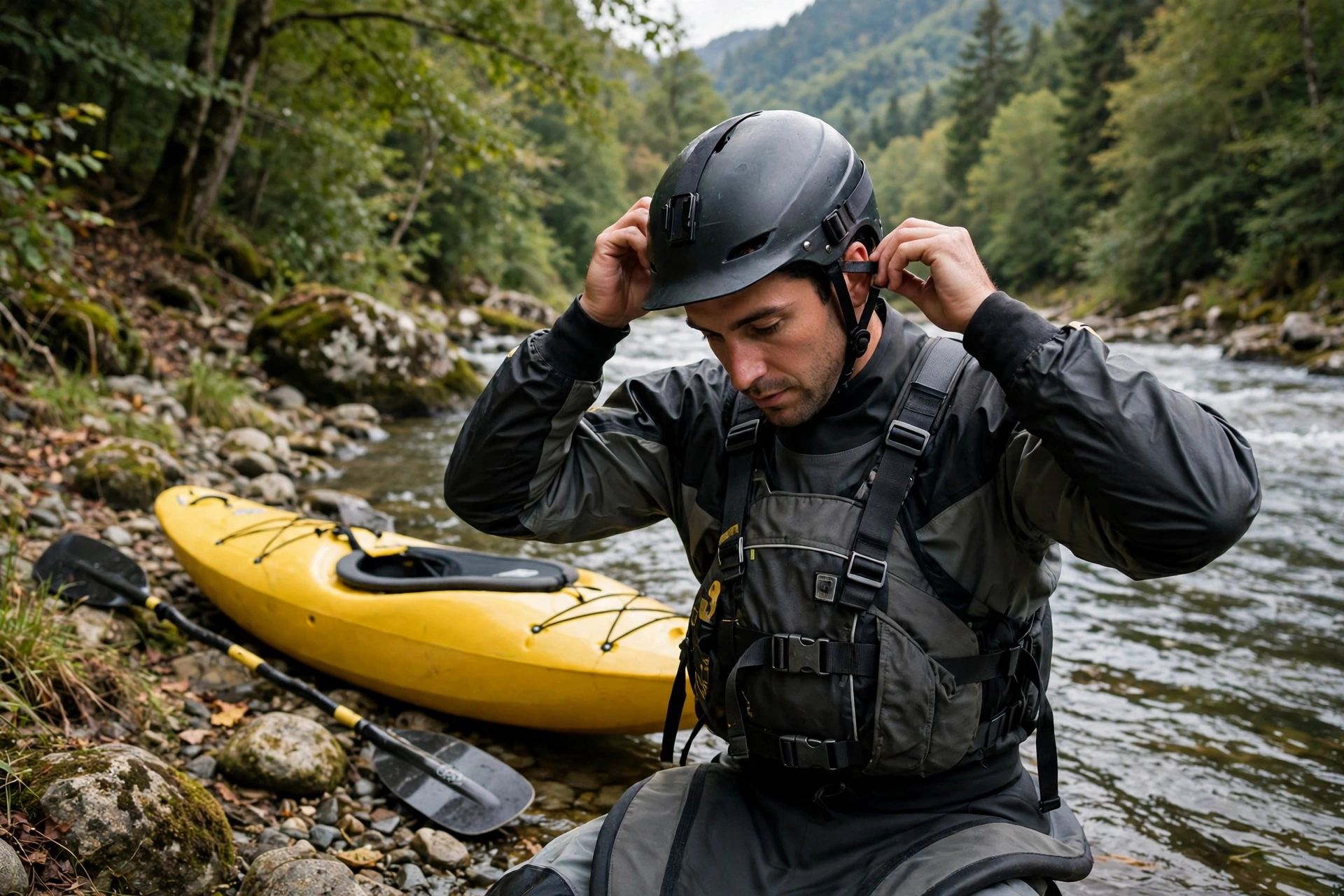
A whitewater helmet should fit snugly all the way around your head — firm contact everywhere, no rocking, no rotating — without causing pain or a headache. It should sit low, covering your forehead down to about an inch above your eyebrows, protect the back of your head and the area around your ears, and stay exactly in place when you shake your head hard or push the helmet from any direction. The chin strap should be snug, and the rear adjustment (occipital dial or cradle) should lock the helmet onto the back of your skull.
If any of those checks fail, fix it with fit foam and shims or try a different size or model. A loose helmet is worse than useless in a swim — current can peel it back or strip it off entirely at the moment you need it most.
How Snug Should a Whitewater Helmet Feel?
The right fit feels like a firm, even hug around your whole head — no pressure point digging in, and no gap you can slip a finger into at the temples or forehead. A new helmet often feels slightly tight at first; the liner relaxes a little with use, so “snug but bearable” on day one is usually perfect by day five.
Too tight is also a failure. A helmet that gives you a headache within fifteen minutes or leaves a deep red mark on your forehead is the wrong size or shape for your head — head shapes differ (rounder versus more oval), and brands cut their shells differently. Wear a candidate helmet for ten to fifteen minutes before committing; discomfort that is mild at minute two becomes misery at hour three on the river.
Where Should a Whitewater Helmet Sit on Your Head?
Position matters as much as tightness. The front edge should sit low on your forehead — roughly a finger’s width or two above your eyebrows — because the classic whitewater head strike happens face-first against a rock while you’re upside down or swimming. A helmet tipped back, cowboy style, leaves exactly that impact zone exposed.
Check the other zones too:
- Back of the head: Coverage should extend low over the occipital bone, the bump at the base of your skull. This protects you in a backward fall or a swim where current pushes you over a rock feet-first.
- Sides and ears: Many whitewater helmets cover the ears or leave ear openings in a reinforced section. Either is fine; what matters is that the shell covers the temples and does not leave the side of the skull exposed.
- Level fit: Viewed in a mirror, the helmet should sit level, not cocked to one side — a tilt usually means the size is wrong or the fit foam is uneven.
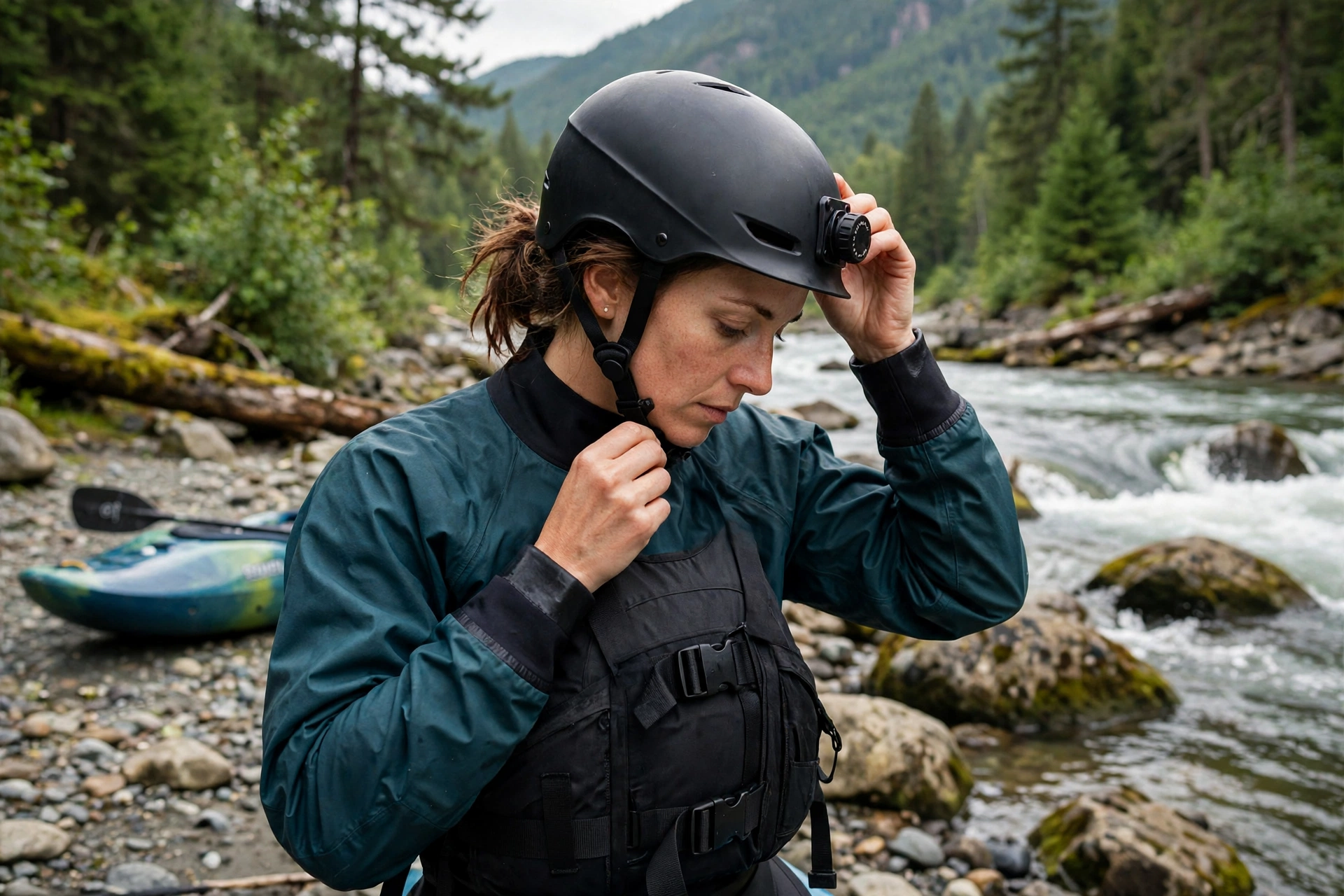
How Do You Test Whether the Helmet Will Stay On?
Do these tests with the chin strap fastened and adjusted, exactly as you would paddle:
- Shake test: Shake your head vigorously side to side, then nod hard. The helmet should move with your head as one unit, with no independent sliding or rocking.
- Roll test: Grip the helmet and try to roll it forward and backward. It should resist — a helmet that rolls forward to cover your eyes or backward off your forehead will do the same in current.
- Push test: Push firmly upward under the front edge and under the back edge. The strap and rear cradle should hold it in place. This simulates water pressure hitting the helmet in a swim.
- Jaw test: Open your mouth wide and talk. The strap should feel snug under your jaw without choking you when your mouth is closed.
If the helmet fails any test, first try the manufacturer’s fit kit — most whitewater helmets include foam pads and shims in different thicknesses. Add padding where there is movement, and use the rear adjustment to pull the helmet down onto the occiput. If it still moves, it is the wrong size. Do not solve a loose helmet by over-tightening the chin strap; the strap is backup retention, not the fit system.
How Do You Use Fit Foam and Shims Correctly?
Fit foam is how a good helmet becomes your helmet. Work in small steps: add the thinnest shims first, put the helmet on, repeat the shake and roll tests, and add more only where movement remains. Common adjustment points are the forehead band, the crown, and the sides above the ears.
Keep the fit symmetrical — padding on one side only will tilt the helmet. And don’t stack foam until a too-big helmet feels tight: thick shim stacks compress unpredictably when wet. If you need more than the included kit’s range, exchange the helmet for the smaller size.
Tip: photograph your final pad layout. After a swim or a wash, pads occasionally come loose, and a photo makes rebuilding your exact fit a two-minute job.
Should a Whitewater Helmet Fit Over a Neoprene Cap?
If you paddle cold water, yes — fit matters with everything you wear under it. A neoprene cap or hood adds a few millimeters all around, which can turn a perfect summer fit into a headache in winter. The cleanest solution is to size the helmet while wearing your usual cold-water layers, then use thinner shims for warm-water days (some paddlers keep two pad sets, labeled by season).
What not to do: size the helmet for bare-head summer use and then force it over a thick hood. Beyond comfort, an over-tight fit changes how the shell sits — it rides higher, reducing forehead and back-of-head coverage precisely when icy, consequential water demands the best fit. Comparing helmet features can help here too; our overview of what MIPS is in a helmet covers one protection system from the bike world, and illustrates how differently each sport’s helmets are engineered — whitewater helmets prioritize rock coverage and retention over rotational systems.
When Should You Replace a Whitewater Helmet?
Replace your helmet after any hard rock strike to the shell — even if the damage looks cosmetic. Shell cracks, crushed liner foam, a stretched strap, or a broken adjustment cradle all mean the helmet has done its job and cannot be trusted to do it again. Inspect after every significant swim: run your fingers over the shell for cracks and soft spots, check the strap hardware, and make sure the rear cradle still locks.
Age matters too. Sun, water, and sweat degrade materials over seasons of use, and manufacturers generally recommend replacing paddling helmets after a few years of regular use. If the liner crumbles or the straps feel brittle, retire it — the helmet is not the place to save money.
Frequently Asked Questions
Q: Should a whitewater helmet cover your ears?
A: Many designs do, and ear coverage adds real protection against side impacts on rocks. Others leave ear openings for hearing and drainage. Either style is acceptable as long as the temples and side of the skull are covered and the fit is secure.
Q: How tight should the chin strap be on a whitewater helmet?
A: Snug enough that you can fit about one finger between strap and jaw, and the helmet cannot be pushed off in any direction. It should not choke you or restrict talking. Always use the rear adjustment as the primary fit tool — the strap is backup retention.
Q: My helmet fits in summer but is too tight with a neoprene hood. What should I do?
A: Re-shim it. Remove or thin the internal fit pads to make room for the hood, and keep a second, thicker pad set for warm-water paddling. If the helmet still rides high or hurts, size up for cold-water use.

Olivia
Writer at Helmet Today, covering helmet reviews, fit and riding safety.