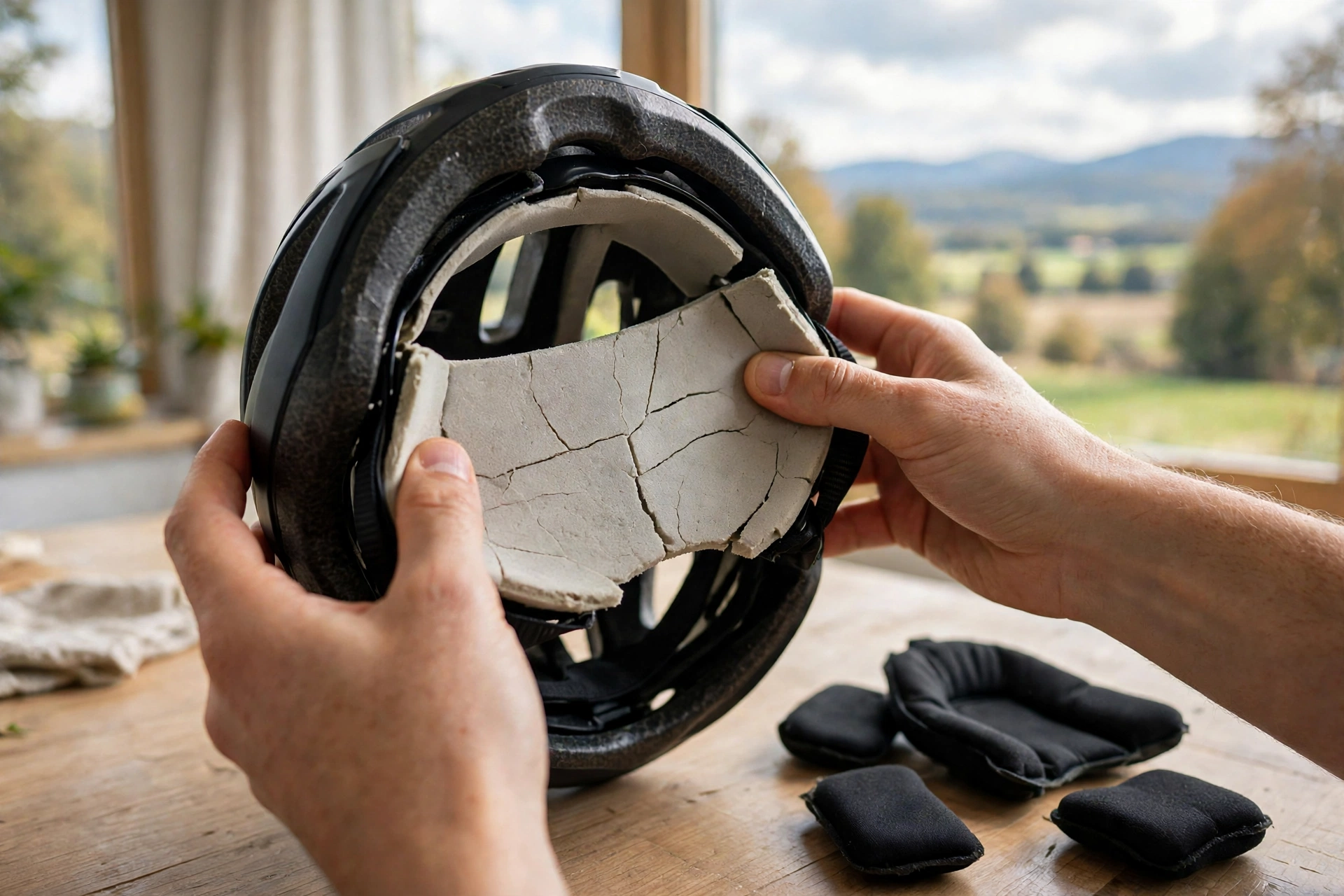
To check a helmet for hidden damage, take out the comfort pads and inspect the foam liner closely in strong light for cracks, dents, and soft or compressed spots, then work through the shell, straps, and buckle — because the impact foam can be crushed in a crash even when the outside of the helmet looks completely untouched.
This is the check that decides whether a helmet keeps protecting you or quietly stops. A helmet’s job is to sacrifice itself once, absorbing energy by crushing its foam. The problem is that the sacrifice is often invisible: the shell flexes back, the scratches look minor, and the damaged foam hides underneath. Here is how to look properly.
Why Can a Helmet Be Damaged Without Looking Damaged?
A modern helmet is a thin outer shell over a liner of expanded polystyrene foam — EPS. In an impact, the shell spreads the force and the foam crushes to absorb it. Foam that has crushed does not spring back. It stays compressed, with less material left to absorb the next impact in that spot.
The shell hides this well because it is designed to flex. After a moderate impact it may show only a scuff or a faint mark while the foam beneath has a flat, compacted area you can only find by looking and feeling inside. Dropped helmets are the everyday version: a fall from a car seat or a shelf onto concrete delivers a sharp knock to one spot, and the damage, if any, is a small dent in the liner rather than a dramatic crack.
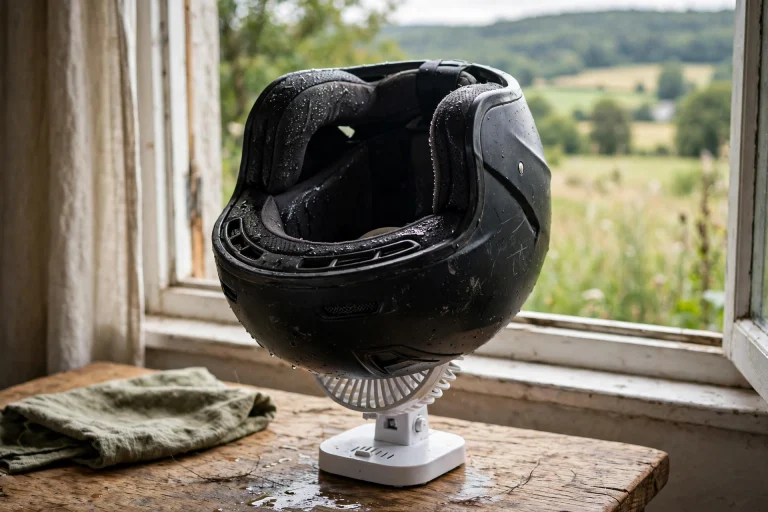
Age and environment add slower damage too: heat, sunlight, sweat, and chemicals soften or degrade foam and straps over the years. A thorough check covers both kinds — the sudden and the slow.
How Do You Inspect the Foam Liner Step by Step?
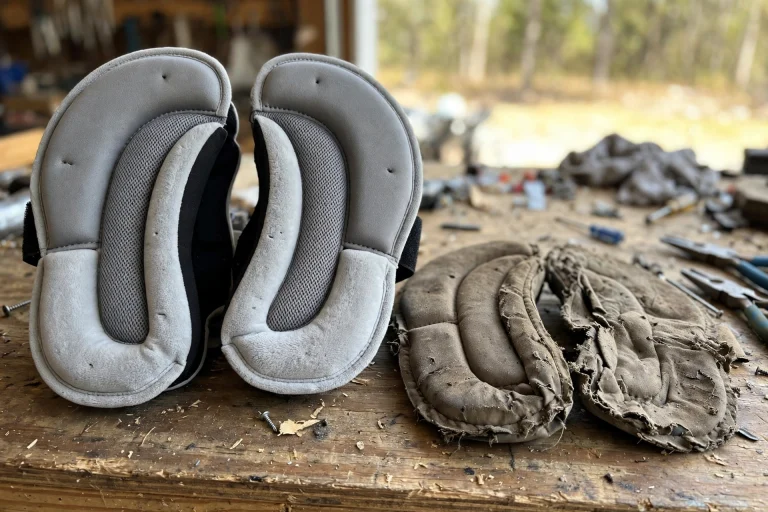
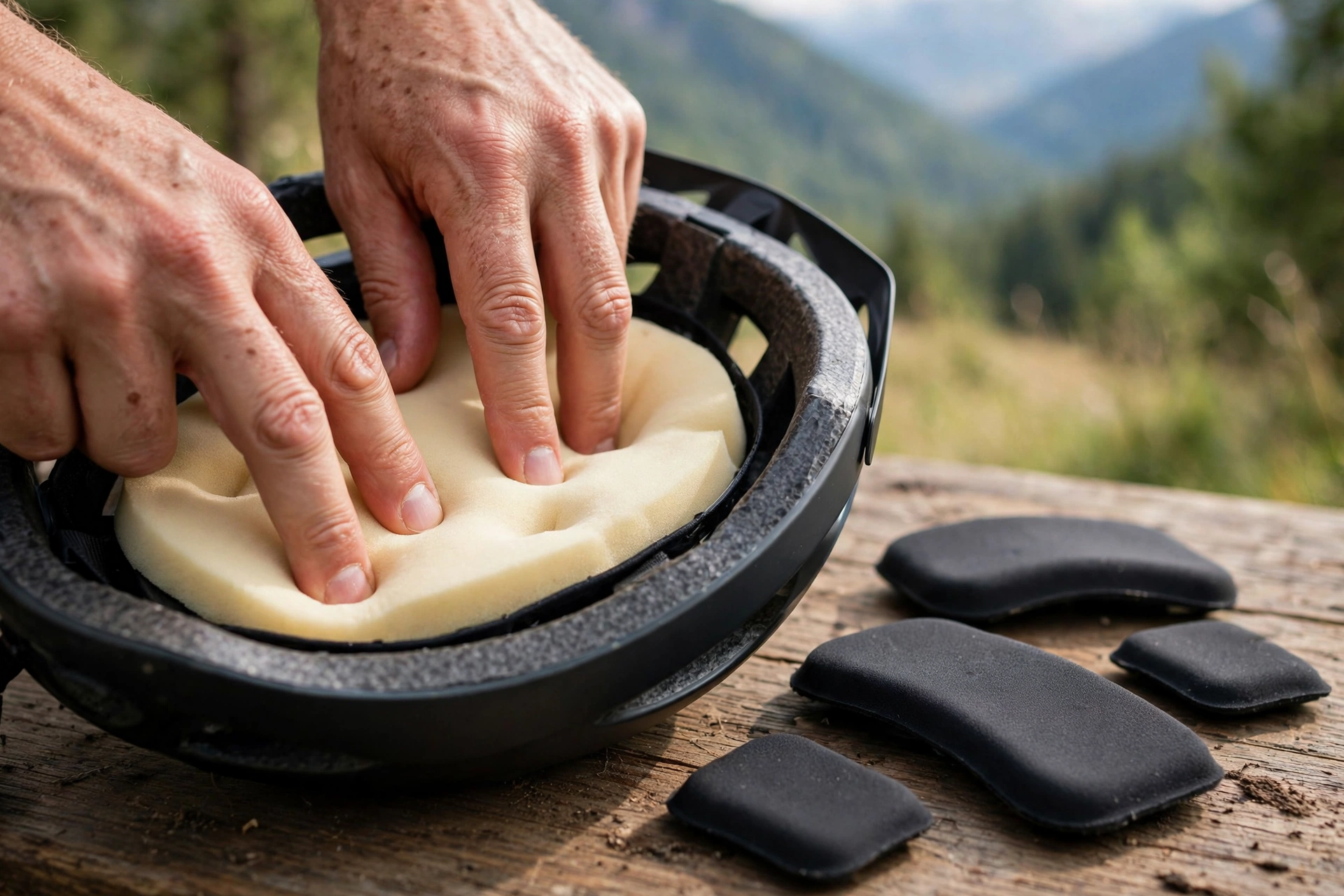
Work somewhere with strong, direct light, and remove every removable pad first — comfort pads clip or peel out on most helmets, exposing the liner. Then go slowly:
- Look along the liner surface at a low angle. Cracks often show as fine dark lines, and compressed areas catch the light differently — flatter and slightly shinier than the surrounding foam.
- Feel with your fingertips, pressing gently all around the crown, temples, and back. Healthy foam feels uniform and firm; a damaged spot feels softer, thinner, or crumbly, or dips where it should curve.
- Compare sides. Helmets are symmetrical, so a spot that feels different on the left than the right deserves suspicion.
- Check the edges where the foam meets the shell, and around vents and strap anchor points — cracks like to start at these stress points.
If your helmet has a rotational liner — the low-friction layer described in our guide to what MIPS is and how it works — make sure it is still seated as designed and moves slightly as intended rather than sitting torn, bunched, or detached.
What Should You Check on the Shell, Straps, and Buckle?
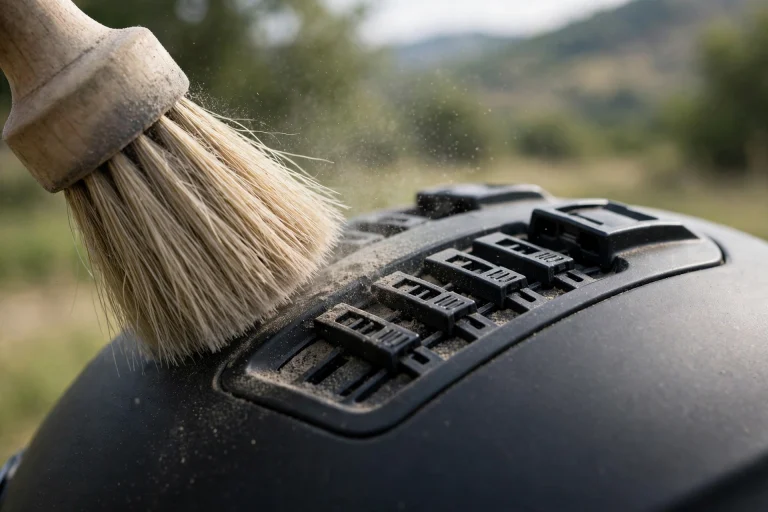
The shell comes next. Flex it very gently and look for hairline cracks, especially around the vents, the edges, and anywhere there is a scuff — a mark on the shell often mirrors a mark in the foam directly beneath it, so use outside marks as a map to where the inside needs the closest look. Deep dents or a shell that has separated from the foam at any point are retirement signs, not cosmetic flaws.
Straps take more abuse than riders realize. Run the full length of the webbing through your fingers: look and feel for fraying, cuts, stiff or sun-rotted sections, and stitching that has pulled loose where the straps anchor into the helmet. A strap that fails in a crash makes the rest of the helmet irrelevant.
Then the buckle and any fit dial. Fasten and unfasten the buckle several times — it should click positively and hold against a firm tug. Work the rear retention dial through its range: it should adjust smoothly and stay where you set it. Cracked buckle plastic, a dial that slips, or a chin strap that creeps loose on its own all mean the retention system can no longer be trusted.
What Are the Clear Signs a Helmet Must Be Retired?
Some findings end the inspection on the spot. Retire the helmet if you find: any crack in the foam, a dent or flat spot in the liner, foam that crumbles or feels soft in one area, a cracked shell, frayed or torn straps, loose strap anchors, or a buckle that does not hold. None of these can be repaired back to certified protection.
The helmet’s history counts as a finding too. If the helmet was in a crash where your head hit the ground or anything else — even if the inspection finds nothing — the standard advice from manufacturers in general terms is to replace it, because some foam damage escapes even a careful home check.
The same goes for a helmet of unknown history. A secondhand helmet may have invisible damage you cannot rule out, which is why buying used helmets is discouraged no matter how clean they look. When in doubt, the cost of a new helmet is the honest price of certainty about the one piece of gear that protects your head.
When Should You Do This Check?
After any impact, obviously — a crash, a drop onto a hard floor from height, or anything heavy falling onto the helmet. That check happens before the helmet goes on a head again, no exceptions.
But build it into routine care as well. A sensible rhythm is a full liner-out inspection at the start of each season and a quick version — shell, straps, buckle, a feel of the foam — every month or so of regular use. Pads come out for washing anyway; make the inspection part of the same job.
Finally, keep the calendar in mind. In general terms, manufacturers suggest replacing helmets after roughly five years of use because materials age even in careful hands. A helmet that passes every check but is well past that age has earned its retirement — and your inspection habit is what makes sure its replacement gets checked just as well.
Frequently Asked Questions
Q: I dropped my helmet on the floor. Do I need a new one?
A: Not automatically. A drop from low height onto a hard floor rarely damages a helmet with no head inside it. Inspect the shell and foam carefully using the steps above; if you find no cracks, dents, or soft spots, it is generally fine to keep using.
Q: Can a shop or the manufacturer inspect my helmet for me?
A: Some manufacturers offer an inspection or crash assessment service if you send the helmet in — check the brand’s website. A good bike shop can also give an opinion, but remember no visual inspection, however expert, can guarantee foam is undamaged after a real crash.
Q: The foam has a tiny hairline crack. Is that really a problem?
A: Yes. A crack means the liner has already failed in that spot and cannot absorb a further impact there as designed. Any crack in the foam, however small, is a reason to replace the helmet.

Olivia
Writer at Helmet Today, covering helmet reviews, fit and riding safety.