A lacrosse helmet fits correctly when it sits level on your head, snug all around without pressure points, with the chin cup centered on your chin and the mask positioned so you see out through the upper part of the cage. It should not wobble when you shake your head, tilt back off your forehead, or rock side to side when the chin strap is fastened.
Because a lacrosse helmet combines the shell, padding, and face mask in one unit, fit is about more than size alone. The shell size, the internal fit system, and the chin strap all work together, and a helmet that is right in one area but wrong in another will move on impact — which is exactly when it needs to stay put. Work through the steps below in order, ideally with a mirror or a teammate to check the mask alignment.
How Do You Measure Your Head for a Lacrosse Helmet?
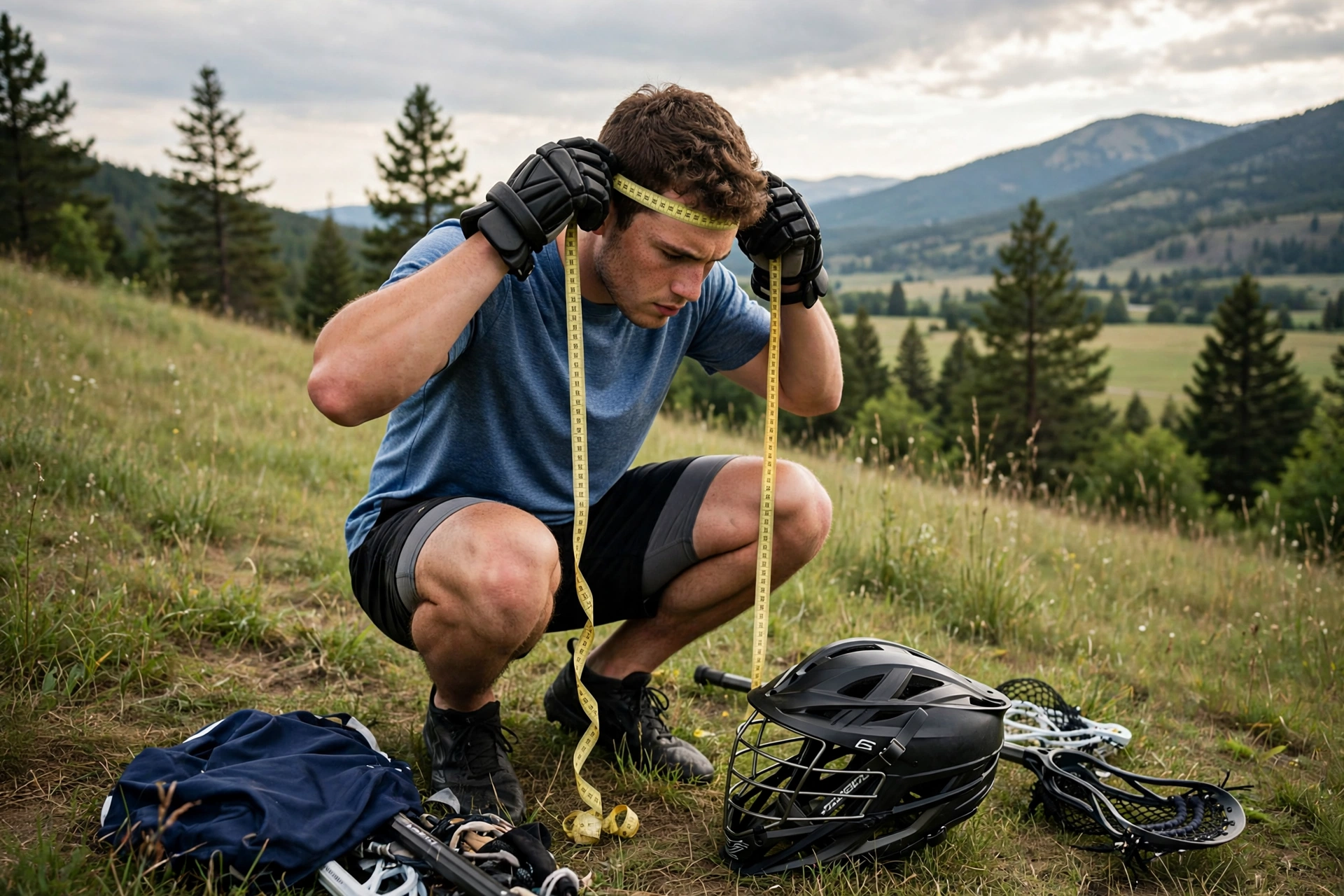
Start with a soft tape measure (or a piece of string you can measure afterward) wrapped around your head at the widest part — roughly an inch above your eyebrows and just above the tops of your ears, around the back of the skull. Keep the tape level and snug without compressing your hair flat, and take the measurement two or three times to be sure it is consistent.
Compare that number with the size chart for the specific model you are buying, because size labels are not identical between brands: one maker’s medium can cover a different range than another’s. If your measurement falls between two sizes, most manufacturers recommend the smaller size for lacrosse, since padding compresses slightly with use — but if the smaller size creates instant pressure points (covered below), go up instead. Players who wear their hair in braids or a bun should measure with their hair as it will be during games, since hairstyle genuinely changes the fit.
Write the measurement down before you shop. Guessing by hat size or by the size of a teammate’s helmet is the most common route to a poor fit, and for youth players, recheck the measurement every season — heads grow faster than helmets wear out.
How Do You Put the Helmet On and Set the Fit System?
Loosen the fit system and chin strap fully before your first fitting. Place the helmet on your head front first, so the front edge of the shell settles about an inch above your eyebrows, then pull it down evenly at the back. The helmet should feel level: the shell’s top ridge running straight front to back, not tipped toward one ear.
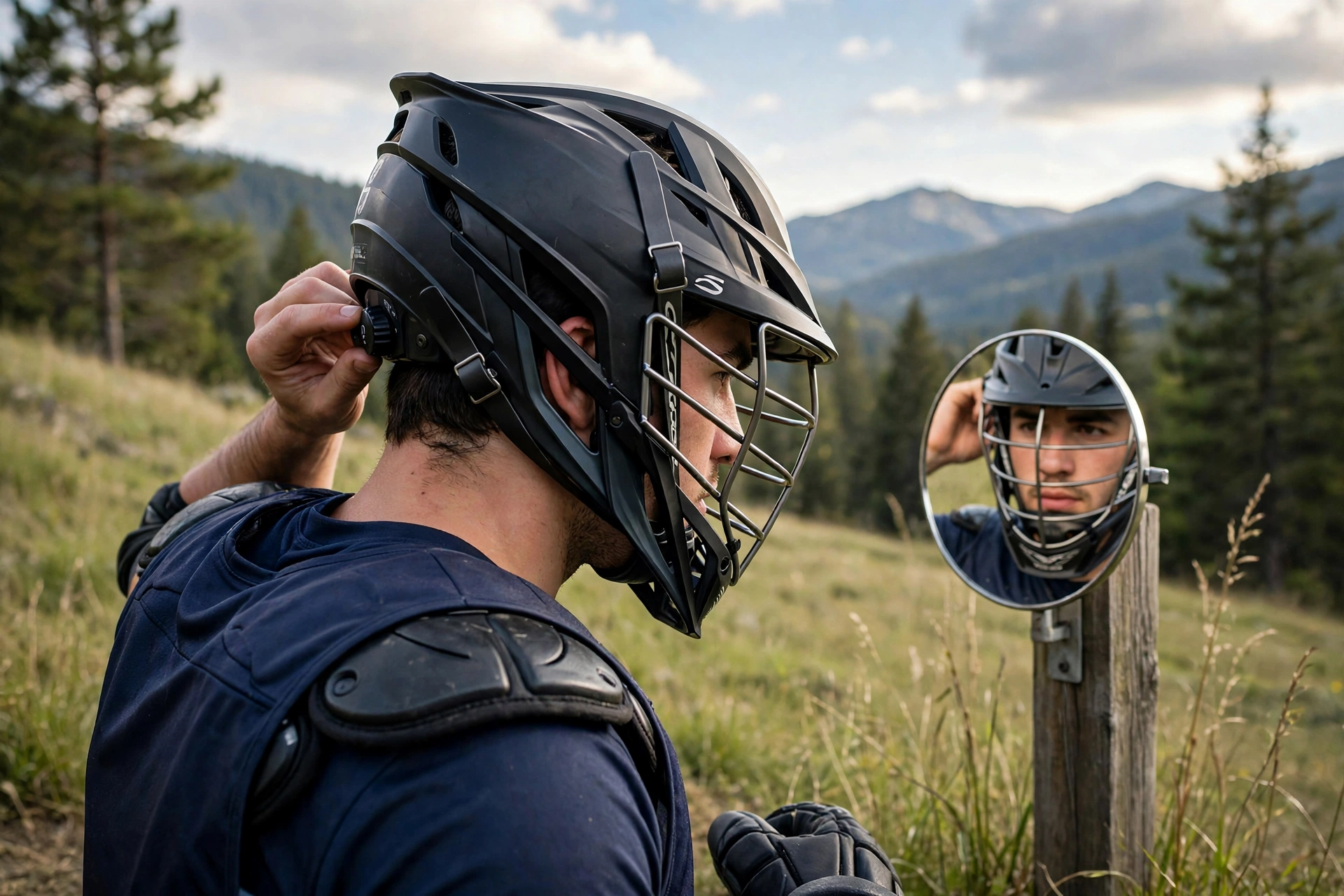
Most modern lacrosse helmets have an adjustable fit system — a dial or sliding mechanism at the back, internal adjustable pads, or both. Tighten the system gradually until the helmet grips the whole circumference of your head evenly. The hold should come from all around your head, not from squeezing your forehead and the back of your skull while the sides float free. If the model uses interchangeable pad thicknesses, swap pads to balance the fit rather than cranking the dial harder.
Padding design is a big part of how a helmet manages impact energy, and it helps to understand what is inside modern shells; our explainer on how MIPS works in helmets covers the rotational-protection ideas now used across several sports. Whatever system your helmet has, set it with the chin strap undone first, so you can judge the shell fit on its own merits.
How Do You Adjust the Chin Strap and Chin Cup?
The chin strap is what keeps the helmet in place during contact, so fit it after the shell. Center the chin cup on the point of your chin — not under your jaw and not riding up over your mouth — then buckle both sides. Adjust the strap lengths so the tension is equal left and right; uneven straps pull the whole helmet crooked and are a classic cause of a mask that will not align.
The strap should be snug: you should be able to open your mouth and talk, but the helmet should move with your jaw rather than sliding when you do. A good check is that you can fit roughly one finger between the strap and your chin. Too loose and the helmet can lift or shift in a collision; too tight and it will distract you and can work the buckles loose as you move.
If the helmet has a four-point strap system, adjust the front and back straps so the cup stays centered when you look down — the cup drifting forward as you drop your head into a face-off stance means the rear straps need shortening slightly.
How Do You Check the Mask Alignment and Vision?
With the helmet fitted, look straight ahead in a mirror. On cascade-style helmets and similar designs, your eyes should sit in the upper portion of the mask opening, and you should be looking through or just under the top bar of the cage rather than through the middle of the grid. Seeing through the top section gives you the downward peripheral vision you need to see the ball at your feet without dropping your head.
The mask should sit evenly: the same distance from your face on both sides, with the chin of the mask roughly level. If one side of the cage is noticeably closer to your cheek, the helmet is rotated — usually because the chin straps are uneven or the shell is a touch too big. The bottom of the mask should protect your chin and jaw without digging into your throat when you look down.
How Can You Tell the Fit Is Wrong?
Run three movement tests. Shake your head side to side, nod up and down, and then push the mask gently from the side and from below. A correct fit barely moves in any of these. A helmet that slides down over your eyes, lifts at the back, or rotates so the mask shifts is too big or badly adjusted, no matter how comfortable it feels standing still.
Learn to separate break-in feel from wrong-size signs. Mild, even snugness that eases after ten or fifteen minutes of wear is normal as padding settles. Sharp pressure on the forehead, a headache starting within minutes, red marks on one spot, or the opposite problem — needing the fit system at its absolute tightest with movement left over — all mean the size or shape is wrong for your head. Helmets do not stretch into a good fit, and a too-big helmet cannot be fixed with extra padding beyond what the manufacturer offers.
Frequently Asked Questions
Should a lacrosse helmet feel tight?
It should feel snug and even all around, without sharp pressure points or causing a headache. Mild snugness that settles during the first few wears is normal; pain or numbness means the size or shape is wrong.
Where should my eyes be in the mask?
In the upper part of the mask opening, looking through or just under the top bar. That position gives you the downward vision needed to see the ball while keeping the cage aligned for protection.
How often should youth players recheck fit?
At least every season. Measure the head again, run the shake and push tests, and confirm the chin cup still centers properly — growing players can move up a shell size faster than a helmet wears out.

Olivia
Writer at Helmet Today, covering helmet reviews, fit and riding safety.