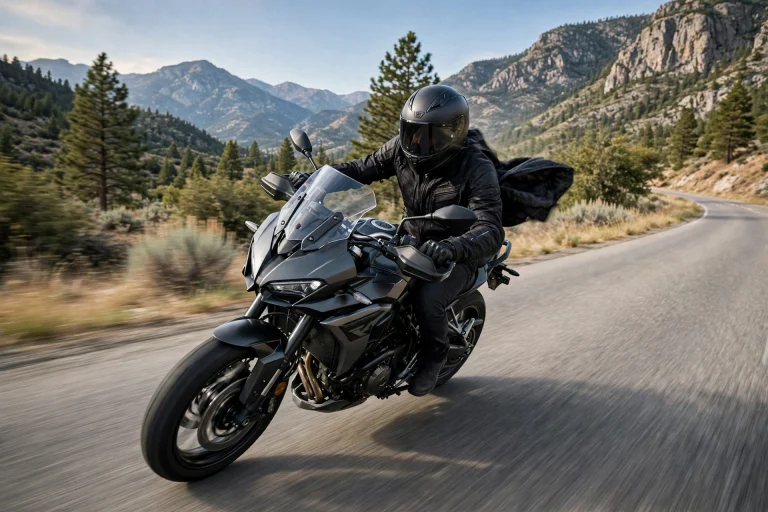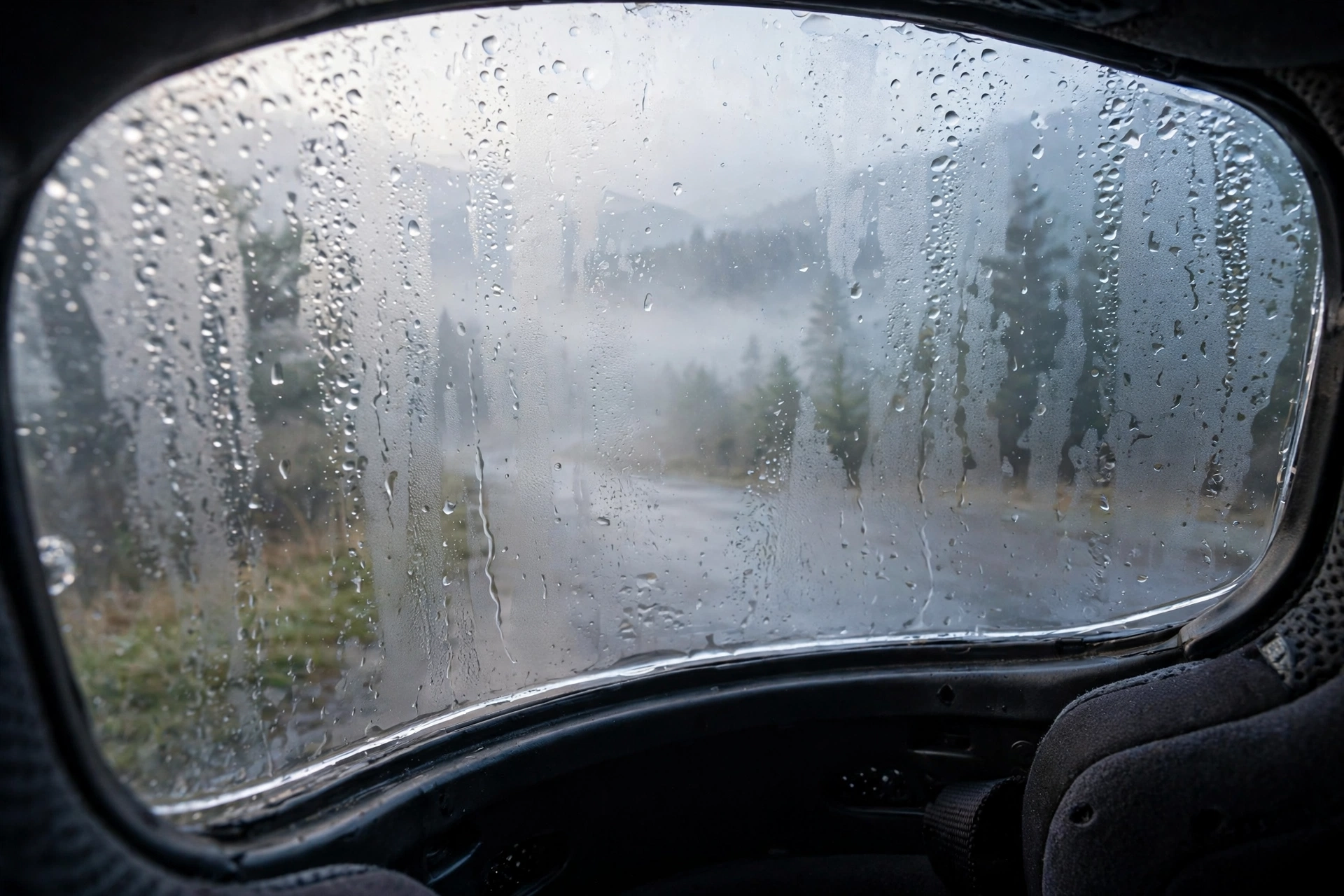
To stop a motorcycle helmet visor fogging up, fit a Pinlock insert if your visor supports one — it is the most effective fix by a wide margin. Combine it with a breath guard and chin curtain, open your vents, and crack the visor a fraction at low speed and at stops. Fogging happens when warm, moist air from your breath meets a cold visor, so every good solution either warms the visor surface, traps a layer of insulating air, or moves the moist air away before it condenses.
Why does a motorcycle helmet visor fog up?
The physics is simple. Your breath and the skin of your face release warm air loaded with moisture. The visor, cooled by outside air rushing past, is often the coldest surface inside the helmet. When that moist air touches the cold plastic, the water vapor in it condenses into thousands of tiny droplets — fog. It is worst in cold and wet weather, at low speeds where little air flows through the helmet, and when you stop at lights and your breathing fills a still helmet.
Understanding that, you can judge every anti-fog method by what it does. Some add an insulating layer so the inner surface stays warmer. Some deflect or exhaust your breath before it reaches the visor. Some treat the surface so moisture spreads into an invisible film instead of droplets. The best results come from stacking two or three approaches rather than expecting one product to do everything. Fit matters too: a helmet whose vents and sealing work as designed — part of what modern safety technology like MIPS in helmets is packaged alongside — gives you more tools to manage airflow.
Do Pinlock inserts really work?
Yes. A Pinlock is a separate inner lens that pins against the inside of your visor, creating a sealed pocket of air between the two layers — the same principle as double glazing in a window. The inner lens stays closer to the temperature inside the helmet, so your breath cannot easily condense on it. In practice, a correctly fitted Pinlock keeps the central field of view clear in conditions that would fog a plain visor in seconds.
Getting it right is about installation and care. The silicone seal around the insert must sit evenly against the visor with no gaps; if it fogs between the layers, remove it, let everything dry, and refit it, adjusting the eccentric pins if your system has them. Keep the insert clean with plain water and a soft cloth only — household cleaners and rough wiping damage its moisture-absorbing surface. Expect the insert to age: after a season or two of heavy use the coating absorbs less and the edges may lift, and a replacement insert restores full performance. If your visor has the pins, this is money well spent; if it does not, some makers sell Pinlock-ready replacement visors.
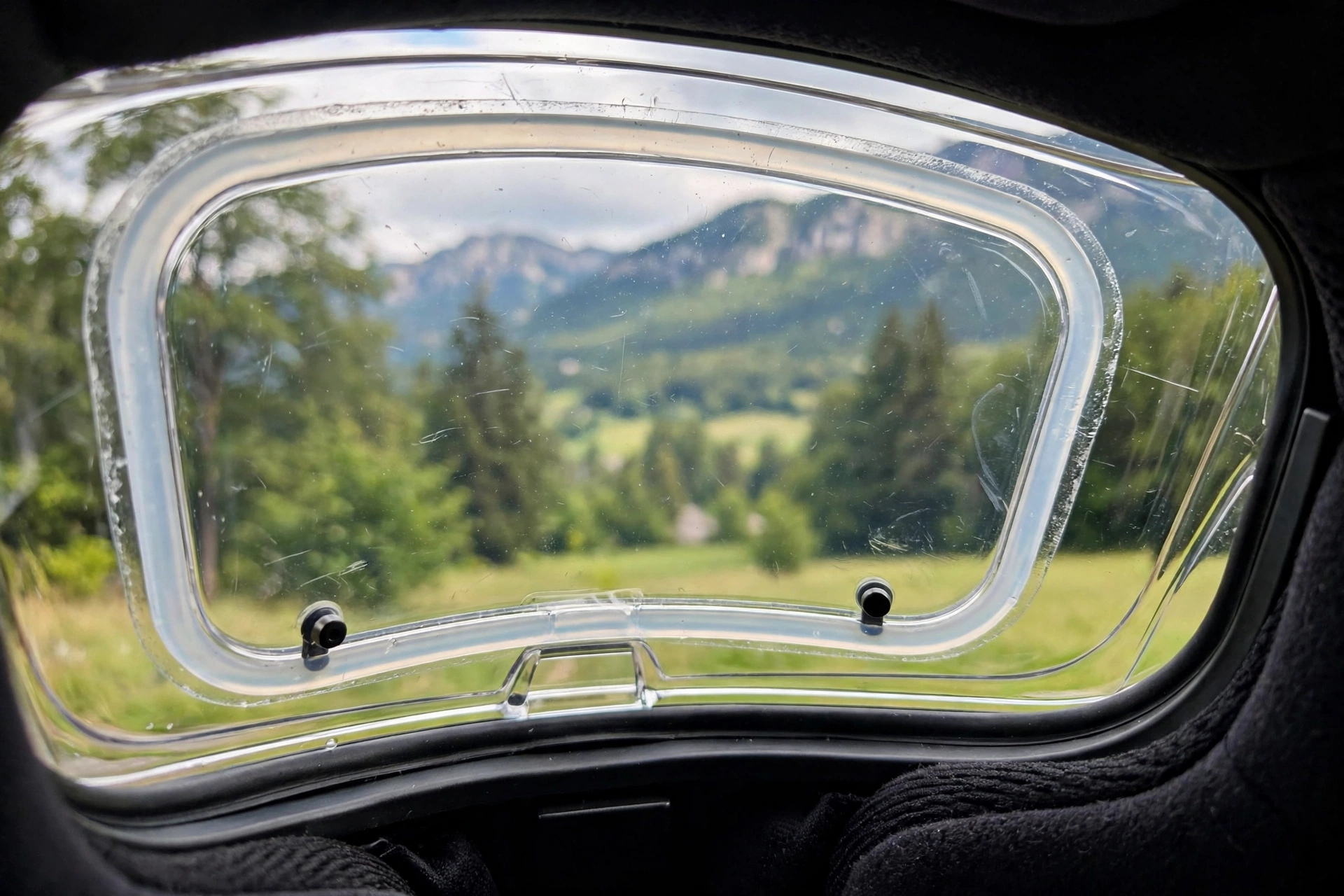
One honest limitation: Pinlock protects the area the insert covers. Fog can still creep in at the edges of your view or on a drop-down sun visor behind it, which is why the airflow steps below still matter.
How do breath guards and chin curtains help?
A breath guard is the shaped plastic and fabric piece that sits over your nose and cheeks inside the helmet. Its job is to deflect your exhaled breath downward, away from the visor. A chin curtain is the mesh or fabric panel under the chin bar that limits air swirling up from below. Together they reduce the amount of warm, moist air circulating around the visor area in the first place.
Many helmets include one or both in the box, and riders often leave them in a drawer without realizing what they are for. Fit the breath guard so it seals gently across the bridge of your nose without pressing uncomfortably, and install the chin curtain in cold weather. The trade-off appears in summer: a chin curtain also blocks some cooling airflow, so many riders remove it in hot months and refit it when temperatures drop. Riders who wear glasses may prefer to remove the breath guard if it pushes frames around — see the glasses notes below.
What vent and visor technique works best on the move?
Airflow is your free anti-fog system. Open the chin vent first — it is designed to direct air up the inside of the visor and carry moisture away. Then use the crown vents to keep air moving through the helmet so humid air is exhausted rather than sitting still. In very cold weather this feels like a compromise between warmth and vision, but a little moving air prevents the sudden white-out that forces you to open the visor completely at speed, which is far colder and less safe.
At stops and in slow traffic, crack the visor to its first detent — most visors have a city position that opens a small gap at the bottom. That gap vents your breath before it condenses and usually clears light fog in seconds once you move off. Make it a habit: crack the visor as you slow for lights, close it as you accelerate. If your visor has no small-gap position, opening it fully for a few seconds at a standstill achieves the same reset. Never ride on with a fogged visor hoping it will clear — pull over somewhere safe and sort it out.
What about anti-fog sprays, coatings, and glasses?
Anti-fog sprays and wipes treat the surface so condensation spreads into a thin, transparent film instead of droplets. They genuinely help, but they are the weakest and shortest-lived of the main options: expect a ride to a few days per application, not weeks, and reapply to a clean, dry visor. Take care with coatings: only use products stated to be safe for your visor and any factory anti-fog or anti-scratch coating, apply with a soft microfiber, and never use household glass cleaner, solvents, or abrasive cloths, which can cloud the plastic.
Glasses wearers have it hardest, because lenses fog from the same breath and sit beyond the reach of a Pinlock. The most reliable fixes are airflow and breath control: chin vent open, breath guard adjusted or removed depending on which fogs less for you, visor cracked at stops. Breathe out downward through your mouth at standstill rather than up through your nose. Anti-fog treatments made for eyewear help on lenses too, and contact lenses — if you can wear them — remove the problem entirely. Some riders also leave a slightly larger gap by using the visor’s first detent permanently in winter; experiment in safe conditions to find what keeps both lenses and visor clear for your helmet.
Frequently Asked Questions
What is the single best way to stop visor fogging?
A properly fitted Pinlock insert. It solves most fogging on its own, and combined with open vents it covers nearly all conditions.
Why does my Pinlock fog between the layers?
The seal is not sitting evenly, or moisture got trapped during fitting. Remove it, let both surfaces dry completely, refit carefully, and replace the insert if the edge seal is worn.
Is it safe to ride with the visor cracked open?
Using the small first-detent gap at low speed is a designed feature and is fine. At higher speeds close it — a fully open visor offers no eye protection and can catch wind dangerously.

Olivia
Writer at Helmet Today, covering helmet reviews, fit and riding safety.