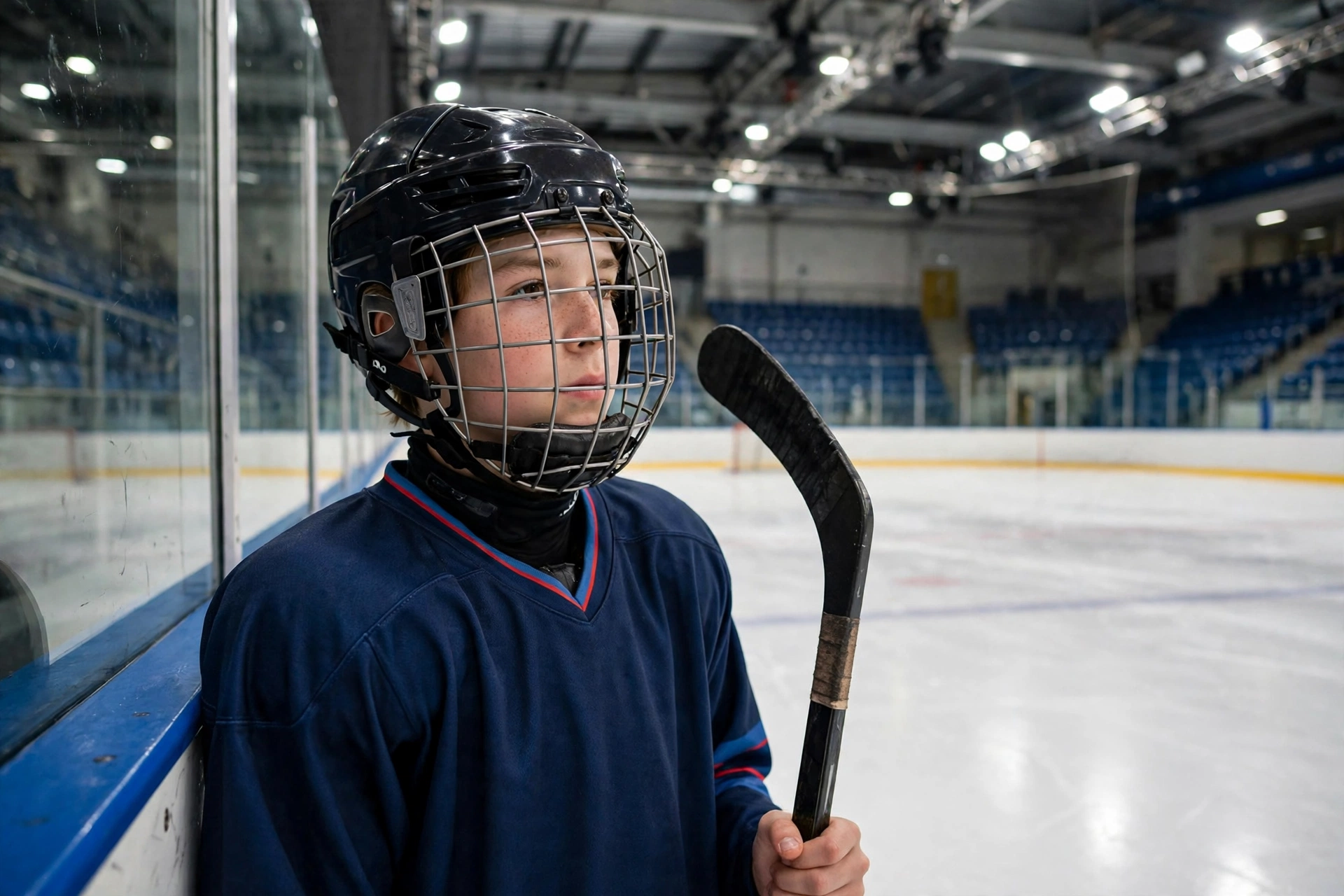
A kids hockey helmet fits correctly when it sits level about a finger’s width above the eyebrows, feels snug all around without painful pressure, and the cage hangs so the chin cup cradles your child’s chin — with the helmet carrying a current HECC or CSA certification sticker. Run through those four checks — position, snugness, cage, certification — at the start of every season and after any growth spurt, because a hockey helmet only protects when it is actually in position.
Hockey helmets look complicated compared with a bike helmet: expansion systems, ear loops, a cage, a chin cup, and stickers with dates. But the fit check itself is simple once you know what to look at. This guide goes through it in order, from the certification sticker to the mistakes that slip past almost everyone.
What Certification Should a Kids Hockey Helmet Have?
In general terms, the marks to look for on a hockey helmet sold in North America are HECC (Hockey Equipment Certification Council) and CSA (Canadian Standards Association). A certified helmet carries a sticker showing its certification and, importantly, an expiry date printed on the sticker — in general terms, HECC certification is valid for a set number of years from manufacture.
An expired sticker means the helmet is no longer certified, whatever condition it appears to be in. That matters beyond paperwork: many leagues and rinks require players to wear certified, unexpired helmets, and officials can and do check stickers. It also matters practically, because helmet foams and plastics age — an old helmet that has passed its certification window is not the protective device it was.
Buy new if you possibly can, sized for your child’s head now rather than to grow into. If you are considering a hand-me-down or used helmet, check the certification sticker and its date, inspect for cracks, missing screws, and compressed foam, and walk away from anything with an unknown crash history. The cage should be certified for hockey use too, and sized for the helmet it is mounted on.
How Should the Helmet Sit on Your Child’s Head?
Start with position. The helmet should sit level, with the front edge low on the forehead — roughly a finger’s width (about an inch, in general terms) above the eyebrows. If it is pushed back like a baseball cap, the forehead is exposed; if it slides down over the eyes, it is too big or adjusted too long.
Most hockey helmets adjust in length by loosening screws or clips and sliding the front and back pieces, then snugging down. Set the length so the helmet feels snug all the way around — firm contact at the front, back, and sides — without needing the chin strap to hold it in place. Snug means even pressure, like a close-fitting winter hat. Pain, a squeezing headache feeling, or a red line across the forehead after a few minutes means too small, too short, or the wrong shape.
Then the movement tests. With the chin strap still open, your child should shake and nod their head: the helmet should move with the head, not lag or slide. If it rocks forward and back, adjust the length smaller or try a different model. The cage and strap checks below only fine-tune a fit that already works at this stage.
How Do You Check the Cage and Chin Cup Fit?
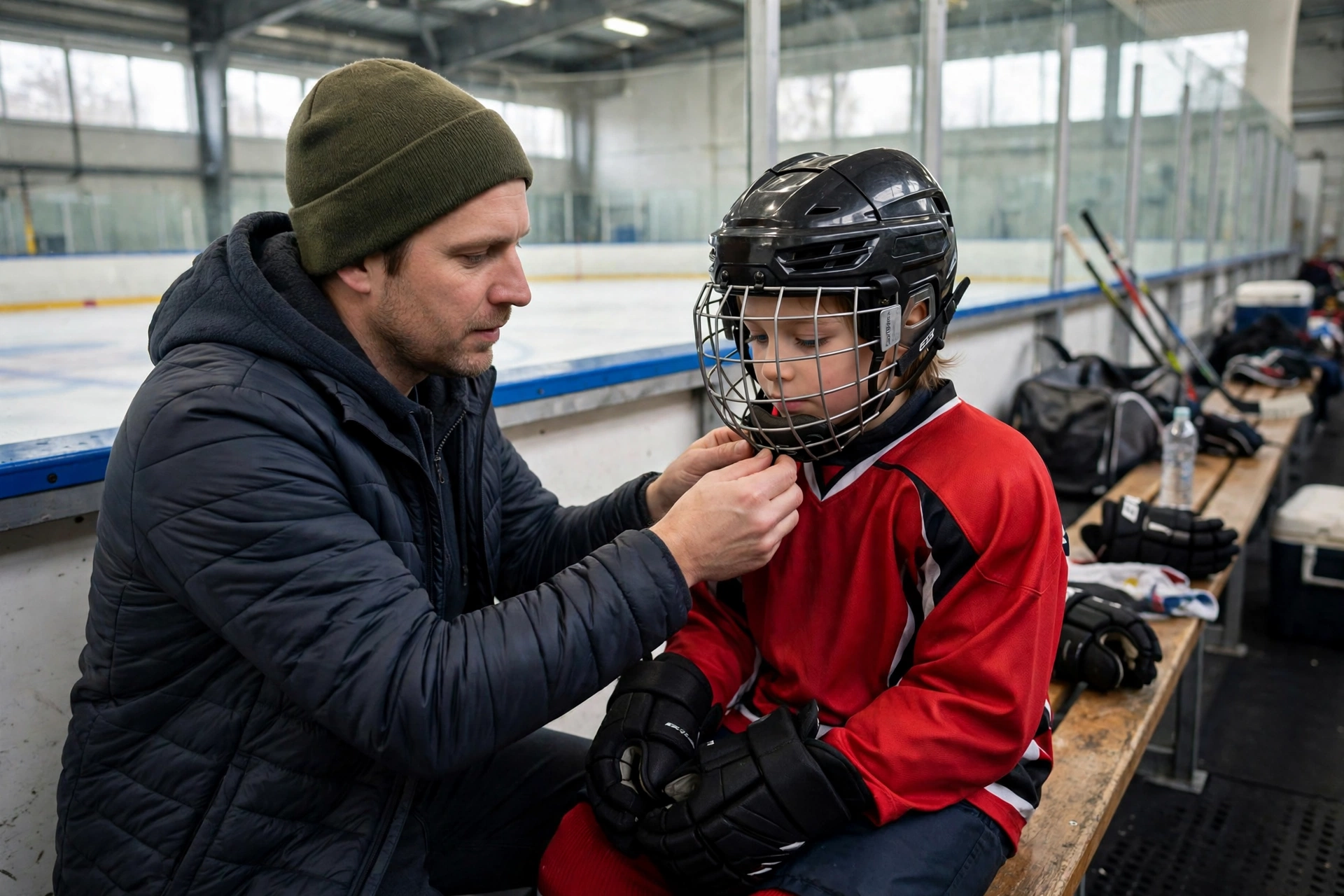
The cage is fitted correctly when its chin cup cradles your child’s chin — resting against it or very close — while the cage itself hangs from the helmet without pressing into the cheeks or forehead. The chin cup, not the chin strap alone, is what keeps the cage positioned so it can do its job in a collision or a fall.
To check: fasten everything exactly as your child will play. The chin should sit in the cup, the cage should not be able to swing up and away from the face easily, and there should be no gap big enough for the cup to slip off the chin if the cage gets pushed. The ear loops should cover the ears fully, sitting flat without folding them.
Also confirm the cage size matches the helmet size. Cages are sold in sizes meant to pair with helmet sizes, and a mismatched cage can hang too low, leaving the chin below the cup, or too high, jamming the cup into the throat. If your child complains the cup digs in or the cage rattles against the helmet, that pairing or the mounting clips are the first suspects — have the shop adjust or swap instead of settling for close enough.
What Are the Most Common Fit Mistakes Parents Miss?
Buying to grow into is the classic. A hockey helmet that will fit “next year too” shifts on this year’s head, and shifting is exactly what a helmet must not do. Nearly as common: skipping the fit re-check. Kids grow fast, and the helmet that fit in September can be outgrown by February. Put a mid-season check on the calendar.
Another missed item is hardware. Screws loosen over a season; a cage clip or ear loop screw that backs out changes the fit and safety. Run a fingertip check over the screws and clips monthly, tighten or replace as the manufacturer directs, and never tape over a broken mounting point as a fix.
Parents also overlook what goes under the helmet. Long hair worn up in a bun or ponytail under a hockey helmet lifts it and changes its position — hair should be worn low and flat. As for the technology inside helmets, newer models increasingly borrow ideas from cycling, such as the rotational liner concept covered in our guide to what MIPS is and how it works. Whatever the liner system, no technology compensates for a helmet that is the wrong size.
When Should a Hockey Helmet Be Replaced or Resized?
Replace the helmet when its certification expires — check the date on the HECC or CSA sticker — or when it has taken a major impact, is cracked, has loose or damaged foam, or has missing hardware you cannot properly replace. Foam that has been crushed in one hard hit has spent its protection, even if the shell looks fine.
Resize whenever your child outgrows the fit: the helmet no longer feels snug at its smallest adjustment, the chin no longer reaches the cup, or the front edge cannot sit at the right height without sliding. Head growth is gradual, so build the fit check into your season routine — first practice, mid-season, and before playoffs.
When in doubt at any point in this checklist, take the helmet to a hockey shop and ask for a fitting. A proper fit check takes minutes, and it is the difference between a helmet that decorates your child’s head and one that genuinely protects it.
Frequently Asked Questions
Q: Can my child use a hockey helmet with an expired certification sticker?
A: It should be replaced. In general terms, HECC certification carries an expiry date printed on the sticker, and an expired helmet is no longer certified — many leagues will not allow it, and its materials have aged past the window the certification covers.
Q: Should a hockey helmet feel a little painful at first so it lasts longer?
A: No. A new helmet should feel snug and even, never painful. Foam may settle slightly with wear, but pressure points and headaches are signs of the wrong size or shape, not a good investment in future fit.
Q: Is a used hockey helmet a safe way to save money?
A: It is risky. Check the certification sticker and expiry date, inspect for cracks, dried or compressed foam, and loose hardware, and avoid any helmet with an unknown history. In general terms, a new, certified helmet in the correct size is the safer choice and the one leagues expect.

Olivia
Writer at Helmet Today, covering helmet reviews, fit and riding safety.