

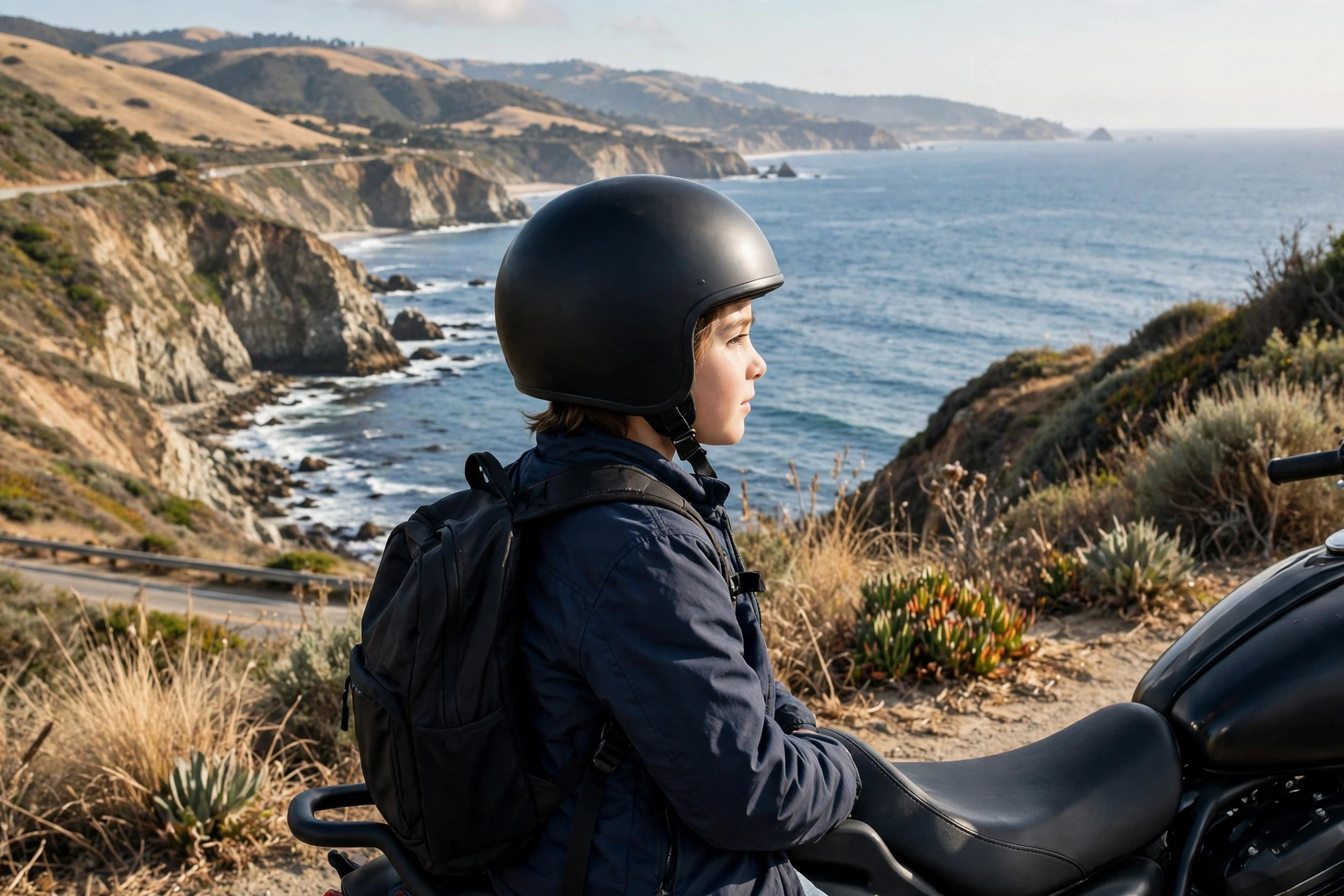
California has no minimum age for motorcycle passengers. State law does not set any age — not 5, not 8, not 12 — that a child must reach before riding on the back of a motorcycle. Instead of an age limit, California uses practical legal tests: the passenger must ride on a proper passenger seat, must be able to keep both feet on the passenger footrests at all times, and must wear a DOT-approved helmet, because California’s universal helmet law covers every passenger at every age.
That surprises many parents, because several other states do set a minimum passenger age. In California, the question is not “how old is the child?” but “can the child ride safely and legally on this particular motorcycle?” Below, we explain the rules that actually apply, and how to judge whether a child is genuinely ready.
Is There Really No Minimum Passenger Age in California?
Correct. Unlike states that ban passengers below a certain age, California law contains no minimum-age rule for motorcycle passengers. There is no statute that says a passenger must be 5, 8, 10, or any other age. A child who can meet the equipment and seating requirements can legally ride as a passenger, and a child who cannot meet them cannot ride — whatever their birthday says.
This is a deliberate difference in approach. Rather than picking an age, California ties legality to the physical fit between the passenger and the motorcycle. For a full picture of how rules differ from state to state, see our guide to helmet laws by state.
What Does California Law Require for a Motorcycle Passenger?
Three requirements do the real work. First, the motorcycle must be equipped to carry a passenger: a proper seat designed for a passenger and a set of passenger footrests. A child may not ride on the fuel tank, on the driver’s lap, or perched on a solo seat.
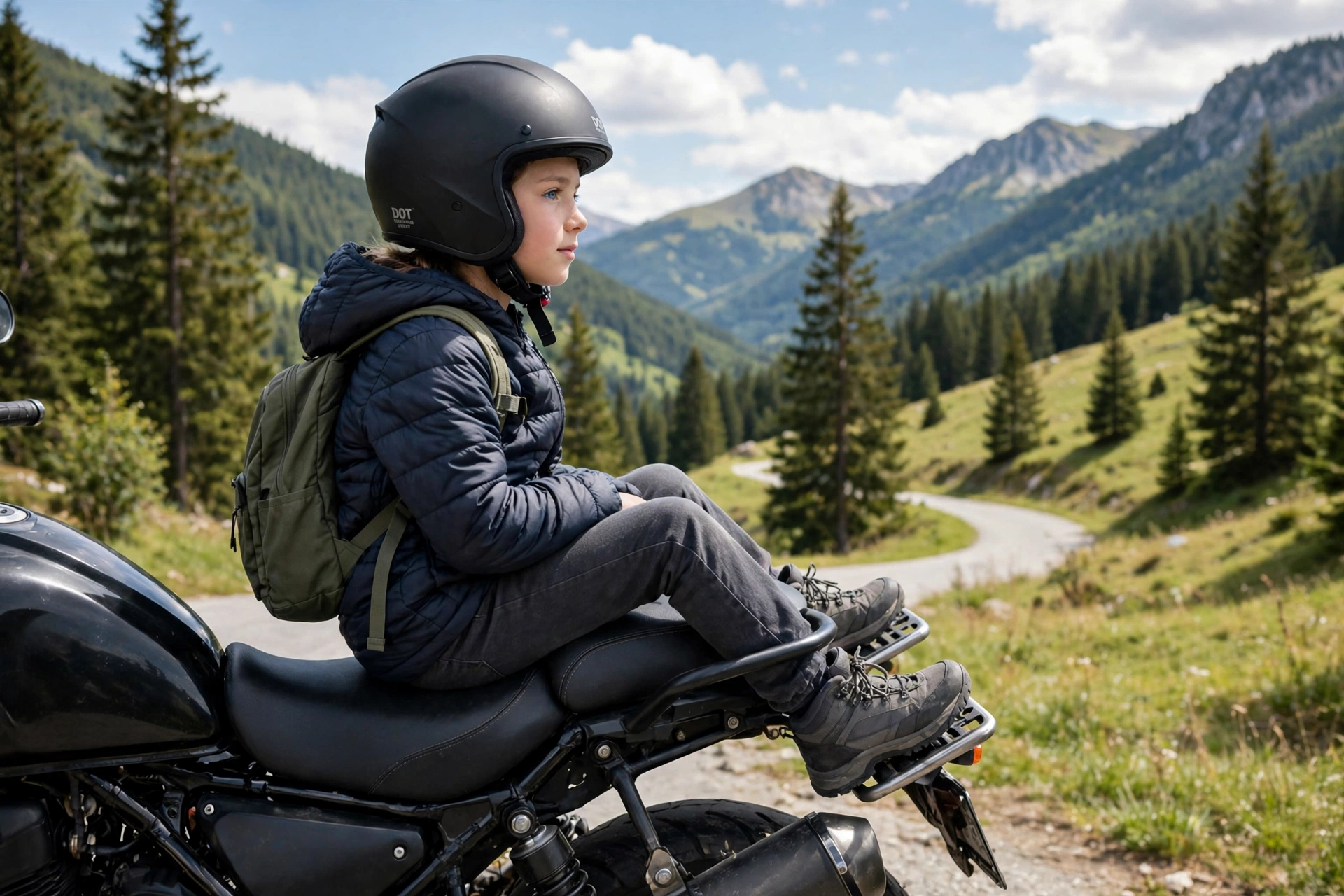
Second, the passenger must keep both feet on the footrests while the motorcycle is moving. This is the rule that effectively sets a size minimum. If a child’s legs are too short to reach and rest securely on the passenger pegs, the child cannot legally ride on that bike — even with a helmet on, even for a short trip. On some motorcycles the pegs sit high, so a child who fits one bike may not fit another.
Third, every passenger must wear a properly fitting, DOT-approved motorcycle helmet. California has a universal helmet law: it applies to operators and passengers of all ages, with no under-21 or adult exceptions of the kind found in partial-law states.
Does the Child Need Their Own Helmet, or Can They Share an Adult One?
The child needs a helmet that actually fits the child’s head. California’s helmet law requires a compliant helmet, and a loose adult helmet on a small head is not meaningful protection — in a crash it can shift, block vision, or come off entirely. Youth and child sizes exist for exactly this reason.
A correct fit means the helmet sits level, is snug all around without painful pressure, and does not rock when the child shakes their head. The chin strap should be fastened snugly every ride. If you are borrowing gear, check the helmet’s labels and condition: no cracks, no crushed foam, no crash history. Never buy a used helmet for a child passenger, because hidden damage is impossible to rule out.
What Should Parents Check Before Taking a Child as a Passenger?
Beyond the legal minimums, experienced riders use a simple readiness checklist:
- Feet: Can the child place both feet flat and secure on the passenger footrests, and keep them there?
- Reach and grip: Can the child hold on steadily — to the rider’s waist or the grab handles — for the whole ride?
- Attention: Can the child follow instructions, sit still, and not lean the wrong way in corners?
- Endurance: Can the child stay alert? A sleepy passenger is a serious hazard.
- Gear: Helmet aside, closed footwear, long pants, and a jacket reduce injury in even a minor slide.
Start with short, slow rides on quiet streets. Build up gradually, agree on simple signals (such as a tap meaning “slow down” or “stop”), and check in often. If the child cannot keep feet planted or grip secure, wait — growing a few inches matters more than any birthday.
How Does California Compare With Other States on Passenger Age?
California’s no-minimum-age approach is in the minority. A number of states set a hard floor — commonly somewhere between 5 and 8 years old — below which a child may not ride as a passenger at all, whatever safety gear they wear. Others copy California’s logic and rely on seat and footrest requirements instead.
This matters for family trips. A child who rides legally with you in California may be too young to ride as a passenger the moment you cross into a state with an age floor, and rules for helmets and seating change at the same border. If your route leaves California, check each state’s passenger rules before you set off, not at the state line.
Can a Child Ride in a Sidecar or on Any Motorcycle in California?
Sidecars change the seating picture: a passenger in a sidecar sits in the sidecar’s seat rather than on the motorcycle, and helmet law still applies to them in California. The footrest test is aimed at passengers on the motorcycle itself, but the helmet requirement is universal.
For two-wheelers, the practical limits still come down to the seat and the pegs. Small motorcycles with low or forward pegs may suit a smaller child; tall adventure bikes often leave a young passenger’s feet dangling well short of the pegs, which makes the ride both illegal and unsafe. Judge each motorcycle-child pairing on its own.
Frequently Asked Questions
What is the minimum age for a motorcycle passenger in California?
There is none. California sets no minimum passenger age. Instead, the passenger must sit on a proper passenger seat, keep both feet on the footrests at all times, and wear a DOT-approved helmet.
My child is 6. Can they legally ride with me in California?
Possibly — age alone does not decide it. If your 6-year-old can reach and keep both feet on the passenger footrests, sit on the passenger seat, and wear a properly fitting DOT helmet, state law allows it. If their feet cannot reach the pegs, they cannot ride on that motorcycle.
Do child passengers in California have to wear a helmet?
Yes. California’s universal helmet law applies to all operators and passengers of every age. The helmet must be DOT-approved and fit the child’s head properly — an oversized adult helmet is not a safe substitute.

Olivia
Writer at Helmet Today, covering helmet reviews, fit and riding safety.


