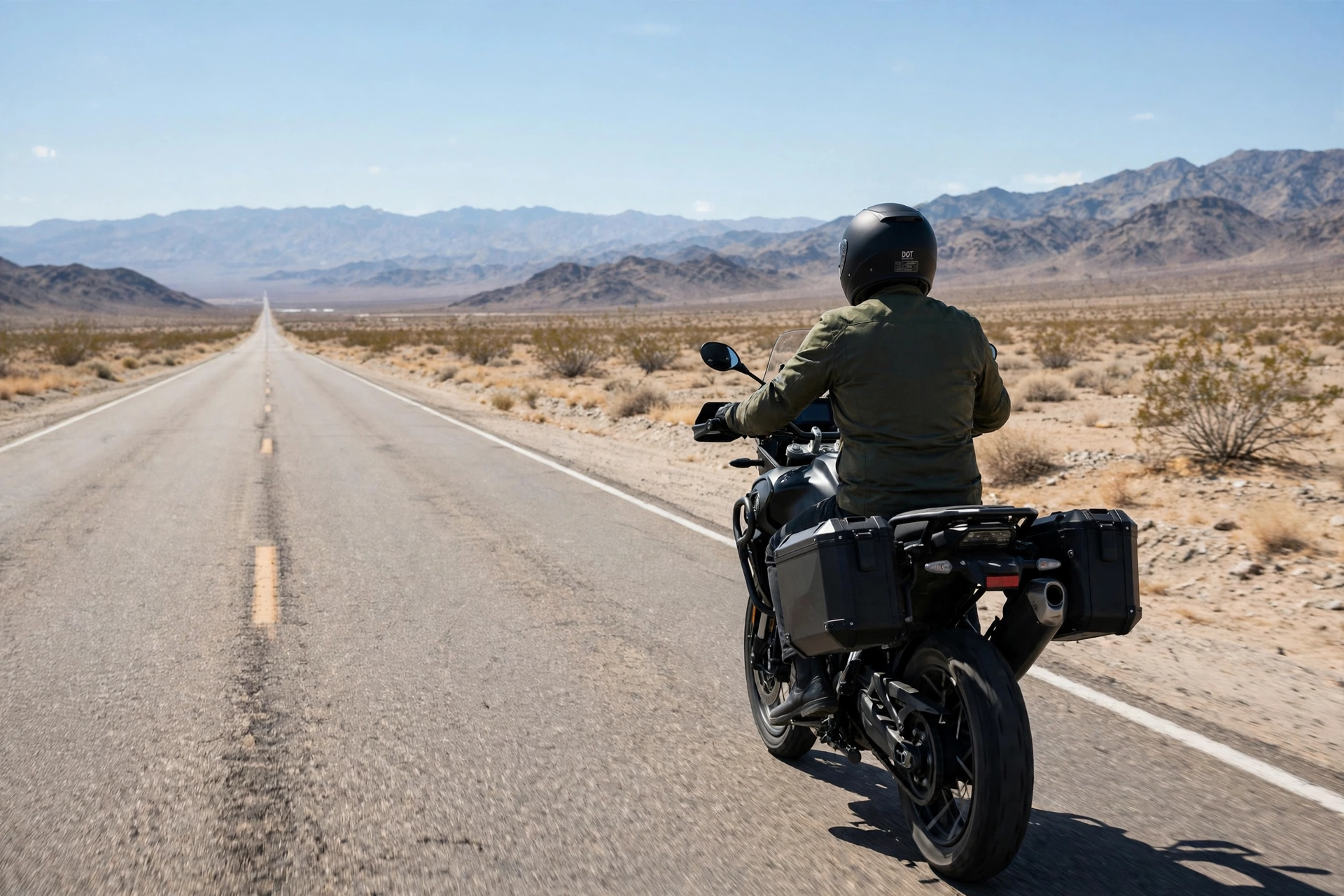
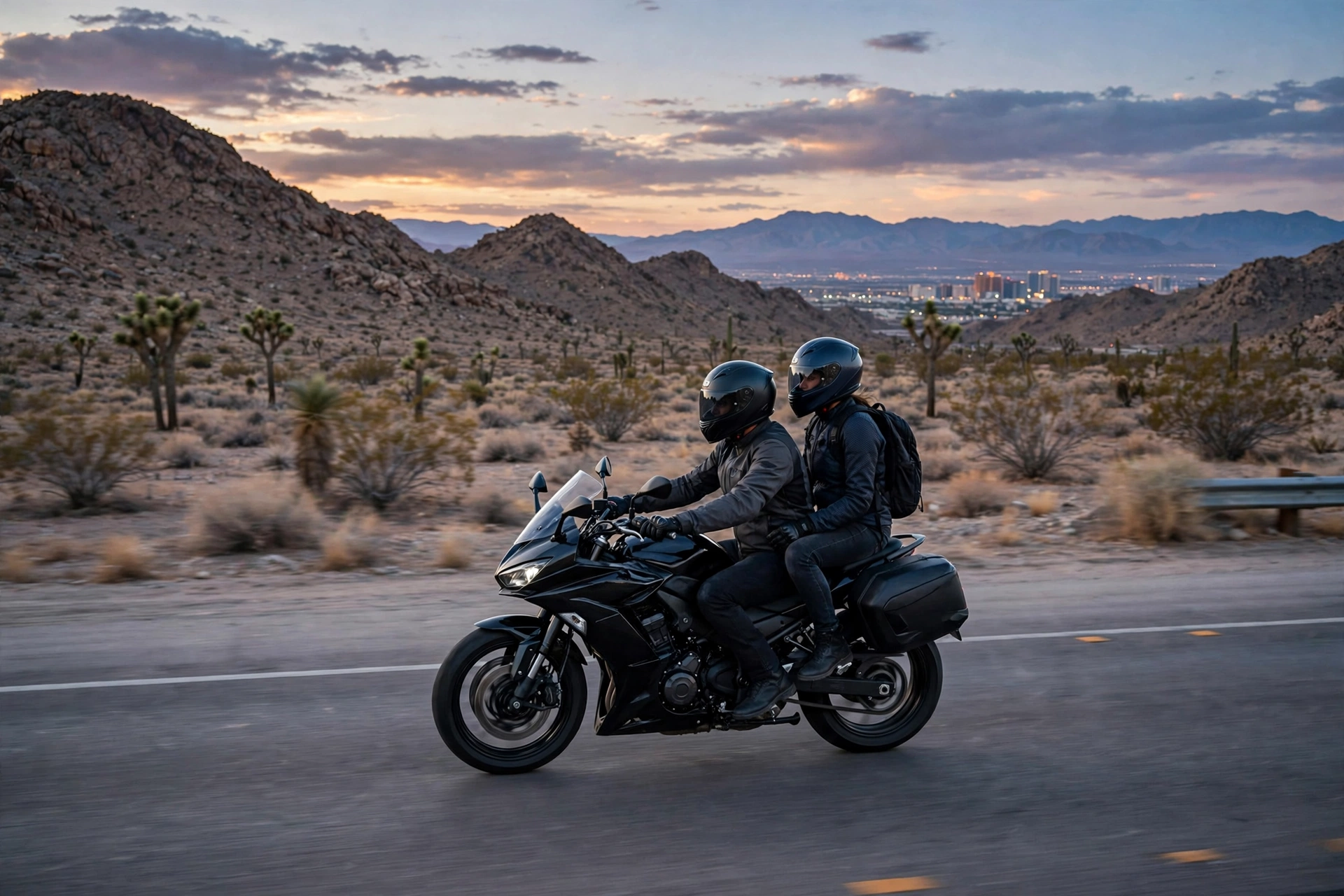
In Nevada, every motorcycle rider and every passenger must wear a DOT-approved helmet — no exceptions based on age. Nevada has a universal helmet law, so adults are covered by the same rule as teenagers.
If you are used to riding in a state where adults can choose, Nevada is different. Crossing the state line into Nevada means the helmet goes on, however short your ride will be.
Does Nevada Require Helmets for All Motorcycle Riders?
Yes. Nevada’s helmet law is universal: anyone operating or riding on a motorcycle must wear protective headgear that meets federal safety standards. There is no exemption for riders over 18 or over 21, no exemption based on experience, and no exemption based on carrying extra insurance.
The rule applies on every public road in the state, from the Las Vegas Strip to the loneliest stretch of desert highway. It also applies to passengers of any age — if someone is on your motorcycle in Nevada, they need a helmet too.
Nevada also requires eye protection, such as a face shield, goggles, or glasses, unless the motorcycle is equipped with a windshield. Many riders simply use a helmet with a built-in shield and satisfy both rules at once.
What Kind of Helmet Is Legal in Nevada?
Your helmet must meet the U.S. Department of Transportation standard, commonly shown by the DOT symbol on the rear of the shell. Compliant helmets have a thick impact-absorbing liner, strong construction, and a secure chin strap.
Novelty helmets are the most common problem. Thin “beanie” or “skull cap” style helmets without real energy-absorbing foam generally do not meet the federal standard, and wearing one can still get you cited in Nevada because it does not count as an approved helmet.
The helmet must also be properly fastened. Riding with the strap undone, or with the helmet perched rather than fitted, can be treated the same as not wearing one. Choose a helmet that fits snugly, does not roll off when you shake your head, and feels comfortable enough for Nevada’s long, hot rides — good ventilation matters in this state.
Are There Any Exceptions to the Nevada Helmet Law?
The exceptions are narrow. The helmet requirement is written around motorcycles used on public highways, so fully enclosed vehicles and certain off-road situations can fall outside it, and participants in an authorized parade traveling at low speed under permit have historically been treated differently.
For ordinary road riding, though, you should assume there is no exception that applies to you. Three-wheeled motorcycles ridden on public roads are generally treated under the same protective-gear expectations, and moped riders in Nevada are also required to wear helmets.
If you ride in from a neighboring state, be aware that Nevada’s universal rule is stricter than Arizona’s under-18 rule and different from states with partial laws. Our overview of helmet laws by state makes it easy to check the rules before a multi-state trip.
What Happens If You Ride Without a Helmet in Nevada?
Riding without an approved helmet in Nevada is a traffic offense, and you can be stopped and cited for it alone. The fine amount is not one fixed statewide figure for every situation — fines vary by court, and additional court fees can apply on top.
Beyond the ticket, riding unhelmeted can complicate an insurance claim after a crash. Insurers and opposing lawyers may argue that your injuries were worse because you were breaking the helmet law, which can affect how a claim is handled.
For visitors, there is another practical point: a Nevada citation does not disappear when you go home. Like most traffic tickets, it must be paid or contested by the date on the citation, or it can escalate.
How Should You Choose a Helmet for Riding in Nevada?
Start with fit and certification: a DOT-approved helmet that fits your head shape, snug without pressure points. Then think about Nevada conditions. Summer temperatures regularly pass 100°F in the south of the state, so strong vents and a light-colored shell help. A drop-down sun visor or a tinted shield is useful in the desert glare, paired with a clear shield for night riding.
If you carry passengers, keep a spare DOT-approved helmet in reasonable sizes rather than handing them an old, loose, or damaged one — the law requires the passenger to be helmeted, and the helmet only works if it fits.
Nevada’s rule is simple, and so is complying with it: approved helmet, strap fastened, every ride, every person on the bike.
One more Nevada-specific tip: if you ride in the cooler north or at elevation around Reno and Lake Tahoe, your summer setup may not be enough. A helmet with a removable thermal liner, or room for a thin balaclava underneath without changing the fit, keeps the same legal helmet comfortable across the state’s big temperature swings. Whatever the season or the region, the compliance checklist never changes — if the helmet is DOT-approved, fitted, and fastened, you are legal anywhere in Nevada.
Does Nevada’s Helmet Law Apply to Trikes, Mopeds, and Scooters?
Nevada’s protective-gear rules reach beyond full-size motorcycles. Moped riders are required to wear helmets in Nevada, and riders of three-wheeled motorcycles on public roads should expect the same universal requirement to apply to them when the vehicle is operated like a motorcycle.
Fully enclosed three-wheelers and vehicles with car-style controls can fall into different legal categories, and low-speed neighborhood vehicles have their own rules. The safe approach is simple: if it is registered as a motorcycle or moped and you ride it on public roads, wear a DOT-approved helmet.
Electric scooters and similar small machines are a gray area that depends on how the vehicle is classified and where it is ridden. Riders are never wrong to wear a helmet on them, and in a state with Nevada’s universal approach, assuming the helmet rule applies is the prudent default.
The same universal mindset applies to visitors renting motorcycles in Las Vegas for day trips to places like Red Rock Canyon or the Valley of Fire: rental companies will supply helmets because Nevada law requires every rider and passenger to wear one, with no age-based escape hatch.
Frequently Asked Questions
Is Nevada a universal helmet law state?
Yes. Nevada requires all motorcycle riders and passengers to wear a DOT-approved helmet, regardless of age, experience, or insurance coverage.
Can adults ride without a helmet in Nevada?
No. Unlike age-based states, Nevada gives adults no exemption. Every person on a motorcycle on a public road must wear an approved helmet.
Do motorcycle passengers need a helmet in Nevada?
Yes. Passengers of any age must wear a DOT-approved helmet, properly fastened, just like the operator.

Olivia
Writer at Helmet Today, covering helmet reviews, fit and riding safety.