RHEON in a helmet is a smart, energy-absorbing material developed by the company RHEON Labs that is used inside helmet liners and pads to manage both direct and rotational impact forces. The material is described as a non-Newtonian substance, which means it behaves differently depending on how hard it is hit: it stays soft and flexible during normal wear, but stiffens in the instant of an impact to absorb energy. In general terms, it is a reactive material that is soft when you need comfort and firm when you need protection.
RHEON has been adopted by a number of helmet makers, including in cycling, snow sports and motorcycle helmets, where it is often used as a liner insert or as part of a rotational-impact system. It is sometimes found on its own and sometimes combined with other technologies. This guide explains what RHEON is in general terms, how the material works, where it is used in helmets, and what to consider if you are looking at a helmet that contains it.
How Does RHEON Work?
The key to RHEON is that it is a non-Newtonian material, which is a technical term for a substance whose behaviour changes with the force applied to it. At rest, or under gentle pressure, RHEON is soft and pliable, so it moulds to the shape of the head and feels comfortable. When it is struck hard and suddenly, the material stiffens and resists the impact, absorbing energy as it deforms. Once the force passes, it returns to its soft state.
A useful comparison is the familiar mixture of cornflour and water, which pours like a liquid when stirred gently but feels solid when struck sharply. RHEON works on a similar principle, though it is a manufactured material designed specifically for impact protection rather than a kitchen experiment. The stiffening happens in a fraction of a second, which is fast enough to matter in a crash.
Where Is RHEON Used in a Helmet?
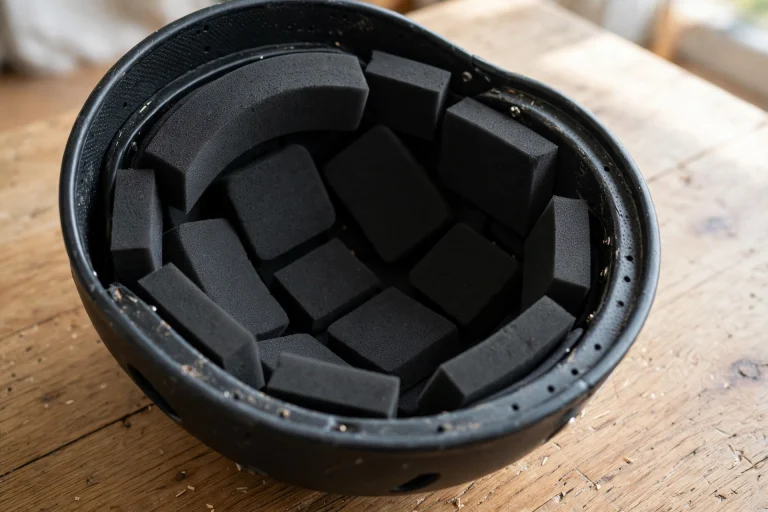
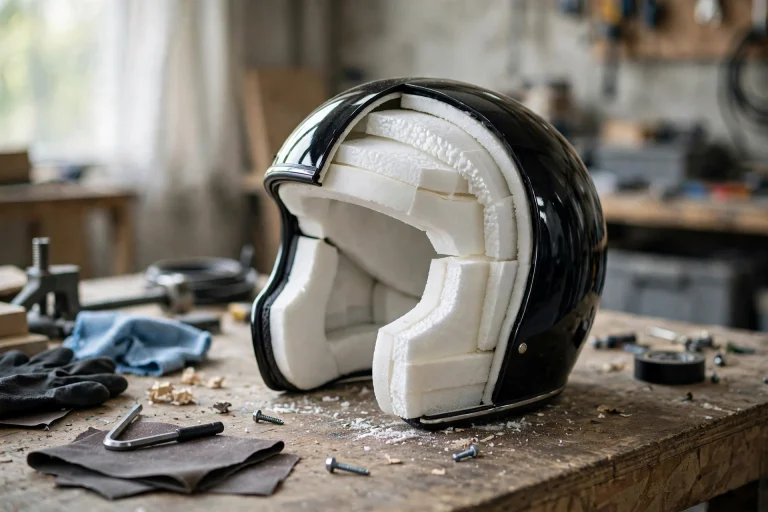
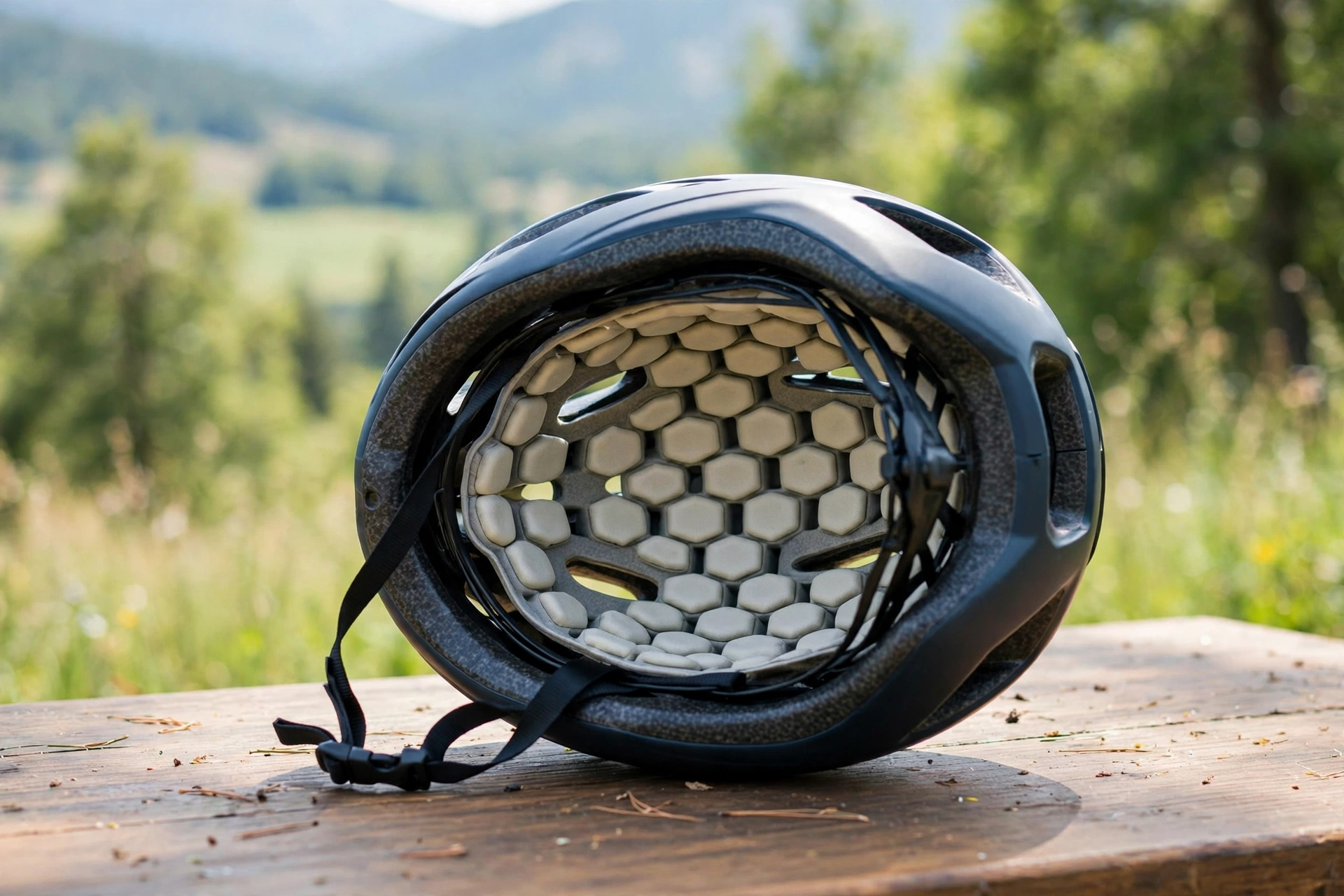
RHEON is most commonly used as a liner material, either as pads inside the comfort padding or as a layer within the impact liner itself. In some helmets it appears as a set of small cells arranged across the crown and sides of the head, while in others it forms a continuous layer. The exact arrangement depends on the helmet maker and the model, and the product description should say how it is used.
The material is also used in systems designed to manage rotational forces. In some helmets, RHEON cells are placed so that they can shear or slide slightly during an angled impact, absorbing some of the twisting force as well as the direct force. This dual role — handling both the straight-line and the rotational parts of an impact — is one of the reasons helmet makers are interested in it.

How Is RHEON Different from MIPS?
RHEON and MIPS are different kinds of technology that aim at overlapping problems. MIPS, which stands for Multi-directional Impact Protection System, is a complete system built around a thin, low-friction layer that lets the shell slide a short distance relative to the head during an angled impact. The sliding motion absorbs some of the rotational energy. RHEON, by contrast, is a material that stiffens on impact, and it is used inside a helmet to absorb energy, whether that energy comes from a direct hit or an angled one.
Another difference is that MIPS is a single, defined system licensed to many brands, while RHEON is a material that different makers use in different ways. Two helmets that both contain RHEON may use it in quite different arrangements, and the amount of RHEON inside can vary. That makes it harder to compare RHEON helmets directly with each other than it is to compare MIPS helmets.
For the rider, the practical difference is small. Both technologies are aimed at improving impact protection, and both sit inside helmets that also rely on a hard shell and foam for the bulk of that protection. If you are learning about how helmets handle different kinds of impact, reading about what MIPS is for helmets can help you compare the two approaches and understand which system a given helmet uses. In general terms, neither one is a substitute for a good fit and a recognised safety standard.
What Kind of Helmets Use RHEON?
RHEON has been used in helmets for cycling, snow sports and motorcycling, and it appears in models from several different makers. In cycling, it is often found in higher-end road and mountain bike helmets, where weight and ventilation matter and a thin, flexible liner material is attractive. In snow sports, it appears in ski and snowboard helmets, where cold-weather comfort is an added benefit of a material that stays soft at rest.
The material is also used beyond helmets, in protective gear such as body armour and impact pads, which is a sign that its energy-absorbing behaviour is useful in a range of applications. For helmets, though, the key point is that RHEON is an ingredient, not a brand of helmet in itself. You will not buy a “RHEON helmet” in the way you might buy a helmet from a single maker; you will buy a helmet from a maker that has chosen to use RHEON inside it.
What Should You Check Before Buying a Helmet with RHEON?
Start with the fit, as you would with any helmet. Try it on, fasten the strap, and move your head from side to side. The helmet should sit level, feel snug without pressing painfully anywhere, and should not rock or slide around. A helmet containing RHEON fits in the same way as any other helmet, and the usual fitting checks still apply. If it does not fit, the liner material will not make up for it.
Next, check which safety standard the helmet meets. RHEON is a material, not a standard in itself, so the helmet should still carry a recognised certification for the type of riding you do. Look at the label inside the helmet or the product description, and make sure the standard matches your needs, whether that is cycling, snow sports or motorcycling.
It is also worth paying attention to comfort. One of the advantages of RHEON is that it stays soft during normal wear, so it should feel comfortable against the head. Try the helmet on for a few minutes and notice whether any pads press or rub. A helmet that is comfortable enough to wear every time is safer than one that is technically advanced but sits on a shelf because it is uncomfortable.
Frequently Asked Questions
Q: What is RHEON in a helmet?
A: In general terms, RHEON is a smart, energy-absorbing material used inside helmet liners and pads. It stays soft and flexible during normal wear but stiffens in the instant of an impact to absorb energy.
Q: Is RHEON the same as MIPS?
A: No. MIPS is a system built around a low-friction layer that lets the shell slide during an angled impact, while RHEON is a reactive material that stiffens on impact. They are different technologies, and some helmets use them in combination.
Q: Do I need a helmet with RHEON?
A: Not necessarily. It is a useful extra feature in some higher-end helmets, but fit, comfort and a recognised safety standard matter more. Choose a helmet that fits well first, and treat RHEON as a bonus.

Olivia
Writer at Helmet Today, covering helmet reviews, fit and riding safety.