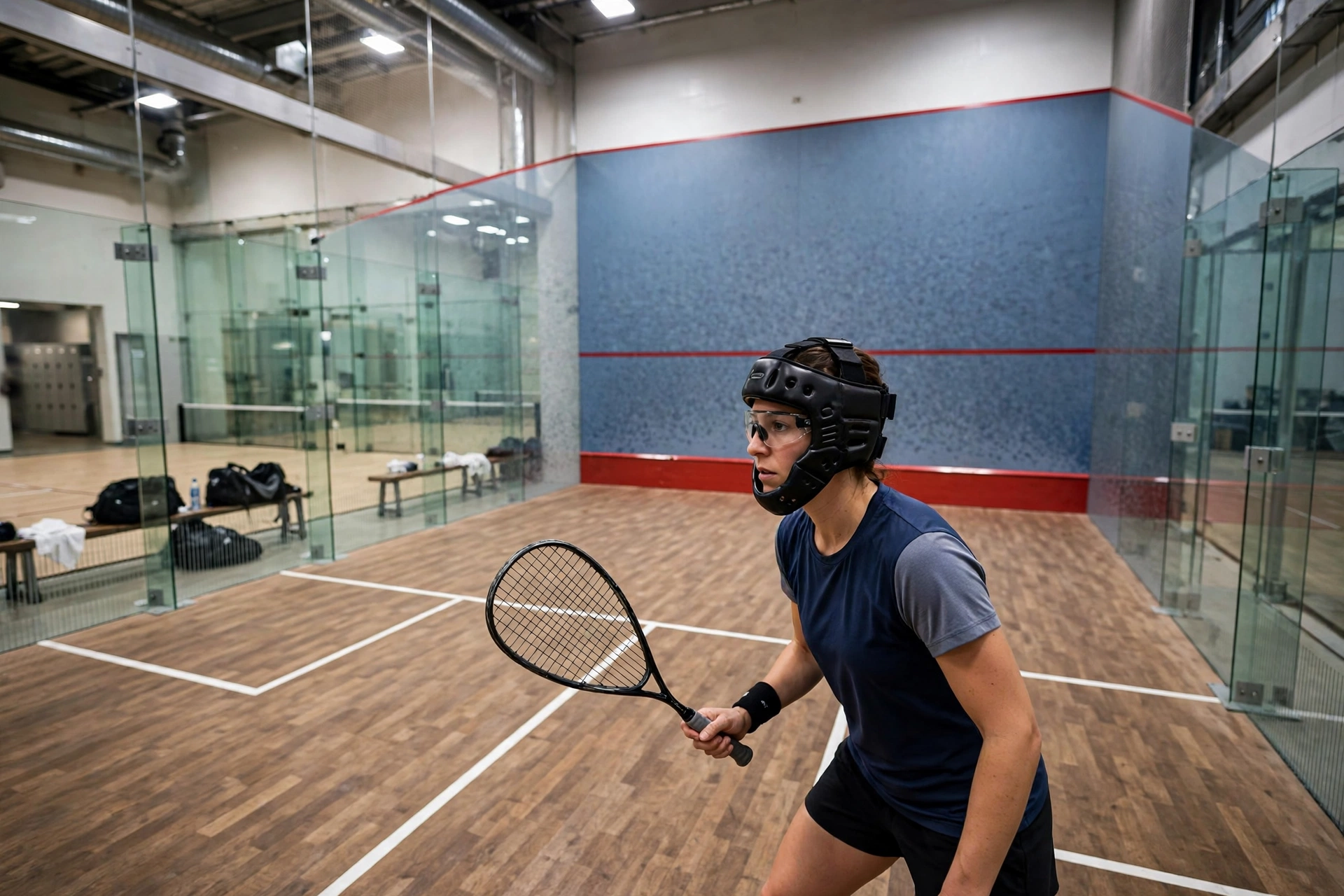
No, in general terms squash players do not wear helmets, and head protection is very uncommon in squash at every level, from casual games to professional matches. Squash is played in an enclosed court with a small, fast ball, and the players wear eye protection rather than a helmet. The risk in squash is mainly to the eyes, from the ball or from a racket, and that is what the protective kit is designed for.
That does not mean squash is risk-free for the head. Players move quickly in a small space, they turn suddenly, and they can collide with each other or with the walls. A fall or a knock can happen, but it is rare enough that helmets have never become part of the sport. The question is still worth asking, because new players often wonder whether they should protect their head as well as their eyes.
Why don’t squash players wear helmets?
Squash players do not wear helmets mainly because the head is not the main target of injury in the sport, and because a helmet would get in the way of the game. In general terms, squash is a fast, close-quarters game, and the players need to hear, see, and move freely. A helmet would add weight, trap heat, and narrow the player’s vision, all of which would make the game harder to play.
The ball in squash is small and light, and while it travels fast, it is not heavy enough to cause the kind of head injury that a helmet is designed to prevent. The main risk from the ball is to the eyes, which is why eye protection is the standard safety kit in squash. In general terms, the sport has decided that eye guards, rather than helmets, are the right protection, and that is the approach used at every level of the game.
What protective gear do squash players wear?
Squash players wear protective eyewear, and in general terms that is the main piece of safety kit in the sport. The eyewear is made from impact-resistant material, and it shields the eyes from the ball and from a racket that swings too close. Many clubs and competitions require eye protection, especially for juniors and for doubles, where two players share a small court and the risk of being hit is higher.
Players also wear non-marking court shoes with a good grip, because the court floor can be slippery and a fall is a real risk. Some players wear a headband or a sweatband to keep sweat out of their eyes, and some wear a knee support or an ankle support if they have had an injury. In general terms, the kit is light and simple, because squash is a fast game and the players need to move freely. A helmet would be out of place among that kit, and it is not worn by players at any level.
Is there a risk of head injury in squash?
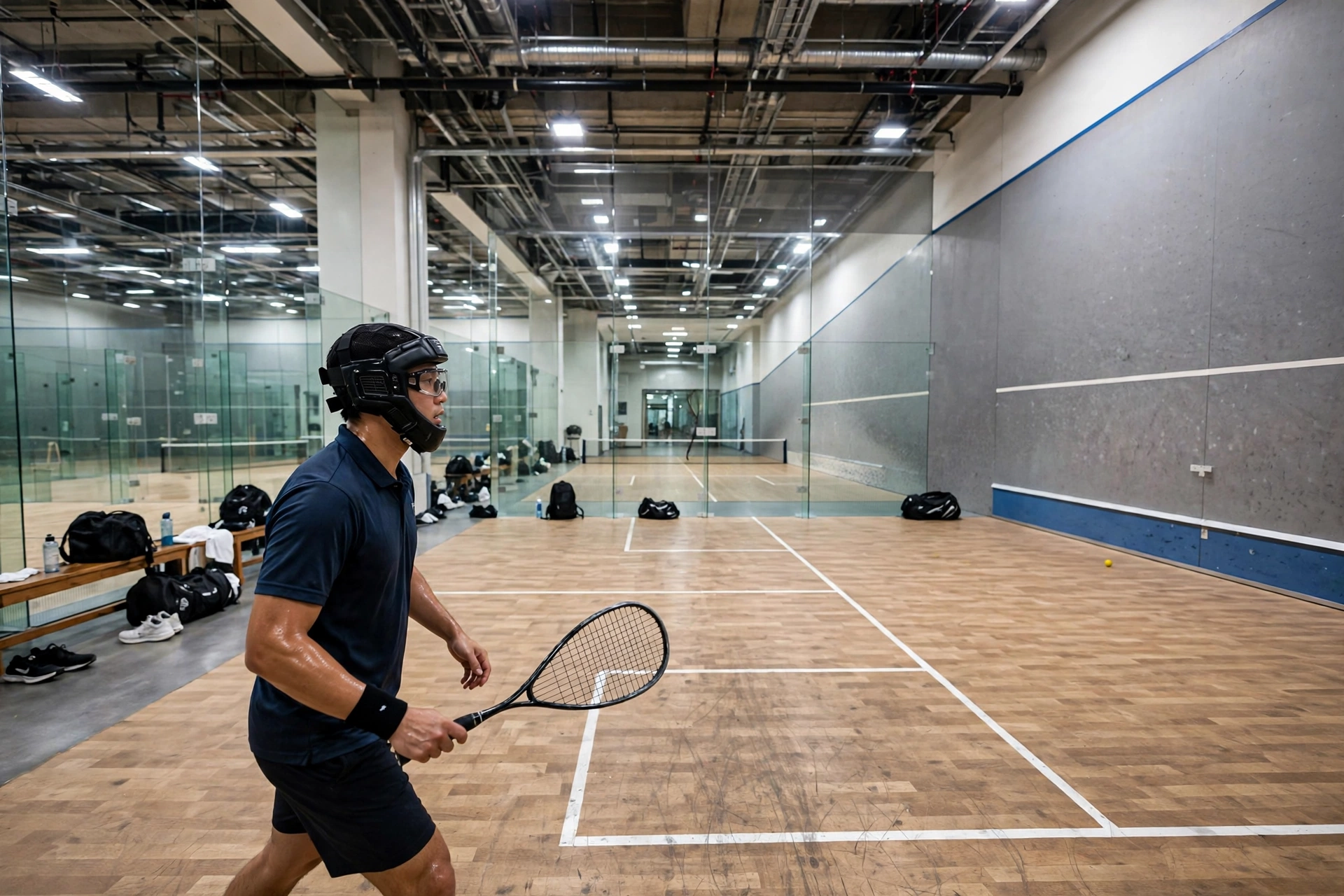
Yes, there is a small risk of head injury in squash, but in general terms it is low compared with contact sports. Players can collide with each other, fall onto the court floor, or hit their head on a wall during a sudden turn. The ball itself can strike the head, although that is less common than a strike to the eye or the body. Most head knocks in squash are minor, and serious head injuries are rare.
The risk is higher in doubles, where four players share a court, and in games where the players are mismatched in skill or speed. In general terms, the best protection against a head injury in squash is not a helmet, but good court awareness, clear calling, and proper technique. Players are taught to call “let” when they are in the way, to watch where their opponent is, and to avoid swinging a racket near another player’s head. Some helmets include a system designed to reduce rotational forces in a fall, such as MIPS, but that feature belongs to helmets for cycling, skiing, and similar sports, and it has no place in squash, where helmets are not worn.
Should squash players wear a helmet?
In general terms, squash players do not need a helmet, and wearing one would be unusual in the sport. The protective kit that matters in squash is eye protection, and that is what players, coaches, and clubs focus on. A player who is worried about head injury should talk to their coach about court awareness and safe play, rather than buying a helmet.
There are exceptions: a player who has had a head injury, or who has been advised by a doctor to protect their head, might choose to wear a soft headguard. In general terms, a soft padded headguard would not be banned by the rules, as long as it has no hard parts that could injure another player. But it would be very uncommon, and most players in that situation would be advised to focus on eye protection and on playing safely, rather than on wearing a helmet.
What should a new squash player wear for safety?
A new squash player should wear protective eyewear, non-marking court shoes, and comfortable sports clothing, and they should learn the safety rules of the court before their first game. In general terms, the eyewear is the most important item, because the eyes are the part of the head most at risk in squash. Choose eyewear made for squash or racquet sports, with impact-resistant lenses, and make sure it fits snugly and does not fog up.
Learn the calls used in squash, especially “let” and “stroke”, and learn to watch where your opponent is before you swing. Play at a speed you can control, and do not chase a ball that puts you in danger of colliding with the wall or with another player. In general terms, a new player who learns the safety rules and wears eye protection is well protected, and a helmet is not part of the kit they need.
Do professional squash players wear helmets?
No, professional squash players do not wear helmets. In general terms, they wear protective eyewear, and helmets are not used in professional squash at any level.
Can a squash player wear a helmet if they want to?
In general terms, yes, the rules do not ban a soft headguard, as long as it has no hard parts that could injure another player. But it would be very unusual, and most players and coaches would suggest eye protection and safe play instead.
Is eye protection required in squash?
In general terms, eye protection is required for juniors and for doubles in many clubs and competitions, and it is strongly recommended for all players. Check the rules of your club or competition before you play.

Olivia
Writer at Helmet Today, covering helmet reviews, fit and riding safety.