In general terms, an MTB helmet slips on rough descents because it is the wrong size, the retention system is loose, or the straps are not adjusted — and fixing it usually means resizing, tightening the fit system, and levelling the straps, not buying a new helmet. A helmet that creeps forward over your eyes or slides back on every rock garden is not just annoying; it is a helmet that may not be in the right place when you crash.
Slipping is one of the most common fit complaints in mountain biking, and it gets worse exactly when you need your helmet most: on rough, fast descents where vibration and impacts shake everything loose. This guide walks through the causes in order, from the simplest fixes to the point where a different size is the answer.
Why Does an MTB Helmet Slip on Rough Descents?
Rough descents shake a helmet in every direction at once. Vibration from rocks and roots, sudden jolts from drops, and the forward pitch of braking all test how well the helmet grips your head. A helmet that feels fine on smooth trails can start moving once the terrain gets rough, because the forces are bigger and more frequent.
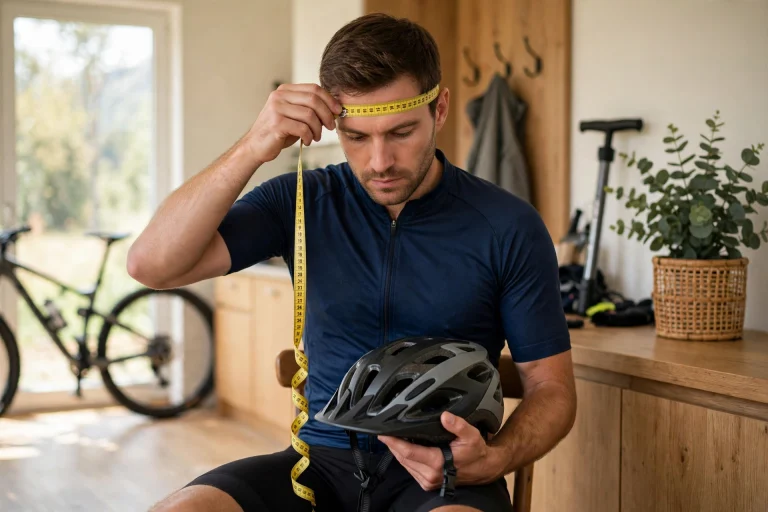
The most common cause is size. A helmet that is even slightly too large will move no matter how tight you pull the straps, because the shell itself has room to shift on your head. Retention systems and straps can compensate for a small amount of looseness, but they cannot fix a shell that is fundamentally too big.
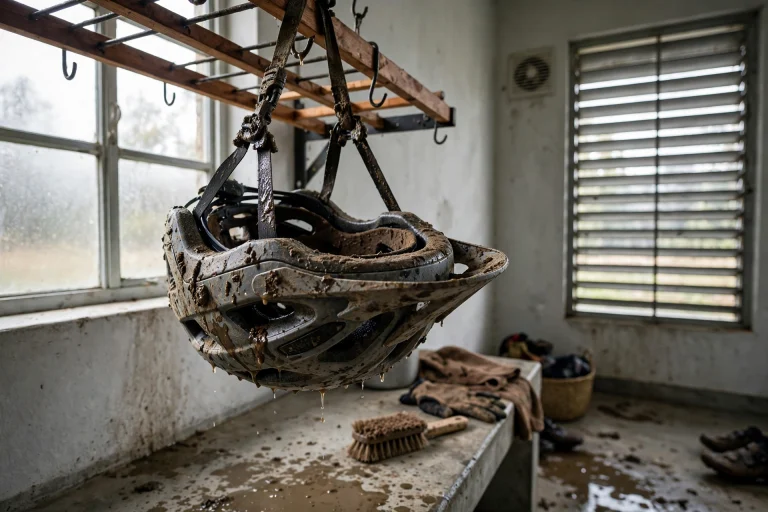
Other causes include a worn or compressed liner, pads that have thinned with use and washing, and straps that have stretched or slipped out of adjustment. Hair also plays a role — a helmet fitted over a cap or with wet, flattened hair can sit differently once you are riding hard and sweating.
How Do You Check Whether the Fit Is Right?
Start with the helmet level on your head, sitting just above your eyebrows and covering your forehead. It should feel snug all the way around, with even pressure and no rocking. Push the front of the helmet up and back: it should resist and spring back, not slide freely over your eyes or expose your forehead.
Next, check side-to-side movement. Grip the helmet and try to twist it. A well-fitting helmet moves your skin and scalp with it rather than sliding over them. If the shell rotates easily while your head stays still, the fit is too loose, the pads are worn, or the size is wrong.
Finally, fasten the chin strap and open your mouth wide. You should feel the strap pull snugly against your chin and throat. If the helmet still moves a lot with the strap fastened, the problem is size or retention, not the strap alone — straps secure a good fit, they do not create one.
How Should You Adjust the Retention System?
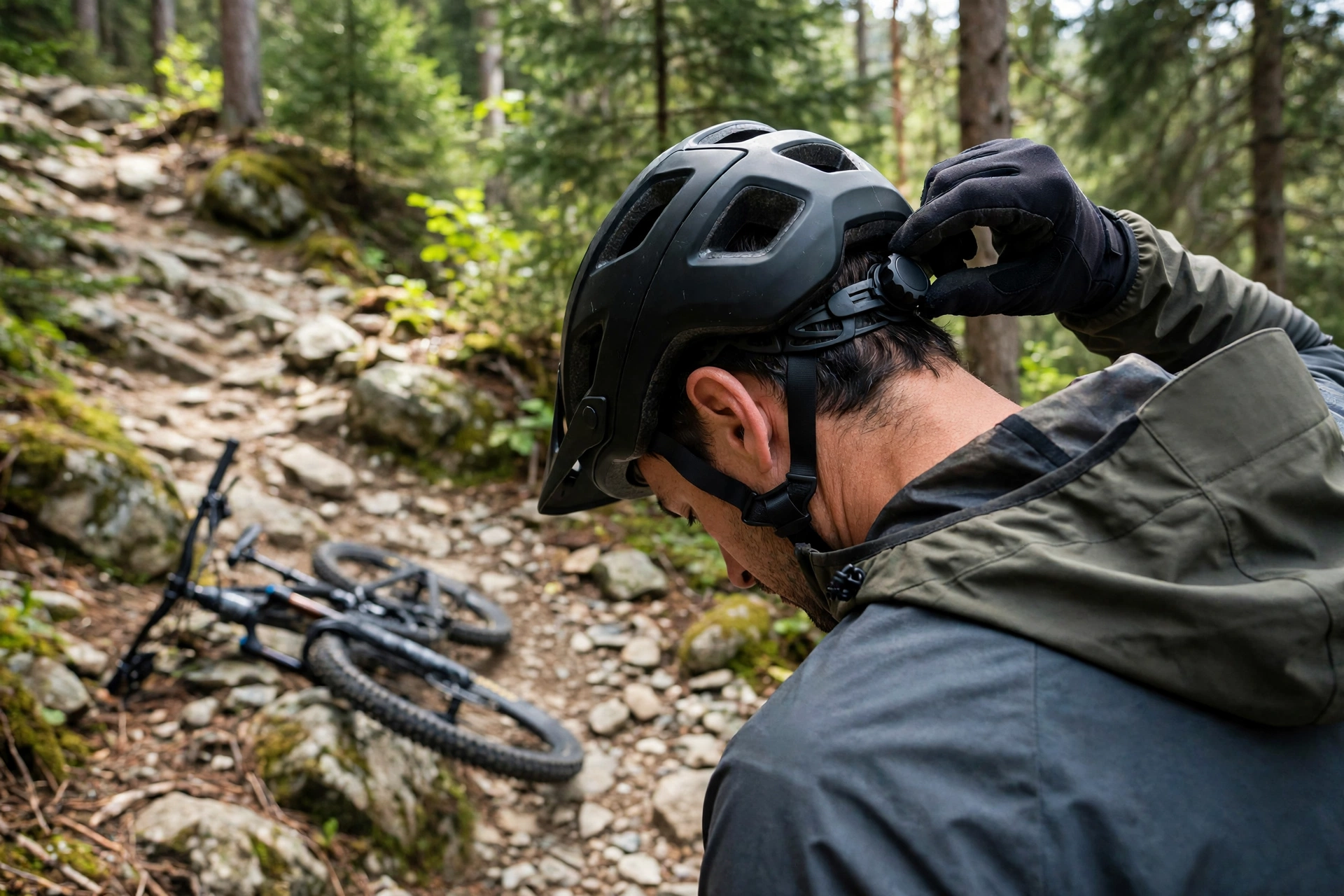
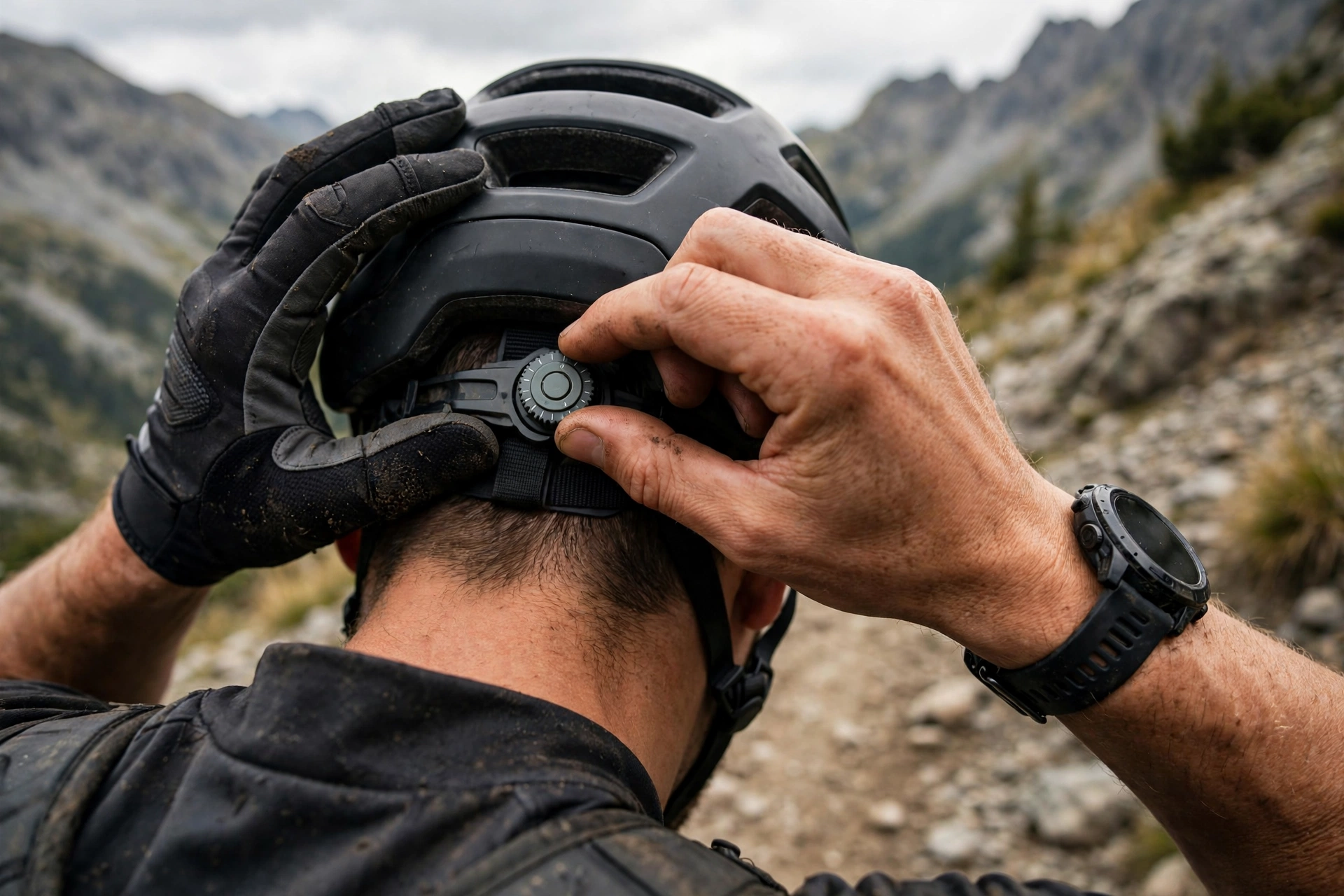
Most modern MTB helmets have a rear retention dial or cradle that tightens an inner band around the back of your head. This is your first adjustment. Turn the dial until the helmet feels snug but not painfully tight, then re-check the push and twist tests. A common mistake is leaving the dial loose and relying on the chin strap instead.
Many retention systems also adjust vertically. If the cradle sits too high, the helmet can tip forward; too low, and it can slide back. Set the cradle so it cups the back of your head at about the level of the base of your skull. This vertical position matters as much as tightness, and it is often overlooked.
Adjust the retention system before every ride, not just once. Dials can loosen with vibration, and pads compress slightly during a ride.
What About Straps and Pads?
Straps should form a neat triangle around each ear, with the junction sitting just below the earlobe. If the junction has slid down the strap, the helmet can rock forward and back. Slide the junction back into place and make sure both sides match — uneven straps pull the helmet to one side on rough ground.
The chin strap should be snug enough that you can fit no more than about two fingers between strap and chin. A loose chin strap lets the helmet lift and shift, especially on drops and jumps.
Pads matter more than riders expect. Most helmets come with spare pad sets of different thicknesses, and swapping a thin pad for a thicker one can take up slack without changing size. If your pads are flattened, torn, or compressed from years of use, replace them — fresh pads restore grip and comfort, and they cost far less than a new helmet.
When Is Slipping a Sign of the Wrong Size?
If you have tightened the retention system fully, adjusted the straps, and replaced worn pads, and the helmet still slips, it is almost certainly the wrong size. No adjustment can compensate for a shell with too much room, and continuing to ride in it means accepting a helmet that may shift in a crash.
Head shape matters too. Some helmets suit rounder heads and others suit longer, narrower heads, so a helmet in your measured size can still fit poorly if its internal shape does not match yours. If a helmet presses hard at the sides but still rocks front to back, shape — not just size — may be the issue.
Do not try to fix a too-large helmet with a thick cap or extra padding stuffed inside. Improvised padding changes how the helmet sits and can interfere with how it performs in a crash. If the helmet does not fit, replace it with one that does, and keep the old one for spare parts or retire it.
How Can You Stop Slipping for Good?
Build a pre-ride fit routine: level the helmet, tighten the retention dial, check the strap triangle and chin strap, and do the push test. Do it every ride, because fit changes with pads, hair, and wear. A helmet that is checked stays put; a helmet that is assumed to be fine drifts out of adjustment quietly.
Replace worn parts on schedule. Pads, straps, and retention dials wear out, and a helmet with tired components will slip no matter how carefully you adjust it. Most brands sell replacement pad sets, so there is no need to tolerate flattened pads.
Finally, remember that fit is part of protection. A helmet that stays in place covers the areas it is designed to cover, and rotational protection systems work best when the helmet is snug. This guide to what MIPS means for helmets explains why a stable, well-fitting helmet matters for angled impacts too.
Frequently Asked Questions
Q: Should I tighten the chin strap as tight as possible to stop slipping?
A: No — a very tight strap is uncomfortable and still will not fix a loose shell. The strap should be snug, but the retention system and correct size do most of the work.
Q: Does a full-face helmet slip less than an open-face helmet?
A: In general terms, yes, because cheek pads and a chin bar grip more of the head. But a poorly sized full-face helmet can still slip, so fit matters for both styles.
Q: Can I wear a cap under my helmet to stop it slipping?
A: A thin cycling cap can help with sweat, but it should not be used to fill out a too-large helmet. If the helmet only fits with a cap stuffed inside, it is the wrong size.

Olivia
Writer at Helmet Today, covering helmet reviews, fit and riding safety.