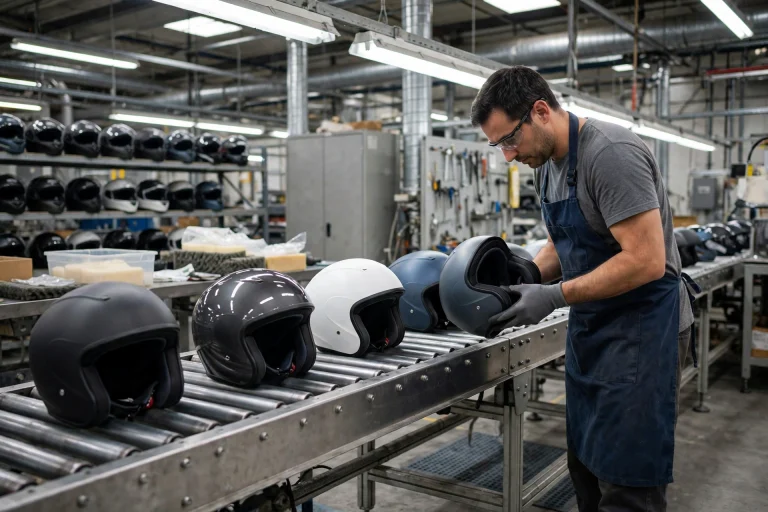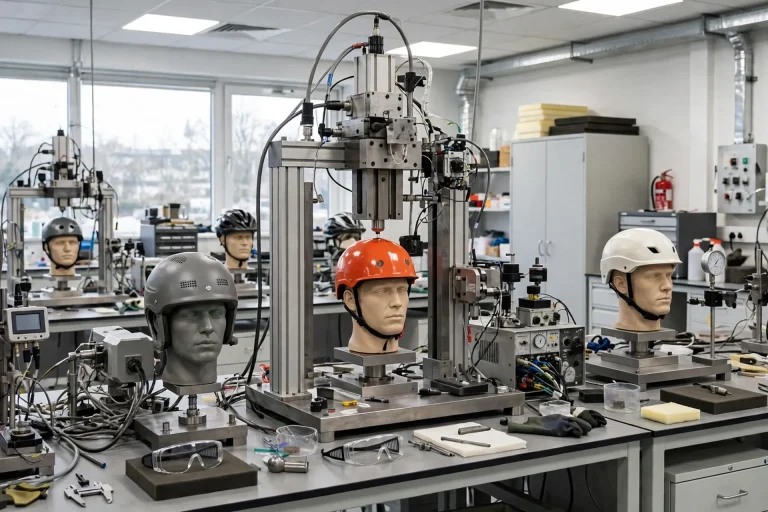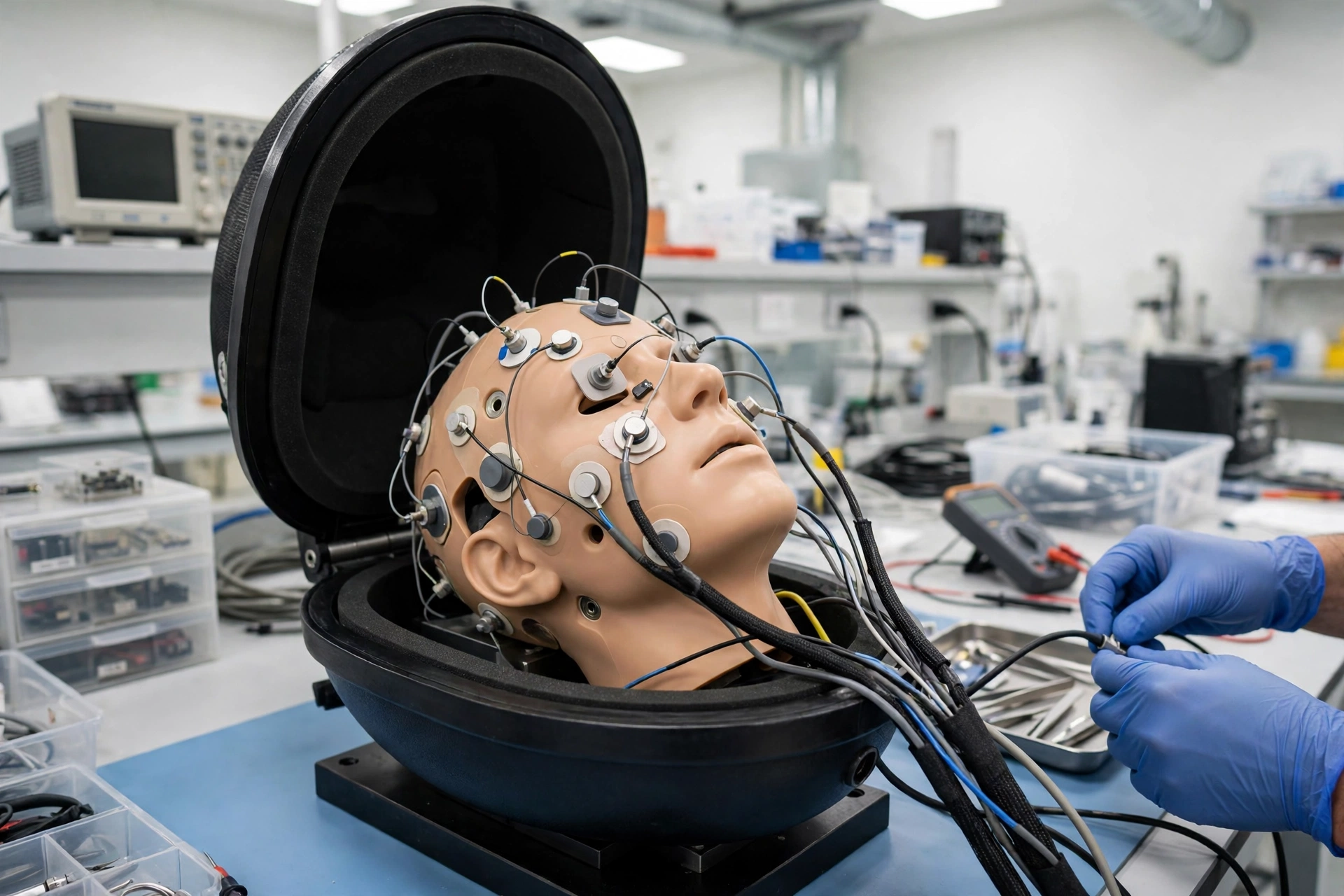
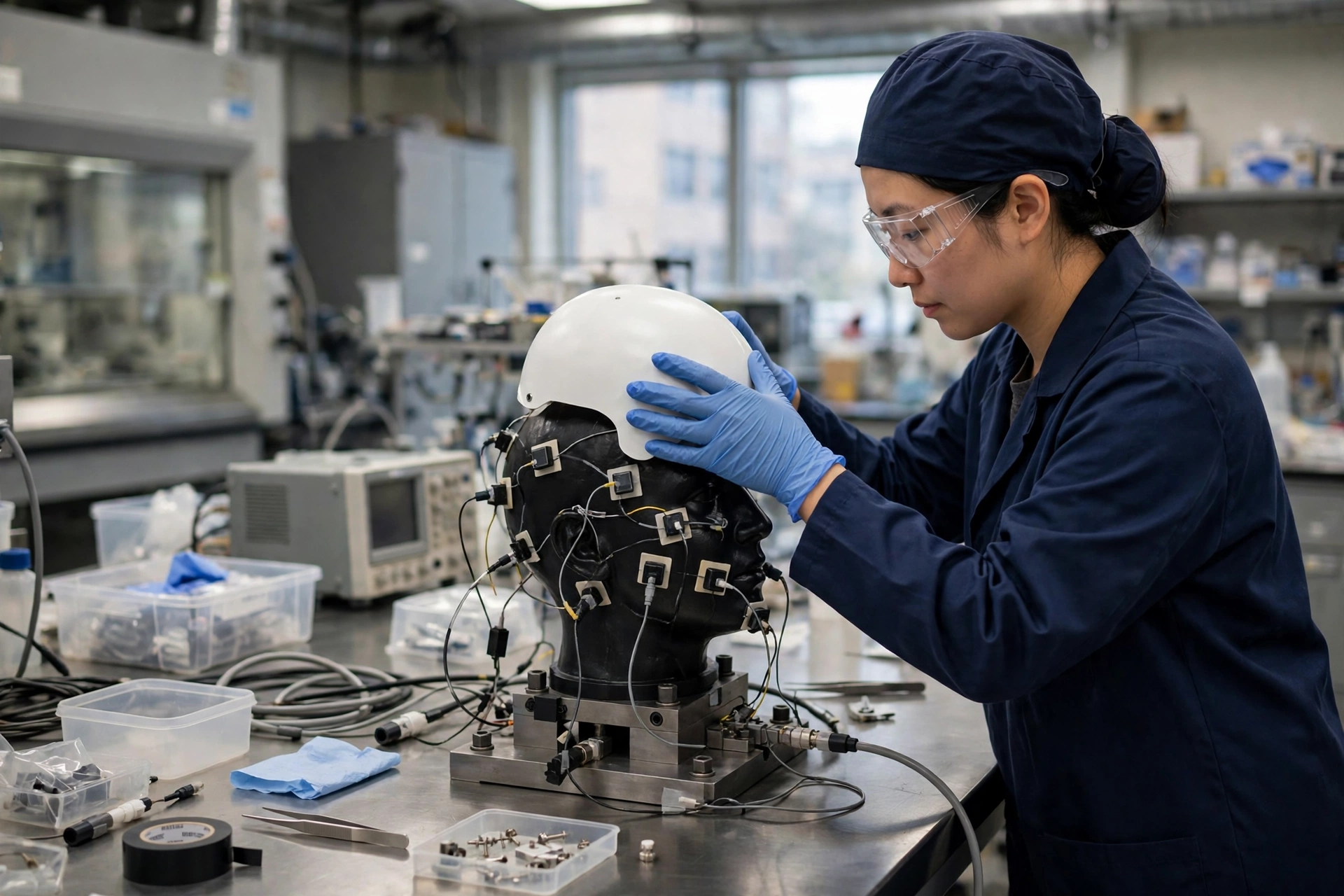
Test labs measure helmet safety by fitting a helmet onto a sensor-filled model head, striking it in controlled ways, and recording how much of the blow reaches the head inside. The sensors show how quickly the head slows down, how much force it takes, and whether the blow twists the head, and the lab compares those readings with the limits set by the safety standard. A helmet that keeps the readings within the limits passes; one that does not, fails.
Measuring safety sounds simple, but a crash is a messy event. A helmet can be struck from any direction, at any speed, in any weather, and the lab has to turn that chaos into numbers that can be compared fairly. That is why test labs use the same methods, the same equipment, and the same headforms for every helmet, so that a result from one helmet means the same as a result from another.
What does the sensor inside the headform measure?
The main sensor inside a headform measures acceleration, which is how quickly the head changes speed when it is struck. When a helmet hits a hard surface, the head inside slows down very fast, and that sudden slowing is what can injure the brain. The sensor records that slowing moment by moment, and the lab looks at both the highest value and how long the high values last.
Some headforms also carry sensors that measure rotation, which is the twisting motion of the head. A glancing blow can spin the head as well as pushing it, and that twisting is thought to be a major cause of brain injury in crashes. Labs that measure rotation can show whether a helmet, or a liner system such as MIPS, reduces that twisting, and that is becoming an important part of modern helmet testing.
How do labs copy a real crash?
A lab cannot copy every crash, so it picks a set of standard impacts that cover the most common dangers. The helmet is dropped onto a flat surface to copy a fall onto a road, onto a rounded surface to copy a kerb or a rock, and sometimes onto a shaped surface that copies a particular kind of hazard. Each surface gives the helmet a different kind of blow, and the lab tests them all.
What do the numbers from a lab test mean?
The numbers from a lab test are only useful when they are compared with a limit. Every safety standard sets limits for the readings a helmet is allowed to produce, and a helmet passes if its readings stay within those limits. The limits are set by experts who study crash injuries, and they are meant to mark the line between a blow the head can take and a blow that is likely to cause serious injury.
It is important to know that a lower reading is not always a better helmet in a simple way. Two helmets can both pass the standard with different readings, and the one with the lower reading is not automatically the safer choice for every rider, because fit, comfort, and the type of riding matter too. The lab numbers prove the helmet meets the standard, but they do not rank helmets in a simple league table.
Labs also record more than the headline numbers. They note how the shell cracked or bent, how the liner crushed, and whether the helmet stayed in place on the headform. These observations are written into the test report, and they help the maker understand why a helmet passed or failed, and what to change in the next version.
How do labs check the strap and the fit?
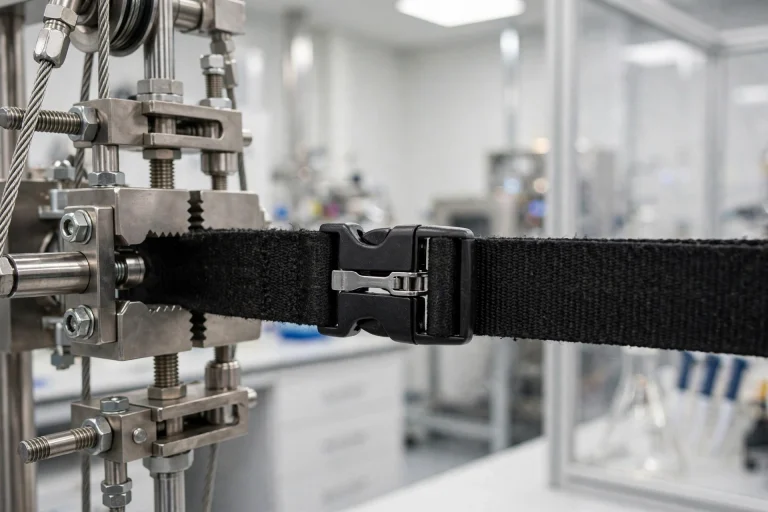
Safety is not only about the shell and the liner, so labs also measure the retention system. In one common check, the strap is pulled with force to see whether it stretches too far, whether the buckle slips, or whether the stitching or rivets give way. A strap that fails lets the helmet come off, and a helmet that comes off cannot protect the head, so this test is treated as seriously as any impact test.
Labs also test roll-off, which is the tendency of a helmet to roll off the head when it is struck from the front or the back. A force is applied to the edge of the helmet, and the lab watches whether the helmet stays in place or rolls forward over the eyes. This matters because a helmet that rolls in a crash can leave the head exposed, or block the rider’s vision at the worst moment.
Why do different helmets get different results?
Helmets get different results because they are built differently. A thick, dense liner will absorb a blow differently from a thin, soft one, and a stiff shell will spread force differently from a flexible one. The shape of the helmet matters too, because a round shell will glance off a surface differently from a flat one, and the position of vents changes how the shell bends on impact.
The size of the helmet matters as well. A larger helmet has more liner to crush, but it also has more weight, and the headform used for testing is matched to the helmet size. That is why labs test more than one size of each model, so that the results are fair for small and large helmets alike. A model that passes in one size but fails in another cannot be certified for the full range.
Finally, the materials matter. Different foams, fibres, and resins behave differently under a blow, in heat, and in cold, and a lab test will show those differences. That is why makers spend so much time choosing materials, and why a change in material often means the helmet has to be tested all over again, even if the shape has not changed.
Can you trust a lab result?
You can trust a lab result when it comes from a recognised lab testing to a recognised standard. Independent certification labs have no link to the maker, so they have no reason to make a helmet look better than it is, and their results are checked by the certification body before a label is granted. A helmet that carries a certification mark has been through this process, and the mark is the proof.
Do labs test helmets bought from shops?
Yes, in general terms certification bodies sometimes buy helmets from shops and test them, to check that production helmets still match the ones that passed the original tests. This is called market surveillance, and it helps catch any model whose quality has slipped since it was certified.
Why do some helmets score better in one lab than another?
Different labs may test to different standards, or use different test methods, so results are only comparable when the same standard and the same method were used. Always check which standard a result refers to before comparing two helmets.
Does a lab test prove a helmet will save me in a crash?
No test can prove that, because every crash is different. A lab test proves the helmet meets the standard for the kinds of blows it was tested against, which is the best evidence available, but fit, correct fastening, and replacing the helmet after a crash all matter just as much.

Olivia
Writer at Helmet Today, covering helmet reviews, fit and riding safety.