Your helmet needs are driven by speed, traffic, and how you actually ride — not by whether your e-bike has a throttle. A throttle does change riding patterns in ways that matter, though: throttle riders often cruise at a steady top speed with less effort and arrive at junctions fresher but faster, while pedal-assist riders vary their speed with their pedaling. In general terms, the faster and more traffic-exposed your typical ride, the more coverage and certification your helmet should have, whatever the motor setup.
E-bike classes make this concrete. Class 1 e-bikes are pedal-assist only up to 20 mph, Class 2 adds a throttle that can propel the bike up to 20 mph without pedaling, and Class 3 is pedal-assist up to 28 mph. Two riders on the “same” 20 mph limit can have quite different rides — and slightly different helmet priorities.
How Do Throttle and Pedal-Assist Riding Actually Differ?
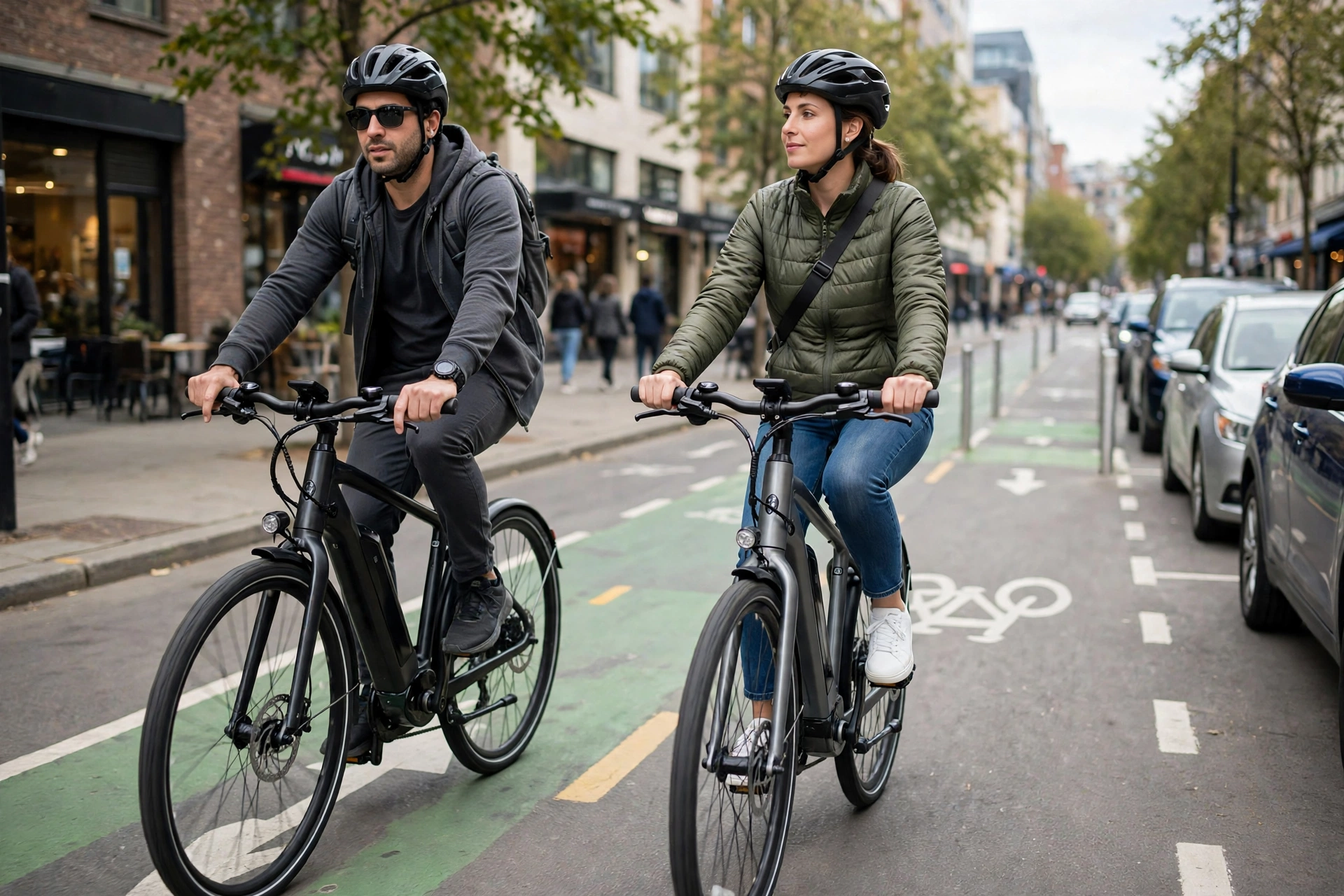
On a pedal-assist bike, your speed rises and falls with your effort. You ease off at a blind corner, soft-pedal through a crowded stretch, and surge when the road opens. That natural modulation means pedal-assist riders spend much of a ride below their top assisted speed, especially in town.
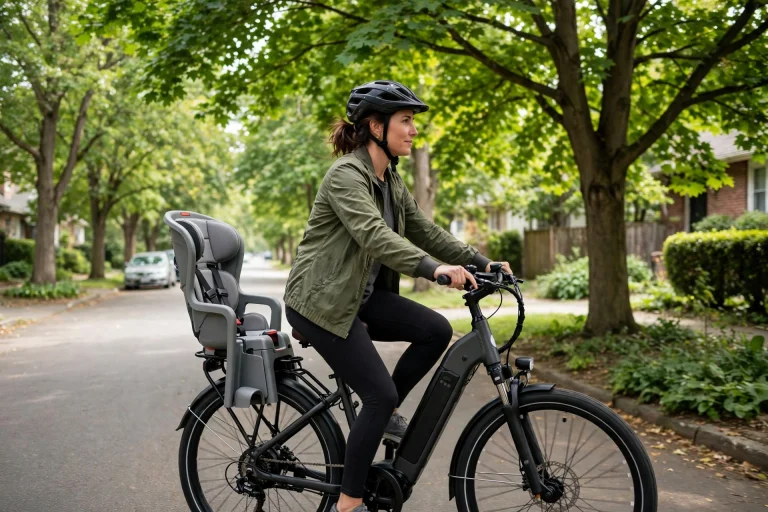
A throttle removes that link. On a Class 2 bike you can hold 20 mph continuously with your legs still, accelerate from a stop without a pedal stroke, and ride in a more upright, scooter-like posture. Riders also tend to use throttle bikes for more car-like trips — errands, school runs, carrying loads — which often means more time on busier roads rather than recreational paths.
Neither style is inherently riskier. But the patterns differ: sustained top speed, upright posture, quick throttle acceleration, and heavier traffic exposure on one side; variable speed, more rider effort, and more path and leisure riding on the other. Helmet choice should follow the pattern, not the label.
Do Helmet Needs Really Differ Between the Two?
In the ways that matter most, no. Both throttle and pedal-assist riders fall the same ways — over the bars, sideways in a low-side slide, or backward off the saddle — and both benefit from the same fundamentals: proper certification, extended coverage at the back and sides of the head, a snug fit that will not shift in a fall, and high visibility in traffic.
Angled impacts are common in real cycling falls for both groups, which is why many riders on either setup look for a rotational-impact liner. Our guide to what MIPS is and how it works explains the thinking behind those liners, and they are widely available in commuter helmets at mid-range prices.
Where needs do start to diverge is at the top end of speed and exposure. A throttle rider who holds 20 mph in traffic for a 30-minute commute is, minute for minute, riding more like a light moped rider than a leisure cyclist, and a pedal-assist rider cruising bike paths at 14 mph is not. Matching protection to that reality is the whole game.
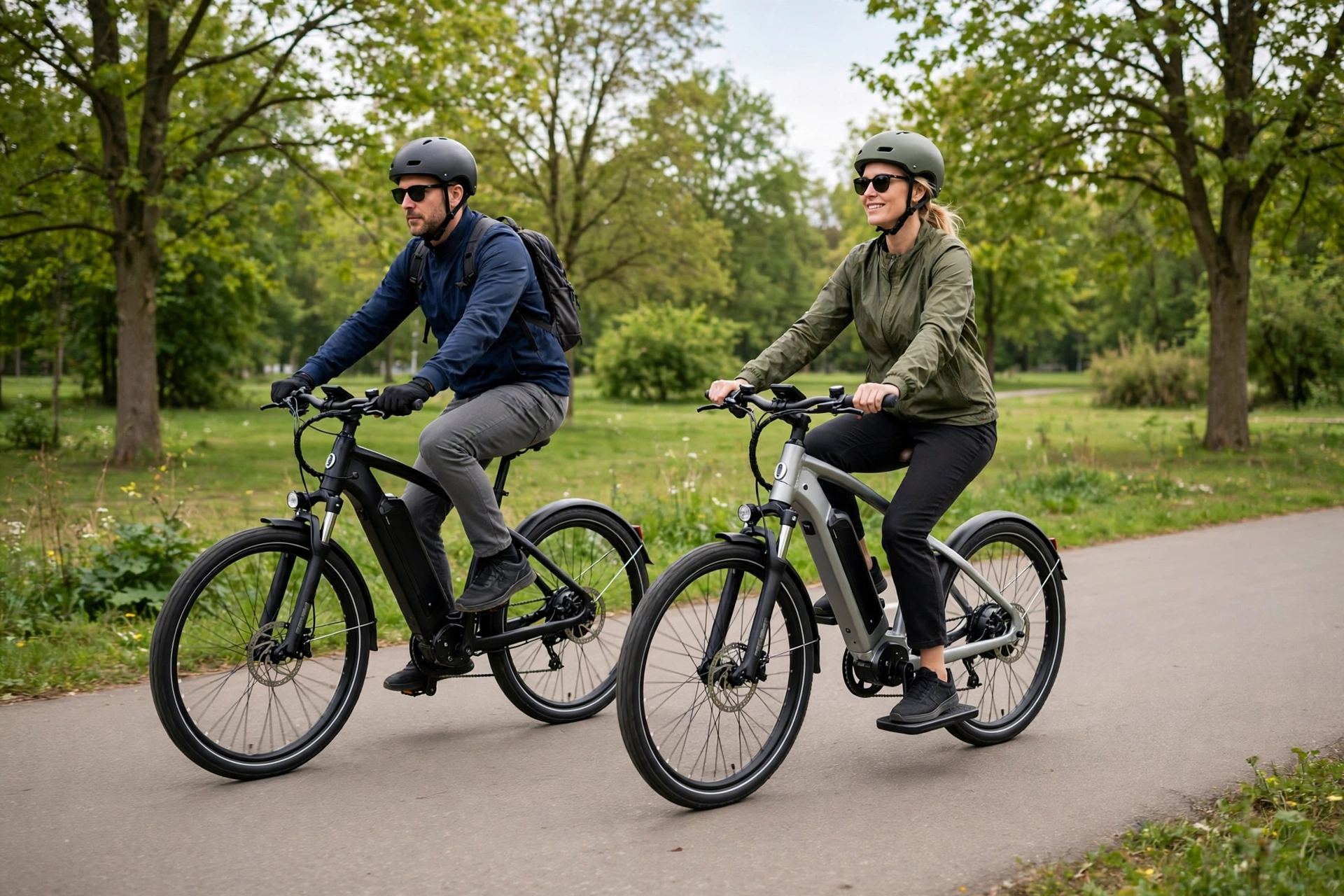
When Should a Throttle Rider Consider a Stronger Helmet?
Consider stepping up if your throttle riding looks like this: long stretches at or near 20 mph, busy urban roads, riding after dark, or carrying cargo that makes the bike heavier and slower to maneuver. In those conditions, an e-bike-specific helmet with deeper coverage — and, where available, certification to the Dutch NTA 8776 higher-speed standard in general terms — is a reasonable upgrade over a basic recreational helmet.
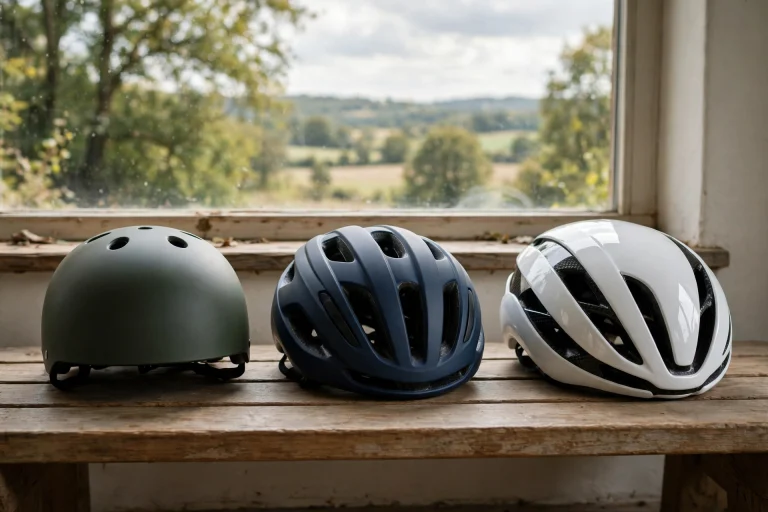
Riders who regularly mix with faster traffic sometimes go further, toward a lightweight full-face or a convertible helmet with the chin bar fitted, for jaw and face protection. That is a personal call based on your route, but it is a legitimate one for high-exposure throttle commuting, and modern cycling full-face helmets are far lighter and better ventilated than motorcycle helmets, which are generally overkill and uncomfortably hot at bicycle exertion levels.
Visibility deserves the same step-up thinking. A built-in rear light or strong reflective detailing helps drivers judge your speed — and drivers consistently underestimate how fast an e-bike traveling at a steady 20 mph is approaching.
What Should Pedal-Assist Riders Prioritize?
Pedal-assist riders work harder physically, so ventilation and low weight climb the priority list — a hot, heavy helmet on a rider generating their own heat is a helmet that ends up hanging on the handlebars. Look for real internal air channeling, wicking pads, and a fit system you can adjust with one hand while riding.
The exception is Class 3. If your pedal-assist bike assists to 28 mph, your helmet priorities converge with the fast throttle case: deeper coverage and higher-speed certification become genuinely worthwhile, because crash energy rises steeply with speed. It is also worth knowing that some states set helmet requirements specifically for Class 3 riders — the details vary by state, so check the rules where you live rather than assuming your Class 1 habits carry over.
Trail-focused pedal-assist riders should also think about terrain: rocky or technical riding at moderate speeds still produces hard, angled falls, which argues for trail-style coverage even when speeds look modest on paper.
What Helmet Features Matter for Both Types?
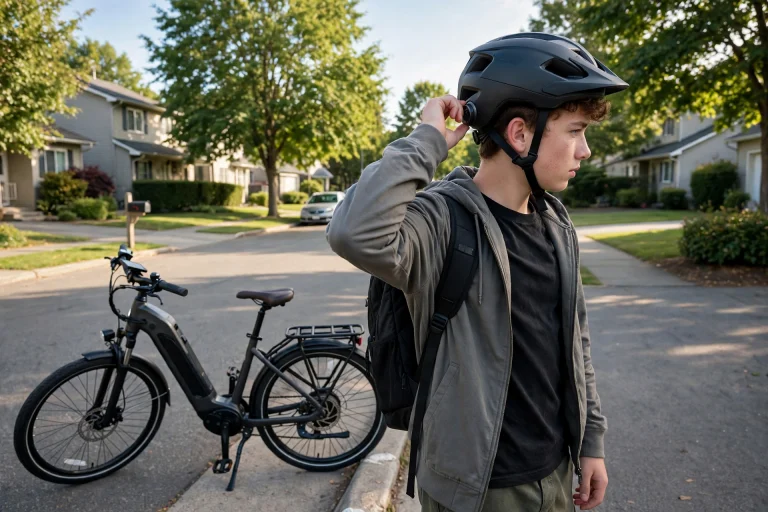
Fit first, always. Measure your head, match the brand’s chart, and confirm the helmet sits level, snug all around, and does not rock when you shake your head. The straps should form a V just below each ear, with about one or two fingers of slack under the chin strap. A loose helmet can shift or come off in the first moment of a crash, before it gets the chance to do its job.
Second, certification you can verify: the helmet should carry the standard bicycle helmet certification for your market, and faster riders should look for e-bike-specific certification on top of that. Third, being seen — bright colors by day, reflectives and lights by night — because the most common e-bike crash involves a driver who did not register the rider in time.
Finally, treat the helmet as a consumable on either kind of bike. Replace it after any crash or hard drop onto a hard surface, and in general terms every few years as foams and straps age. The throttle-versus-pedal-assist question is an interesting one, but it never outranks the basics.
Frequently Asked Questions
Q: Do I legally need a different helmet for a throttle e-bike?
A: In general terms, no — where helmet laws apply, both throttle (Class 2) and pedal-assist (Class 1) e-bikes are usually treated under the same bicycle-style helmet rules, and a certified bicycle helmet satisfies them. Class 3 and local rules can differ, so check the requirements where you ride.
Q: Is a regular bike helmet enough for a Class 2 throttle e-bike?
A: It meets the baseline, and for relaxed path riding at moderate speeds it is a reasonable choice. If you hold 20 mph in traffic for long stretches, an e-bike-specific helmet with deeper coverage and, ideally, higher-speed certification is a worthwhile step up.
Q: I ride both throttle and pedal-assist bikes. Do I need two helmets?
A: Almost certainly not. Buy one helmet matched to your fastest, most traffic-exposed riding, and it will serve you on the gentler bike too. The only common exception is a rider who wants a light, airy helmet for slow summer path rides and a high-coverage helmet for fast commuting.

Olivia
Writer at Helmet Today, covering helmet reviews, fit and riding safety.