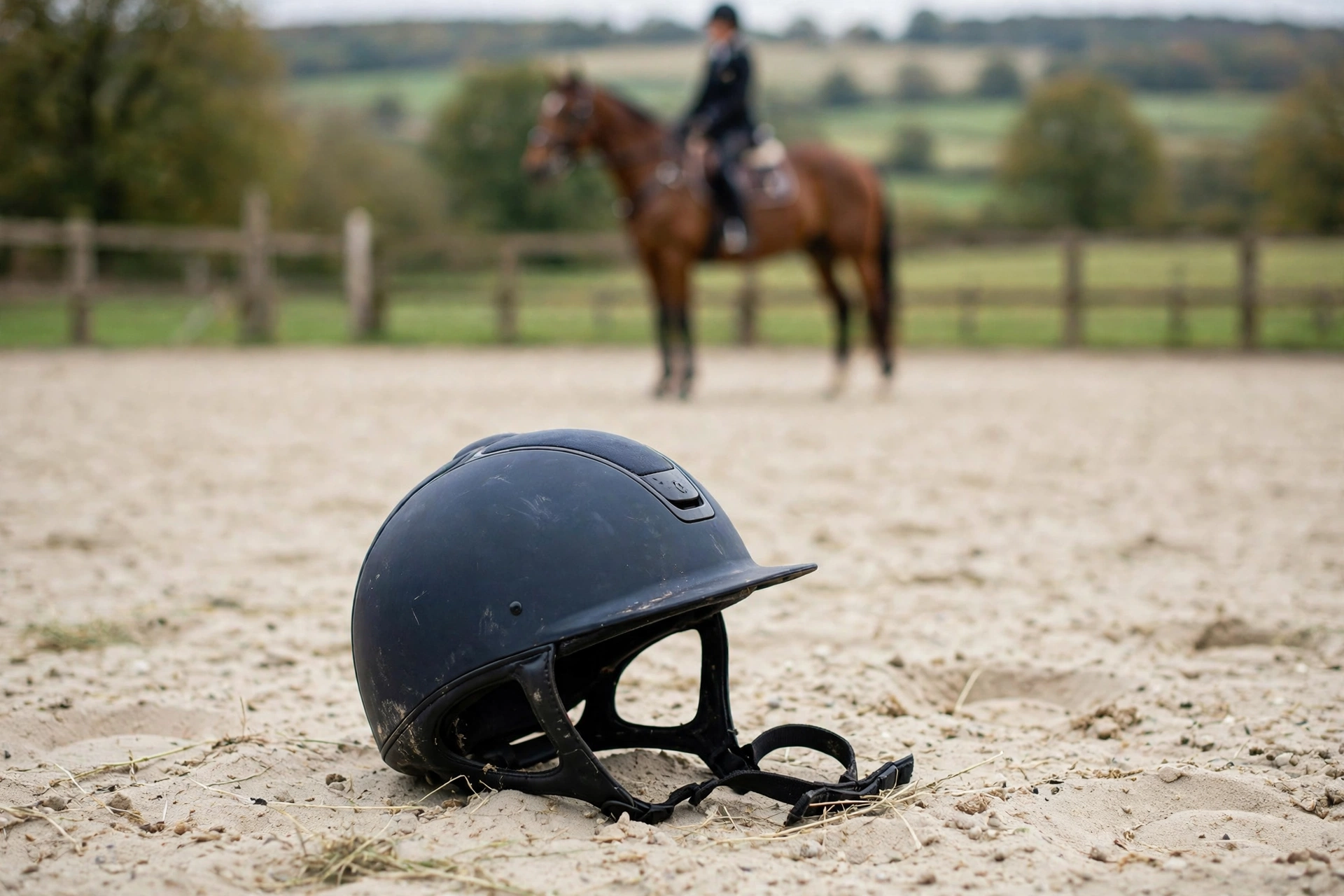
If your riding helmet hit the ground in a fall, replace it — even if it looks completely fine. Equestrian helmets are built to protect you in exactly one impact, and the foam inside can be permanently crushed without any visible crack or mark on the outer shell. Riding again in a helmet that has already absorbed a fall is gambling with protection you can no longer trust.
This rule surprises many riders because a helmet that took a tumble often looks undamaged. The shell may show nothing more than a scuff, yet the energy-absorbing liner underneath has done its job by deforming. Once that foam has compressed, it cannot compress the same way again, so a second impact in the same spot reaches your head with far less protection.
Why does a riding helmet only protect you once?
Inside the hard outer shell of a certified riding helmet sits a layer of expanded polystyrene (EPS) foam. In a fall, that foam crushes in a controlled way, spreading the force of the impact over a larger area and slowing the deceleration of your head. That crushing is permanent. The foam does not spring back, and the damaged area is often impossible to see because the shell flexes back into shape and hides what happened underneath.
This is why manufacturers and safety organizations treat every ground impact as the end of a helmet’s service life. It is not a sales tactic; it is simply how the material works. Some technologies can add protection against rotational forces — our guide to what MIPS is and how it works in helmets explains one of them — but no liner technology makes a crashed helmet reusable. One impact, one helmet.
What if the helmet only fell off a hook or the tack room floor?
There is a difference between a fall with your head inside the helmet and an empty helmet being knocked off a shelf. A short drop of an unoccupied helmet onto a hard floor usually does not crush enough foam to matter, because there is no head mass driving it into the surface. Most manufacturers say such drops are generally not a reason to replace the helmet, though you should still inspect it.
Check for cracks in the shell, dents, loose or damaged harness webbing, and any place where the foam feels soft or separated from the shell. If the helmet was dropped from a height while loaded with something heavy, was run over, or was involved in any incident where a rider’s head was inside it, treat it as crashed and replace it. When in doubt, contact the manufacturer — several brands will inspect a helmet and advise you honestly.

What is hidden damage, and can you spot it?
Hidden damage is the compressed or cracked EPS foam that stays invisible under an intact shell. You usually cannot confirm it by looking. Some warning signs can still show up: a new creak when you gently squeeze the shell, a liner that feels uneven or loose, a harness anchor that has pulled slightly, cracks around vents or the brim, or a spot on the shell that looks polished or stressed.
Be skeptical of anyone who offers to “certify” a used or crashed helmet as safe. There is no practical field test a shop can run that restores confidence in crushed foam, short of destructive testing that ruins the helmet anyway. If the helmet took the hit your head would otherwise have taken, it has already earned its cost. Retire it.
Do helmet brands offer crash replacement programs?
Yes, many equestrian helmet manufacturers run crash or accident replacement programs. The details vary by brand and by country, but the general pattern is similar: if your helmet is involved in a fall within a certain period after purchase — often one to a few years — the maker may offer a replacement at a discount, sometimes with proof of purchase and the crashed helmet returned so they can study it.
Some brands ask you to send the helmet in for inspection first, and if it is damaged they apply the replacement offer. Others work through the retailer where you bought it. Keep your receipt when you buy a new helmet, and register the purchase with the manufacturer if they offer registration. It makes any later claim much smoother, and the discount can take some of the sting out of an unexpected replacement.
What standard should your replacement helmet meet?
For riding in the United States, look for a helmet certified to the ASTM F1163 standard and bearing the SEI mark, which means the model has been independently tested and certified by the Safety Equipment Institute. Governing bodies such as USEF and many show series require ASTM/SEI certified helmets for competition, and the same certification is the sensible baseline for schooling at home.
Never buy a used helmet, even one that looks new. You cannot know its crash history, its age, or how it was stored, and all three matter. Buy new, from a reputable retailer, and check the manufacture date inside — helmets also age out after roughly five years of use as materials degrade with sweat, heat, and UV exposure, even without a fall.
When you shop for the replacement, fit matters as much as certification. A helmet that is slightly too loose can shift during a fall and reduce the protection the certified design promises. Try helmets with your hair styled the way you ride, use the maker’s size chart rather than assuming your old size transfers between brands, and do the gentle head-shake test before you buy. Many riders keep their crashed helmet, clearly marked and with the straps cut, as a loaner reminder of why the rule exists — but it should never go on anyone’s head again, even for a photo. Dispose of it responsibly once any replacement program or inspection is complete, so it cannot be picked up and used by someone who does not know its history.
Frequently Asked Questions
I fell off but my head never touched the ground. Can I keep the helmet?
Yes. If the helmet made no impact — for example, you landed on your side or feet and the helmet never struck anything — it has not done its one job yet and can keep being used, after a quick inspection.
Can a crashed helmet be repaired?
No. The protective foam cannot be repaired or replaced on its own. A damaged harness can sometimes be serviced by the maker, but a shell or liner that has taken an impact means the helmet must be retired.
How long does a riding helmet last without a fall?
As a general guide, replace a helmet about every five years from first use, sooner if the fit becomes loose, the foam feels degraded, or the harness shows wear. Sweat, heat, and daily handling slowly age the materials.

Olivia
Writer at Helmet Today, covering helmet reviews, fit and riding safety.