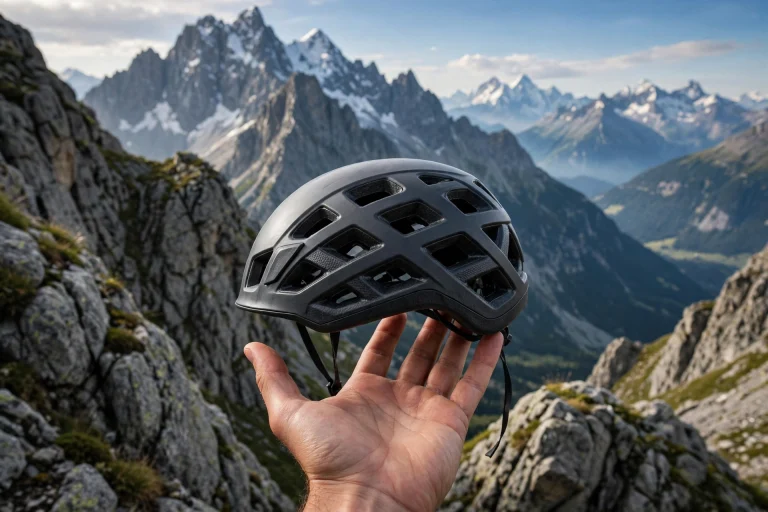
To attach a headlamp to a climbing helmet, either clip it into the helmet’s built-in headlamp clips — usually two at the front and two at the back that grip the headlamp’s elastic strap — or run the strap around the helmet under the shell edge, then adjust the lamp’s tilt so the beam points where you look. Most modern climbing helmets have the clips, and most headlamps fit them without any adapters.
This guide covers the clip method step by step, what to do if your helmet has no clips, and how to stop a lamp slipping, bouncing, or blinding your partner at the belay.
What Are the Main Ways to Attach a Headlamp to a Helmet?
The most common method uses the helmet’s own headlamp clips. These are small hooks or tabs moulded into or riveted onto the shell — typically a pair low at the front and a pair at the back. The headlamp’s elastic strap stretches around the helmet and the clips hold it in place, keeping the lamp body centred on your forehead.
The second method is simply wearing the headlamp’s strap around the outside of the helmet, relying on the strap’s grip and any silicone gripper lines printed on it. This works on almost any helmet and is the fallback when clips are missing, broken, or in the wrong place for a bulky lamp.
A third option is a helmet-specific mounting system: some headlamps come with curved plates, adhesive mounts, or front brackets designed to click into particular helmets. These give the most secure fit and often the easiest tilt adjustment, but they tie you to compatible gear. Whichever method you use, the goal is the same — the lamp stays put through a full day of looking up, down, and sideways.
How Do You Use the Helmet’s Headlamp Clips Step by Step?
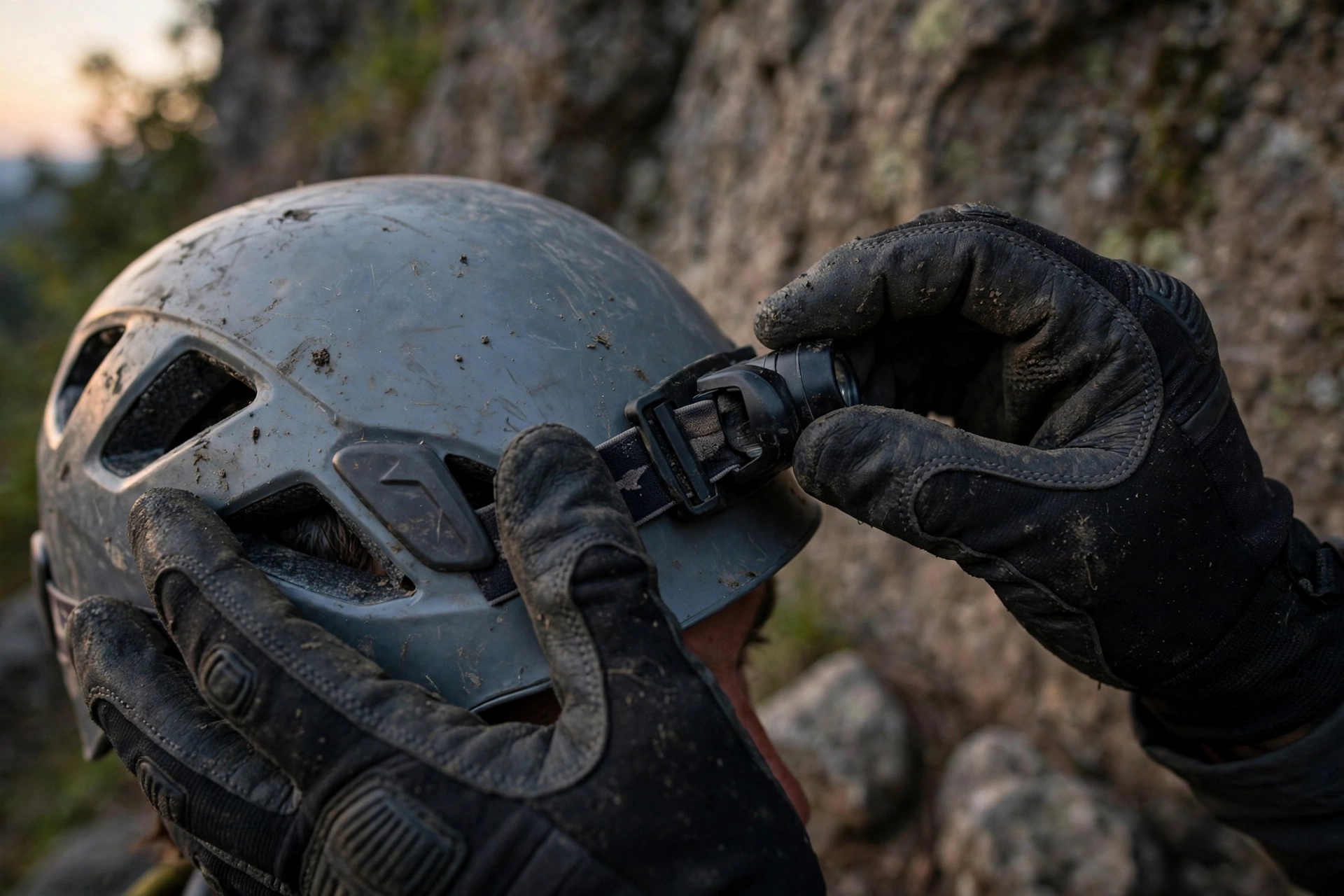
Start with the helmet off your head. Stretch the headlamp strap and hook it under the two front clips first, positioning the lamp body centred on the front of the helmet, roughly where it would sit on your forehead. The lamp should sit low enough that its beam is not blocked by the helmet’s brim.
Then pull the strap around the back and hook it under the rear clips, keeping even tension on both sides so the lamp does not drift off-centre. Most straps have a length adjustment — set it so the strap is firmly stretched, not sagging. A loose strap is the main reason lamps creep and slip mid-route.
Put the helmet on, fasten it properly, and check the lamp’s tilt. Headlamps pivot on their bracket; set the angle so the beam lands where your eyes naturally rest a few metres ahead, then look up and down to confirm the lamp body does not hit the shell at either extreme. Give the helmet a shake — the lamp should not move.
What If Your Helmet Has No Headlamp Clips?
Older helmets and some minimalist designs lack clips, but you still have options. The simplest is the strap-around method: run the elastic strap around the helmet, tucking it under the shell’s edge where possible, and cross or route it through the helmet’s vent slots if the design allows. A strap with a silicone gripper strip holds noticeably better on a smooth shell.
Aftermarket solutions include elastic helmet bands with built-in lamp loops, adhesive-backed mounting plates, and replacement clip kits from some helmet brands. If you add adhesive mounts, follow the adhesive maker’s guidance and place them on a clean, flat part of the shell — and never drill or screw into a helmet shell, which can compromise it.
Whichever workaround you choose, test it hard at home. Wear the setup for an evening, look up at the ceiling and down at your feet, and shake your head. A lamp that survives the living room test usually survives the route; one that slips at home will definitely slip on the descent.
How Do You Stop a Headlamp Slipping or Bouncing?
Tension and routing solve most problems. Shorten the strap so it is genuinely stretched around the helmet, route it through all four clips rather than just the front pair, and make sure the strap is not twisted anywhere. If the lamp body itself is heavy — larger lamps with rear battery packs — balance it by mounting the battery at the back of the helmet if the design allows, so the weight does not pull the front down.
Bouncing usually means the lamp is sitting too high on the curve of the shell, where the strap cannot grip. Nudge the whole setup lower, closer to the brim line, where the helmet’s shape gives the strap a shelf to sit on. A small strip of the strap’s own gripper material, or a helmet band underneath, also helps on very smooth shells.
Finally, build a habit of checking the lamp at every stop. Gloves knock lamps, straps relax in the cold, and the moment you discover a lost lamp should be the belay, not halfway down a dark abseil. Many climbers add a tiny backup light to their harness for exactly this reason.
What Else Should You Consider for Night Climbing?
Beam control is a courtesy as well as a skill. Learn your lamp’s modes before you need them, use the lowest setting that does the job, and tilt the beam down when talking to your partner — a full-power beam in the eyes at a hanging belay destroys night vision and tempers alike. Red modes, where fitted, preserve night vision for map checks and gear sorting.
Cold is the other factor. Batteries lose capacity in low temperatures, so on winter routes keep the lamp on your head rather than in a cold pack, carry spare batteries somewhere warm, and expect shorter runtimes than the box suggests. In general terms, lithium batteries cope with cold better than alkaline ones.
And remember the lamp is an addition to the helmet, not part of its protection. It should attach to the outside without modifying the shell — no holes, no solvents from aggressive adhesives near the foam — so the helmet underneath, including its energy-absorbing foam and any rotational-protection layers like those explained in our guide to what MIPS is for helmets, remains the certified piece of equipment you bought.
Frequently Asked Questions
Q: Do all climbing helmets have headlamp clips?
A: Most modern ones do — usually four clips or hooks for the strap — but older and ultra-minimal models may not. If yours has none, the strap can usually be run around the shell, or you can use an aftermarket helmet band or mount.
Q: Should the headlamp go over or under the helmet strap?
A: The headlamp has its own elastic strap, separate from the helmet’s chin strap. It goes around the outside of the shell, held by the clips, sitting roughly at forehead height. The helmet’s chin strap stays exactly as it was — do not thread the lamp strap through it.
Q: Why does my headlamp keep sliding down over my eyes?
A: Usually the elastic is too loose or routed only through the front clips. Shorten the strap, use the rear clips as well, and position the lamp lower near the brim line where the shell shape helps it grip. Worn-out elastic that has lost its stretch should be replaced.

Olivia
Writer at Helmet Today, covering helmet reviews, fit and riding safety.