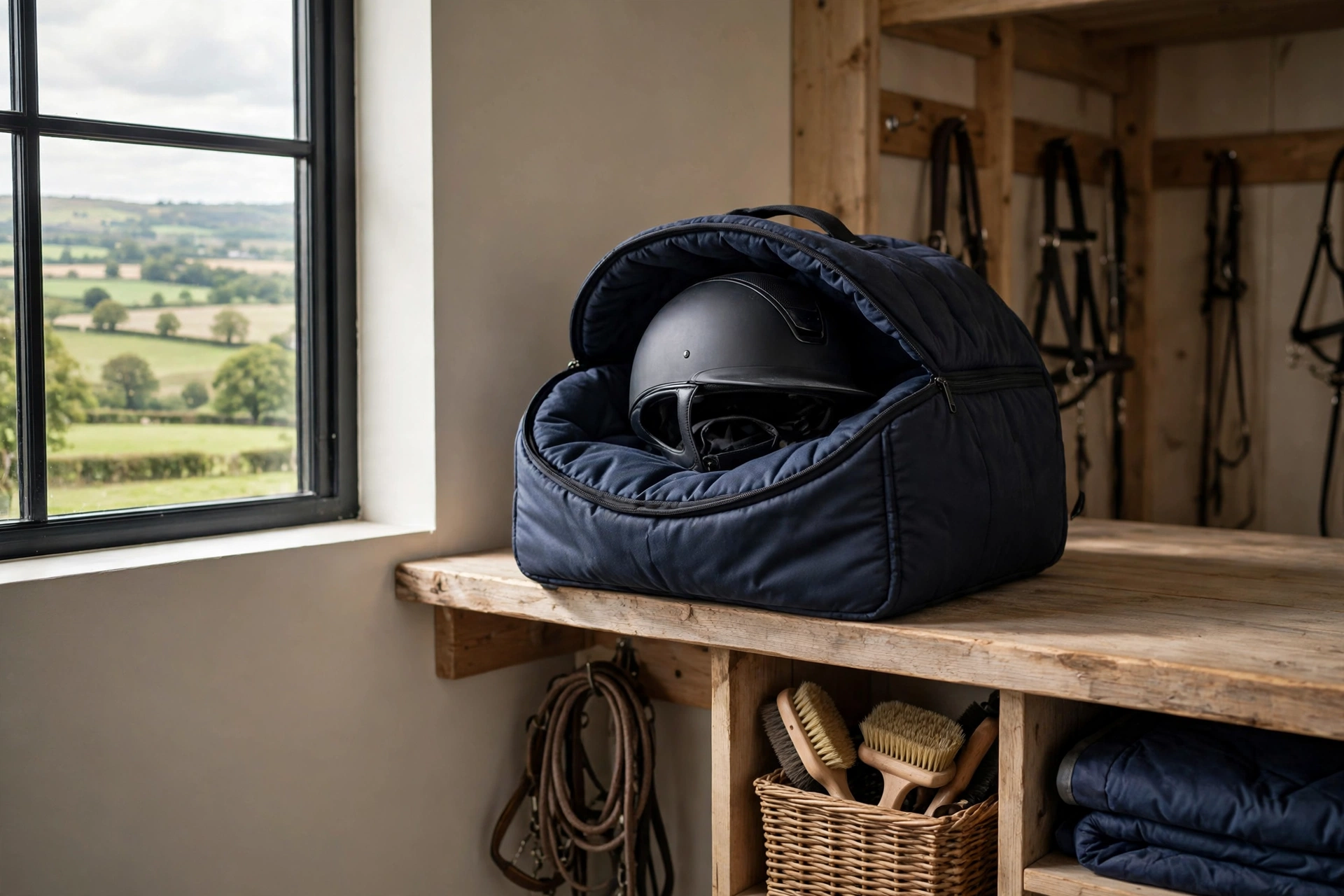
Store your equestrian helmet in its bag, in a cool, dry place away from chemicals, direct sunlight, and heat — never baked in a hot car or left hanging in a steamy barn aisle. Good storage matters because the foam and fabrics inside a helmet age faster when they are exposed to heat, moisture, solvents, and being knocked around.
A riding helmet is precision safety equipment, not just another piece of tack. The way you treat it between rides quietly decides how long it stays protective and comfortable. The good news is that proper storage takes almost no effort once you build the habit.
Why does storage affect how long a helmet lasts?
The EPS foam liner that absorbs impacts slowly degrades when it is exposed to heat, ultraviolet light, and solvent fumes. The comfort padding and harness webbing also break down faster when they sit damp with sweat or are stored against strong-smelling chemicals. Barn environments are tough on helmets: fly sprays, grooming products, leather cleaners, fuel, and fertilizer can all release fumes or splash onto a helmet left out in the open.
Newer helmets often add features like low-friction liners for rotational protection — our explainer on how MIPS works inside a helmet covers the technology — but no feature survives careless storage. Cool, dry, dark, and padded is the formula that keeps every layer doing its job for as long as possible.
Should you keep your helmet in a helmet bag?
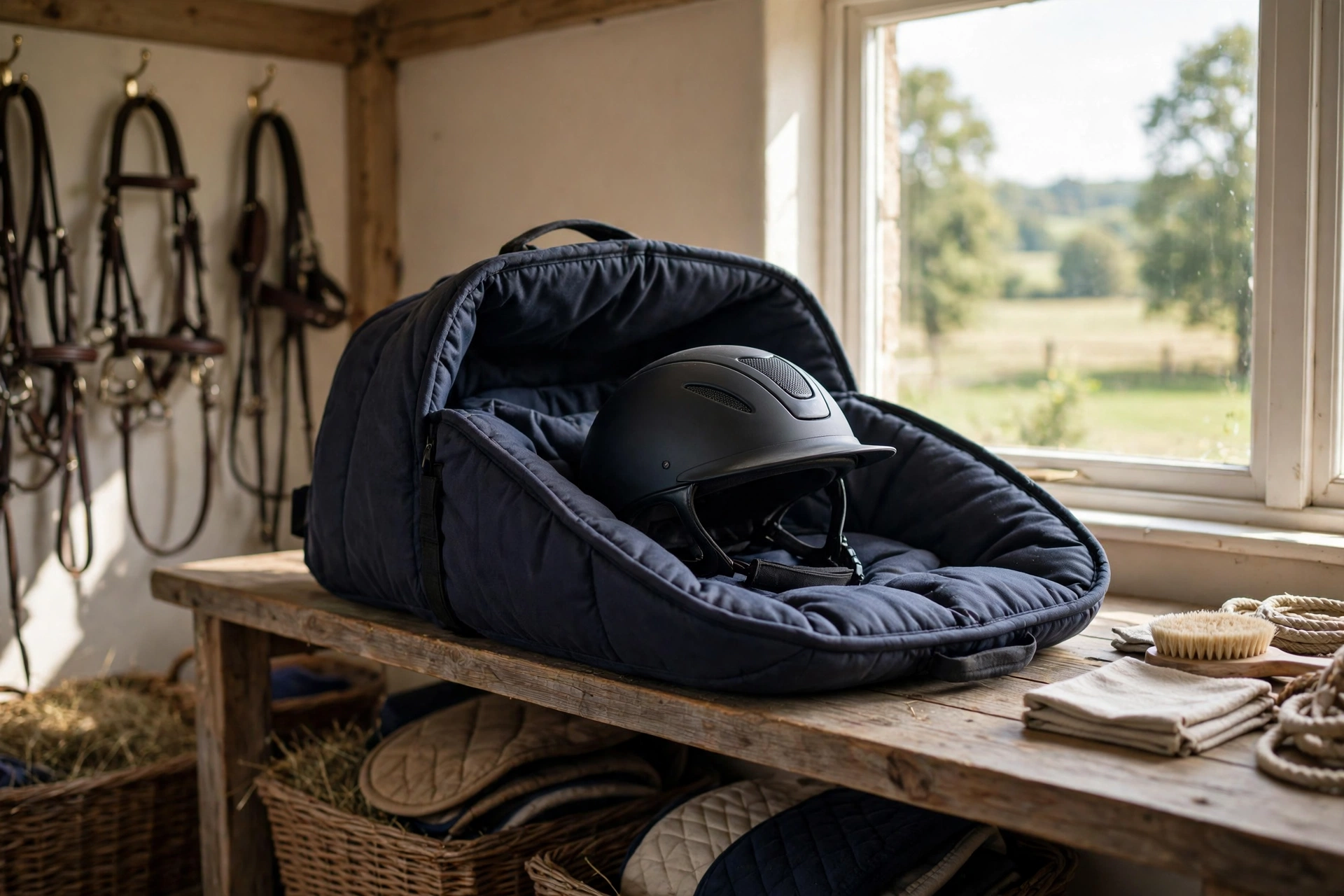
Yes. A padded helmet bag (or the protective bag many helmets ship with) is the simplest upgrade to your storage routine. It shields the shell from scratches, keeps dust and barn grime off the liner, blocks light, and gives the helmet a small cushion against bumps when it travels in a tack trunk, trailer, or car.
If your helmet did not come with a bag, a soft drawstring bag or a small padded case works well. Avoid sealing a sweaty helmet inside an airtight plastic bag or bin right after a ride, because trapped moisture encourages odor and mildew. Let it air out first, then bag it.
Where is the best place to store a riding helmet?
The ideal spot is indoors, at normal room temperature, dry, and out of direct sun — a closet, a shelf at home, or a closed tack locker. Heat is the biggest enemy: a car parked in summer sun can reach temperatures that soften adhesives and age foam quickly, so a helmet that lives in the trunk or on the dashboard will not last as long as one stored at home.
Keep the helmet away from stored chemicals. Fuel cans, paint, solvents, and even strong barn sprays should not share an enclosed space with it. If the tack room is your only option, a closed trunk or cabinet puts a helpful barrier between the helmet and the fumes, dust, and accidental knocks of a busy barn.
Is it bad to hang a helmet by its straps?
Hanging a helmet from a hook by its harness for a short time is common and not catastrophic, but it is not the best long-term storage. Over weeks and months, the helmet’s weight hanging from the webbing can stretch straps, stress anchor points, and let the helmet swing and bang against the wall. It also leaves the liner exposed to dust and spray drift.
It also matters if other gear is piled on top of it. Heavy boots, tack boxes, or a stack of blankets stored on top of a helmet press on the shell for weeks at a time and can stress the brim and vents. Give the helmet its own space where nothing heavy rests against it, and do not leave it sitting on a car seat where it can roll onto the floorboards every time you brake.
Sitting the helmet flat on a shelf, resting on its brim in its bag, or placed on a helmet rack that supports the shell is gentler. Whatever you choose, keep it somewhere it will not be knocked onto a hard floor — repeated drops add up, and a helmet that has been dropped and kicked around a barn aisle ages before its time.
Should you clean your helmet before storing it?
Yes, at least briefly. Sweat is the main daily threat to a liner: salts and moisture left in the padding after every ride break down foams and fabrics and create stubborn odors. After riding, let the helmet air dry in the shade, wipe the shell with a damp cloth, and remove and wash the liner if your model allows it, following the maker’s instructions — mild soap and water, air dry only, never machine heat.
Before any longer break — winter storage, a show season ending, or a few weeks off — give the helmet a full clean, let every part dry completely, then bag it and put it away. A helmet stored clean comes back fresh; a helmet stored sweaty comes back smelling like it.
If you travel to shows, treat transport as storage too. The helmet should ride in its bag, in a place where it cannot be crushed under tack trunks or thrown around loose in the trailer. Many riders keep it in the cab of the truck rather than the trailer for exactly that reason. When you get home, it goes back to its usual cool, dry spot instead of living in the trailer between events.
What should you check before you ride after storage?
Every time you take the helmet out, give it a thirty-second check. Look over the shell for cracks or dents, feel the liner for soft spots or separation, confirm the harness webbing is not frayed and the buckle clicks shut firmly, and make sure the fit still feels snug and even. After long storage, also check for mildew smell, insect nests in vents (it happens in barns), and a manufacture date — helmets generally need replacing about every five years of use regardless of how carefully they were stored.
Frequently Asked Questions
Can I leave my helmet in the car between rides?
Occasionally is fine, but do not make it the helmet’s home. Heat buildup in a parked car ages foam and adhesives, so bring the helmet inside whenever you can.
Is it okay to store a helmet in the barn tack room?
Yes, if it is inside a closed trunk or cabinet, in its bag, and away from chemicals and sprays. Open shelves in a damp, dusty tack room are the worst option.
How should I store a helmet over the winter?
Clean it, dry it completely, place it in its bag, and keep it indoors in a dry room. Check it for mildew and liner condition before the first spring ride.

Olivia
Writer at Helmet Today, covering helmet reviews, fit and riding safety.