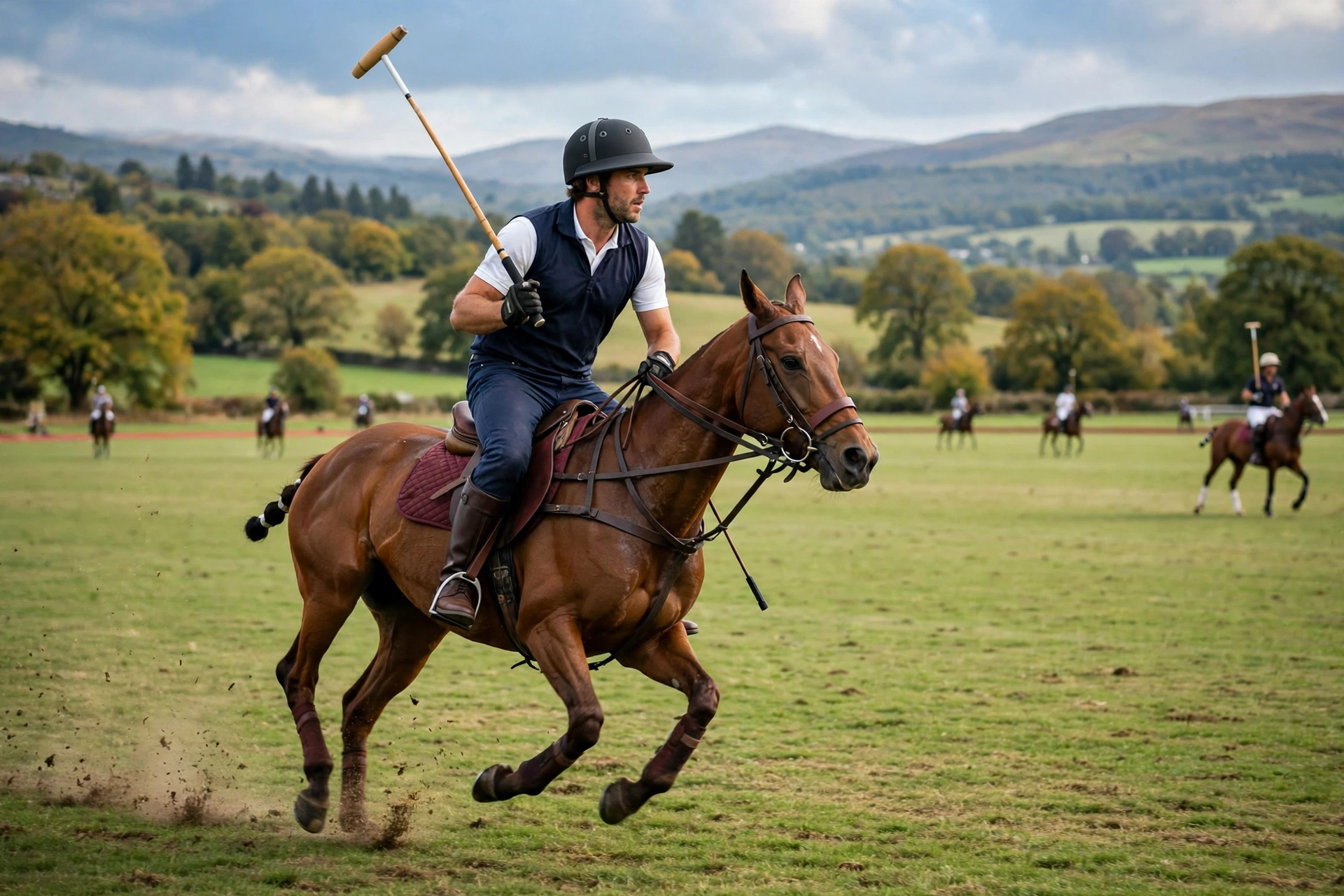
A polo helmet should fit snugly all the way around your head with even pressure, sit level so it covers your forehead, and stay completely still when you shake your head. The three-point harness should be adjusted so the side straps form a point just under each ear and the chin strap sits snug under your chin. If the helmet rocks, slips, or can shift during a gallop test, it is the wrong size or badly adjusted — and it will not protect you properly in a fall.
Polo is played at speed on a moving horse, so a helmet that fits “almost right” is not good enough. This guide covers how a polo helmet should sit, how to size and adjust one, and the fitting mistakes to avoid.
How Should a Polo Helmet Sit on Your Head?
A correctly fitted polo helmet sits low and level on your head, with the front brim roughly above your eyebrows and the shell covering your forehead rather than perched on top of it. If the helmet tips back like a cowboy hat, it leaves your forehead exposed; if it pushes down over your eyes, it blocks your view of the ball and the play.
The shell should feel snug all the way around, with even pressure rather than tight spots. A polo helmet is not supposed to clamp your temples or squeeze your forehead — that kind of pressure means the shell shape does not match your head shape, and it will get worse over a long chukka, not better. Nor should there be loose areas: any gap becomes movement in a fall.
With the harness done up, try to rock the helmet forward, backward, and side to side. A well-fitted helmet moves your scalp with it instead of sliding over it. Any rocking means a different size, an adjustment to the fit pads, or a different model.
How Do You Size a Polo Helmet Correctly?
Start with a measurement, not a guess. Wrap a soft tape measure around your head at the widest point — just above your eyebrows and ears — and compare the result against the size chart of the specific maker you are buying from, because sizing is not perfectly consistent between brands.
A few sizing rules matter more than the number itself:
- Try it on with your hair as you will wear it in play. A ponytail, bun, or hair worn up changes the fit significantly, so fit the helmet with your hair in its playing style. If the helmet has room designed for a ponytail, use it — never stuff hair under the shell, which lifts the helmet and breaks the fit.
- Wear nothing underneath. No caps, bandanas, or sweatbands under a polo helmet. Anything between your head and the liner changes the fit the helmet was designed and tested with, and a cap’s button or seams create pressure points and let the helmet shift.
- Size for now, not for later. Do not buy a helmet a size up “to grow into.” A too-big helmet is a hazard from the first ride, and padding tricks rarely fix a shell that is fundamentally too large.
- Give it time in the shop. Wear the helmet for at least ten minutes before buying. A fit that feels fine for thirty seconds can reveal a forehead pressure point by minute eight.
If you are between sizes, most riders do better with the smaller size plus the maker’s thinner fit pads than with the larger size padded out — but the shake test, not the label, has the final say.
How Should the Three-Point Harness Be Adjusted?
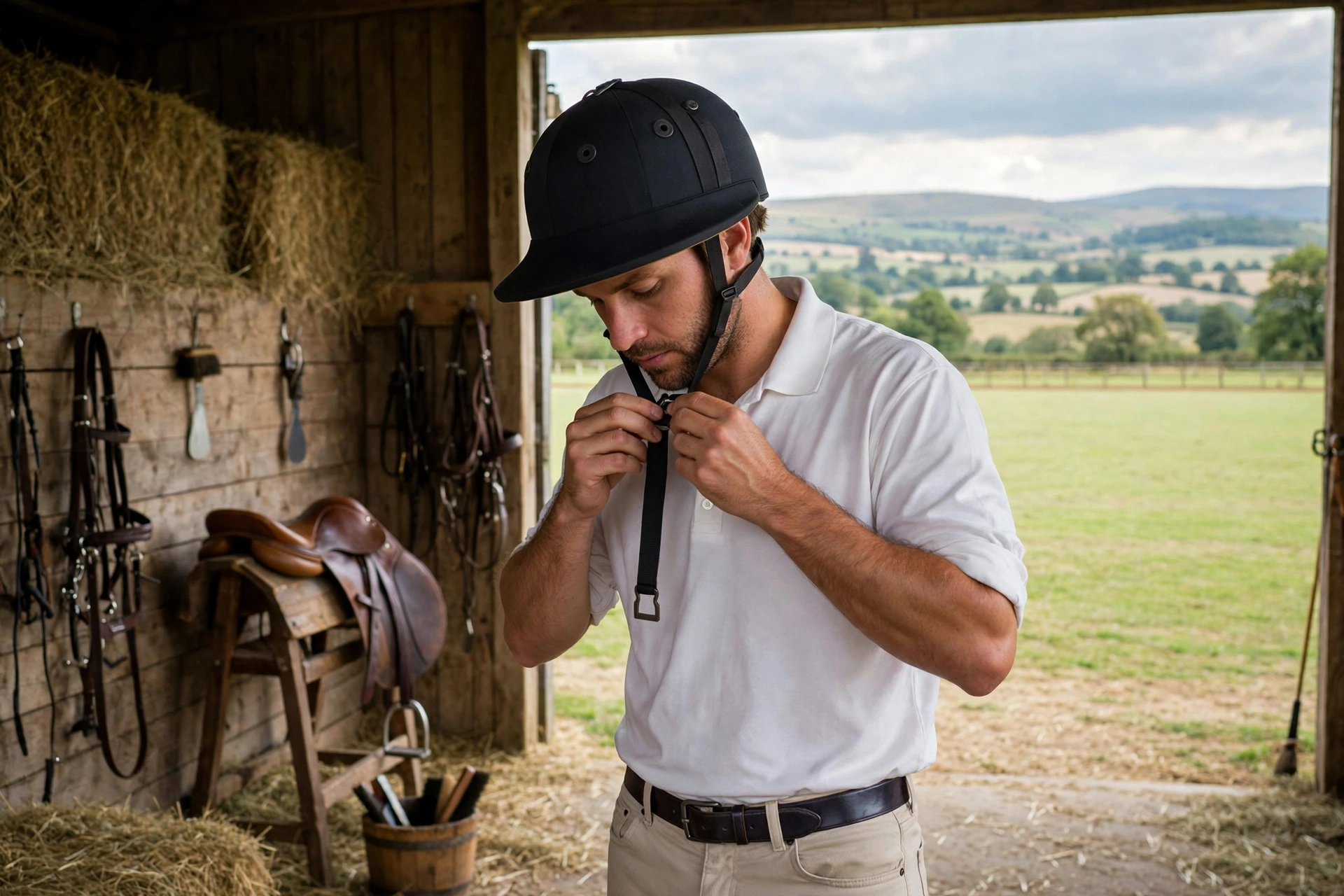
The harness is what keeps the helmet on your head in a fall, so it deserves as much attention as the shell fit. On a typical polo helmet’s three-point harness, work through it in this order:
- Side straps first. Adjust the straps so the junction point sits just below each earlobe. If the straps meet too far forward or behind the ear, adjust the sliders until they are even on both sides.
- Chin strap next. Buckle up and tighten until the strap is snug under your chin — about one finger should fit between strap and chin, no more. Too loose and the helmet can be rolled off in a fall; too tight and you will be tempted to loosen it mid-game.
- Check the back. If your helmet has an adjustable rear cradle or dial, set it to hold the back of your head gently so the helmet cannot tip forward over your eyes when you look down at the ball.
Once adjusted, do two field tests. First, the shake test: shake your head firmly side to side and up and down — the helmet should not shift or rock independently of your head. Second, the gallop test: jog a few strides, or ride a short, controlled canter, and check the helmet stays put through movement and a sudden stop. If it creeps, re-adjust or change size before you play in it.
What Are the Most Common Polo Helmet Fitting Mistakes?
The mistakes fitters see most often are predictable — and all of them reduce protection:
- Wearing it tipped back. A helmet worn high and back exposes the forehead and the front of the skull, exactly where protection is needed in a forward fall.
- Leaving the chin strap loose. An unfastened or slack harness is the single most common reason helmets come off in falls.
- Stuffing hair up inside. Hair piled under the shell raises the helmet, concentrates pressure, and lets it pivot. Use the hairport if your helmet has one, or wear your hair low.
- Ignoring hot spots. Pain is information. A persistent pressure point means the shell shape is wrong for you, and “breaking in” will not fix a mismatch.
- Trusting the size label alone. Two helmets with the same stated size can fit completely differently. The measurement gets you close; the try-on decides.
Helmet design also plays a role beyond fit. Many modern sports helmets now use rotational-impact systems to reduce twisting forces in a fall — our guide to what MIPS is and how it works in a helmet explains the idea, which is increasingly common across riding and cycling helmets.
When Should a Polo Helmet Be Replaced?
Replace a polo helmet immediately after any fall in which it takes an impact — even if it looks undamaged. The foam liner is designed to crush once to absorb energy, and that damage is often invisible. Riding on in a crashed helmet means riding with protection that has already been spent.
Also replace a helmet whose liner has compressed with age and sweat so it no longer fits snugly, one with a frayed harness, cracked shell, or damaged buckle, and any helmet past the maker’s stated service life. Sweat, sun, and heat all age a helmet faster, so store it somewhere cool, dry, and shaded. Re-check the fit every season and after any hairstyle change — a helmet that fitted last year can quietly become the wrong fit.
Frequently Asked Questions
Q: How tight should a polo helmet be?
A: Snug enough that it does not rock or shift when you shake your head, with even pressure all around and no painful hot spots. The chin strap should allow about one finger underneath it.
Q: Can I wear my hair up under a polo helmet?
A: Wear your hair exactly as you will in play when fitting the helmet. Avoid piling hair up inside the shell — it lifts the helmet and breaks the fit. Use a low ponytail or the helmet’s hairport if it has one.
Q: Does a polo helmet need replacing after a fall if it looks fine?
A: Yes. The impact-absorbing liner can be crushed invisibly in a single fall. Any helmet that has taken a hit should be retired and replaced, even with no visible damage.

Olivia
Writer at Helmet Today, covering helmet reviews, fit and riding safety.