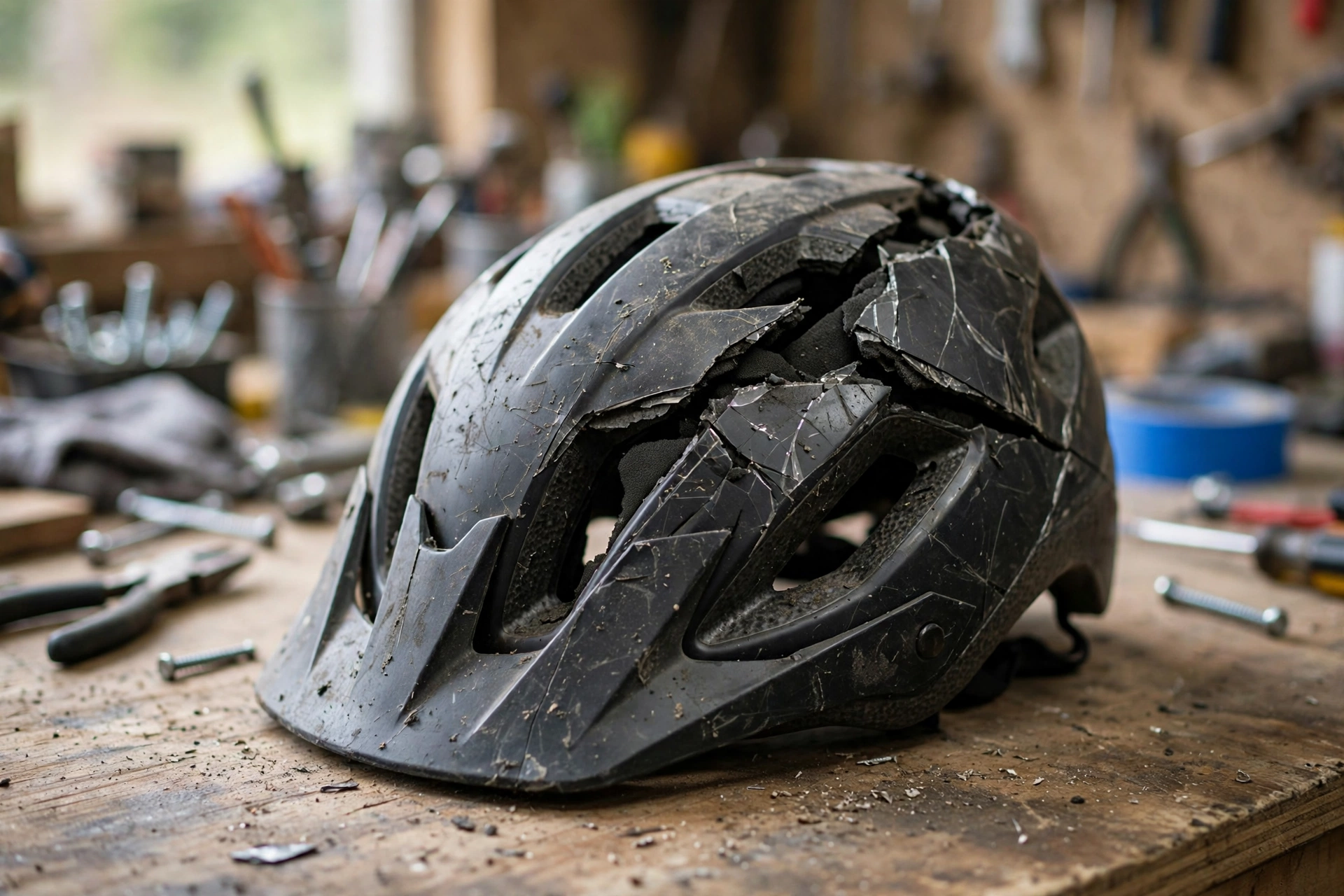
Replace your e-bike helmet after any crash where your head or the helmet hit something — the ground, a car, a curb, even a low branch at speed. The foam inside protects by crushing once, the damage is often invisible, and a crashed helmet cannot be trusted to protect the same way again.
This is the rule riders most want to negotiate with, because a good e-bike helmet is not cheap and the shell often looks fine afterward. It is also the rule with the least room for negotiation. This guide explains what happens inside the helmet during a crash, how to inspect one honestly, and the few situations where a drop does not automatically mean replacement.
What Happens Inside a Helmet During a Crash?
An e-bike helmet protects you with a layer of expanded polystyrene foam — EPS — between the shell and your head. In an impact, that foam crushes and absorbs energy that would otherwise go into your skull. The crushing is permanent by design: the foam cells collapse and do not spring back.
That one-time design is why a helmet can look undamaged and still be spent. The outer shell is flexible and often shows only a scuff, while the foam underneath has compressed in the impact zone. A second impact on the same spot meets foam that has already done its work.
E-bike crashes add energy. Heavier bikes and assisted speeds up to 28 mph on Class 3 models in general terms mean impacts can be harder than at pedal-bike speeds. Helmets certified to NTA 8776 in general terms are tested for higher-energy impacts, but no certification makes a helmet reusable after a crash.
How Do You Inspect a Helmet After a Fall?
Start by being honest about the event. If your head was in the helmet and the helmet struck the ground or another object, the decision is already made: replace it. Inspection is for the gray areas — a helmet knocked off a shelf, or a slow tip-over where you are unsure whether the helmet made contact.
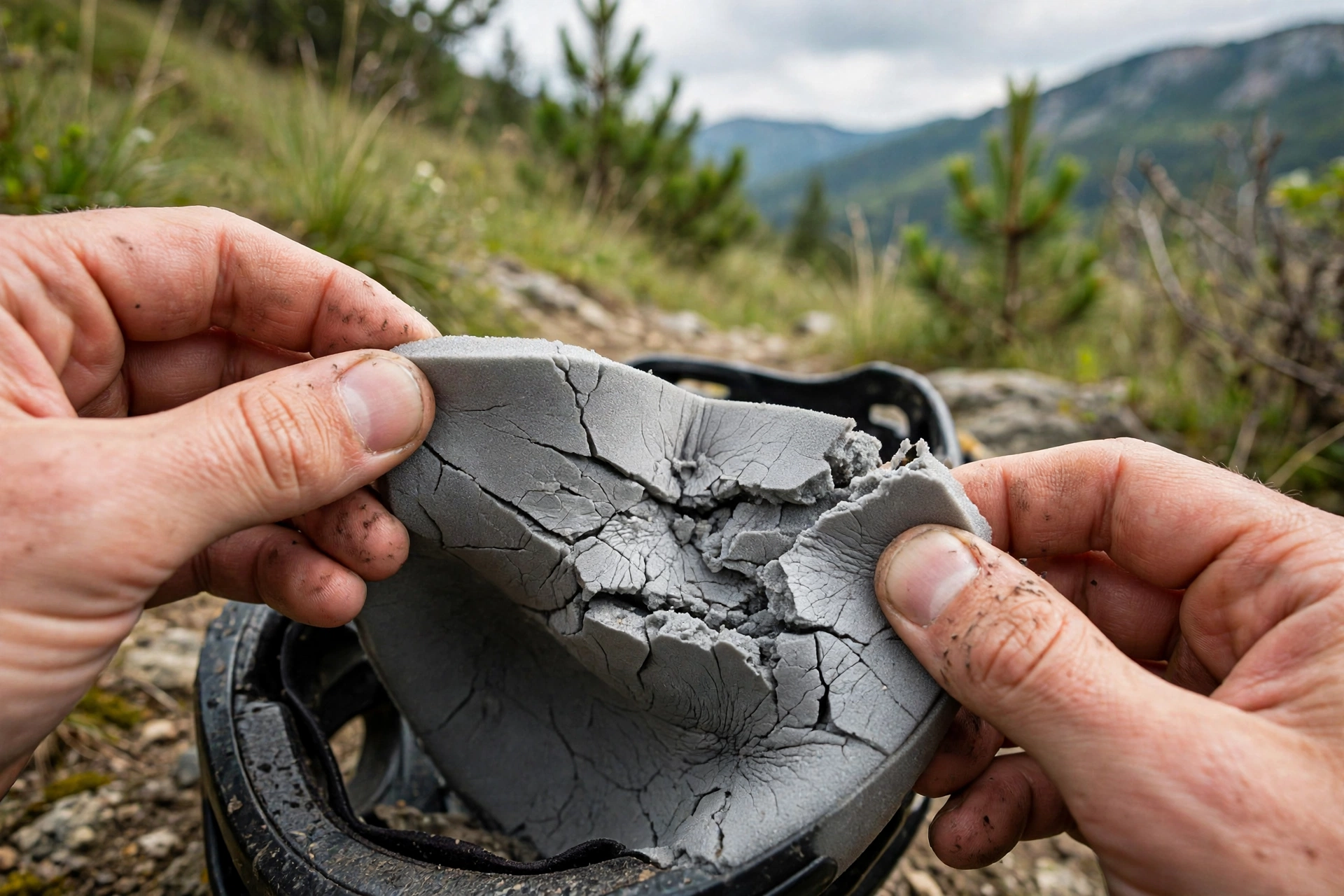
For those cases, remove the comfort liner and examine the foam carefully in good light. Look for cracks in the EPS, flat or shiny compressed patches, dents that mirror a mark on the shell, or foam that feels softer or thinner in one area. Run a thumb gently over suspect spots and compare them with the same area on the other side.
Check the rest of the helmet too: shell cracks or deep gouges, a visor mount that no longer sits straight, straps frayed or torn at the stitching, and a buckle or retention dial that no longer holds adjustment. Any one of those is a reason to retire the helmet even if the foam looks clean — and remember that passing your inspection is not a guarantee, only the absence of visible damage.
Does Dropping a Helmet on the Ground Ruin It?
Usually not, and the distinction matters. A helmet dropped empty from handlebar or table height onto a hard floor has no head inside it to drive the foam into crushing, so a simple drop rarely causes meaningful damage in general terms. Inspect the shell for cracks, shrug, and carry on.
The exceptions are height, weight, and repetition. A helmet that falls from a moving bike, tumbles down stairs, or drops with something heavy inside it — a lock, a water bottle — takes a harder hit. Repeated drops add up as well.
When in doubt, weigh the doubt itself. If you find yourself inspecting the same helmet anxiously before every ride, that uncertainty is the answer: a mid-range certified helmet costs far less than the confidence, let alone the protection, you are missing. Some manufacturers also offer crash-replacement discounts, so keep your receipt and check the brand’s policy before you buy the replacement at full price.
What About Crashes Where the Helmet Never Touched Anything?
They happen: you lay the bike down, slide on your hip and shoulder, and the helmet never strikes the ground. If you are certain the helmet made no contact — no scuffs, no dirt, no grass stains, and no memory of impact — the helmet itself may be fine.
Two cautions apply. First, crashes are chaotic and memory is unreliable; adrenaline edits details. Check for any mark you cannot explain, and ask anyone who saw it. Second, if you have any concussion symptoms at all — headache, dizziness, confusion, nausea — get checked medically regardless of what the helmet shows, and do not ride again until you are cleared.
Modern helmets add features that complicate the picture slightly. Rotational liners, like the systems explained in our article on what MIPS is and how it works, are designed to move in a crash and may not reset perfectly afterward — one more reason a helmet that has been in a real impact should be retired as a complete system, not judged by the shell alone.
When Else Should an E-Bike Helmet Be Replaced?
Crashes are the urgent trigger, but age retires more helmets. In general terms, manufacturers suggest replacing a helmet after a few years of regular use, because sweat, sunlight, heat, and everyday knocks gradually degrade foam, straps, and adhesives — none of which you can inspect directly.
Retire a helmet sooner if the fit has gone loose and new pads do not restore it, the retention system slips, straps are frayed or sun-bleached, the shell is cracked or deeply scratched from a drop, or the liner smells of mildew that washing will not shift. A hand-me-down or secondhand helmet with an unknown history belongs in the same category: never wear a helmet whose crash history you do not know.
To make the next replacement painless, write the purchase date inside the helmet or keep a photo of the receipt, keep the crashed helmet’s straps cut so nobody else uses it, and recycle or dispose of it according to local guidance. Then buy the replacement the same way you bought the first: certified, correct size, correct shape, fitted with your usual hairstyle in place.
Frequently Asked Questions
Q: My helmet only has a small scuff after a fall. Can I keep using it?
A: If your head was in it and it hit the ground or another object, replace it even if the scuff is the only visible mark. The foam crushes invisibly under the shell, and a visual check cannot clear it.
Q: I dropped my helmet off the table onto concrete. Is it ruined?
A: Probably not. An empty helmet dropped from a low height rarely suffers meaningful foam damage. Inspect for shell cracks or foam dents, and replace it if you find any — or if it fell from height or with something heavy inside.
Q: Does insurance or the manufacturer cover crash replacement?
A: Sometimes. Many brands offer a discounted crash-replacement program within a set period after purchase, and a driver’s insurance may cover gear after a collision. Keep your receipt and photos of the damaged helmet, and check both options before paying full price.

Olivia
Writer at Helmet Today, covering helmet reviews, fit and riding safety.