To fit a child’s riding helmet correctly, choose the right size for their head measurement, sit the helmet level about a finger’s width above the eyebrows, adjust it so it feels snug all around with no wobble, and fasten the harness so it sits under the chin with roughly two fingers of room — then re-check the fit regularly, because children grow. A helmet that rocks, tilts, or slips is the wrong size, whatever the label says.
This guide walks through measuring, fitting, and checking a kids’ helmet step by step, plus the mistakes that most often undo a good fit.
How Do You Measure a Child’s Head for a Riding Helmet?
Start with a soft tape measure. Wrap it around the child’s head at the widest part — just above the eyebrows and ears, across the bump at the back of the head — keeping it level and snug without squeezing. That measurement, in centimetres or inches, is what helmet size charts are built on, so measure twice and use the larger reading if they differ slightly.
Measure with the child’s hair as they will actually wear it to ride. A thick ponytail or bun changes the effective size and usually ruins the fit anyway; hair worn low and flat under the helmet is the arrangement to measure with. If your child is between sizes, the usual advice is to try both and choose the one that fits snugly without a pressure point — never the one with “room to grow into,” because a loose helmet shifts in a fall.
Head shape matters as well as size. Some children have rounder heads, others more oval, and brands are cut differently. A size that is right on the chart can still rock front-to-back on a particular child, which is why an in-person try-on at a tack shop, with staff who fit helmets daily, is worth the trip for a first helmet.
What Does a Correctly Fitted Kids’ Helmet Look Like?
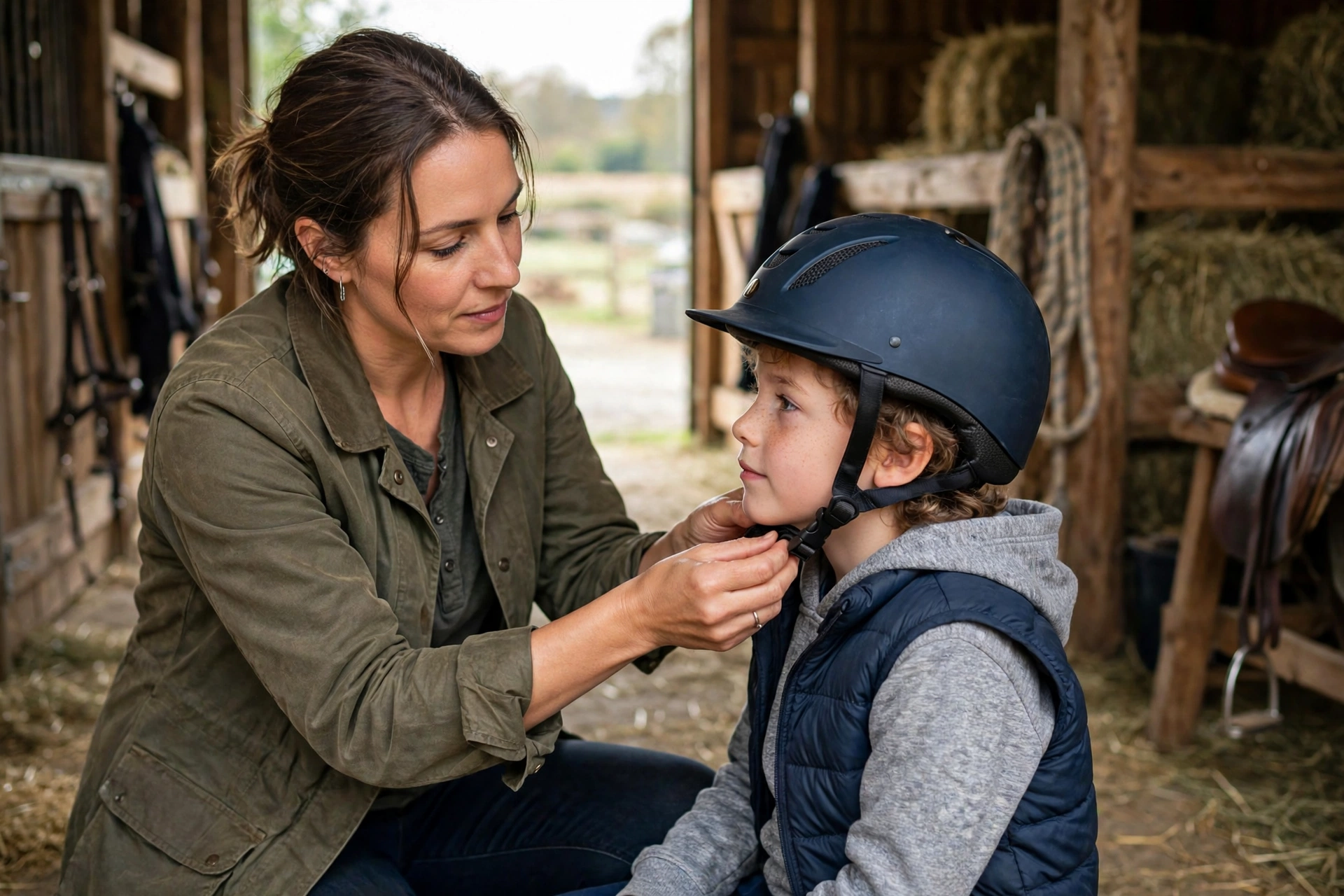
On the head, the helmet should sit level — not tipped back like a cap, not pulled down over the eyes — with the front edge roughly a finger’s width above the eyebrows. It should feel snug and even all the way around, like a firm hug, with no single spot digging in. The skin on the forehead should move slightly when you gently try to shift the helmet; if the helmet slides over the skin instead, it is too big.
Do the wobble test with the harness undone: ask the child to shake their head side to side and nod. A correctly fitted helmet stays in place. If it rocks, slips forward, or falls off, it is too large or the wrong shape — try a smaller size or a different model rather than tightening the harness to compensate, because the harness is there to keep a well-fitted helmet on, not to hold a loose one in place.
Check the harness itself: the straps should form a neat V under each ear, and the chin strap should sit snugly under the chin — in general terms, about two fingers should fit between strap and chin. Fastened correctly, the helmet should not roll off when you gently push up at the front edge.

Dial-Fit or Fixed Size: Which Suits a Growing Child?
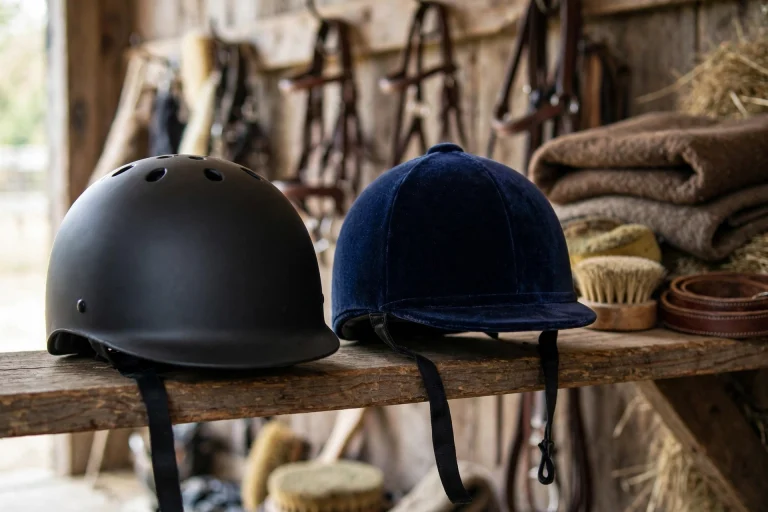
Many children’s helmets use a dial-fit system — a wheel at the back that tightens an internal cradle — which lets one helmet cover a range of sizes. That adjustability is genuinely useful for growing heads and for accommodating a winter hat’s worth of hair difference across seasons, and it makes a correct snug fit easier to achieve day to day.
Fixed-size helmets, padded to an exact size, can feel more solid and are what most older children and teenagers graduate to. Neither system is automatically safer: both are sold as certified helmets, and what matters is that the individual helmet fits the individual child today. Whichever type you choose, use the dial or padding to fine-tune a helmet that is already the right size — not to rescue one that is fundamentally too big.
One caution with dial systems: children love spinning the wheel. Check the setting yourself before every ride rather than assuming yesterday’s fit is still dialled in.
What Safety Features Should a Child’s Helmet Have?
Certification first: look for the label inside confirming the helmet meets a recognised standard such as ASTM/SEI or an accepted European equivalent. That label — not the colour, the brand, or the price — is what makes it a safety helmet. Avoid unbranded helmets with vague “safety tested” claims and no named standard.
Beyond certification, look for a harness that a child cannot easily loosen, a chin strap with a secure buckle they can learn to fasten correctly, and a shell that covers the back and sides of the head well. Some certified helmets add a low-friction liner designed to reduce rotational forces in a fall — understanding what MIPS is for helmets helps you judge whether that extra is worth it for your child. It is an addition to certification, never a substitute for it.
Buy new, not second-hand. A used helmet’s history — falls, drops, heat in a car boot — is invisible, and its protection may already be spent. A child’s helmet is one of the few purchases where “pre-loved” is a genuine risk.
How Often Should You Re-Check a Child’s Helmet Fit?
Children grow in spurts, and a helmet that fitted in spring can be tight or perched by autumn. Re-check the fit every few months and whenever your child complains of headaches, red marks, or a helmet that “feels funny” — complaints like those are fit information, not fussiness. If the helmet leaves a deep red line, rocks despite being the smallest adjustment, or sits higher than it used to, it is time to re-measure and likely replace.
Replace immediately after any fall in which the helmet struck the ground, even if it looks undamaged — the foam inside can be compressed in ways you cannot see. The same applies after a hard drop onto concrete. In general terms, a riding helmet also has a working life of roughly five years from first use, and a child’s helmet will usually be outgrown before it ages out.
Make the checks a habit your child copies: level, snug, harness fastened, every ride.
Frequently Asked Questions
Q: Should I buy a bigger helmet so my child can grow into it?
A: No. A helmet only protects when it fits snugly today. A too-big helmet rocks and can shift or come off in a fall. Buy the size that fits now — dial-fit models give some growing room safely, because the helmet still grips the head correctly at every setting.
Q: How tight should the chin strap be on a child’s helmet?
A: Snug under the chin with roughly two fingers able to fit between the strap and the chin — tight enough that the helmet cannot roll off, loose enough to be comfortable and let the child speak and swallow normally. Re-check it every ride; straps work loose and children fiddle with them.
Q: Can my child share a helmet with a sibling or friend?
A: Sharing is fine only if the helmet genuinely fits each child correctly — same snug, level fit, harness adjusted for that child. In practice, heads differ enough that a shared helmet usually fits one child well and the other badly. Each regular rider is better off with their own fitted helmet.

Olivia
Writer at Helmet Today, covering helmet reviews, fit and riding safety.