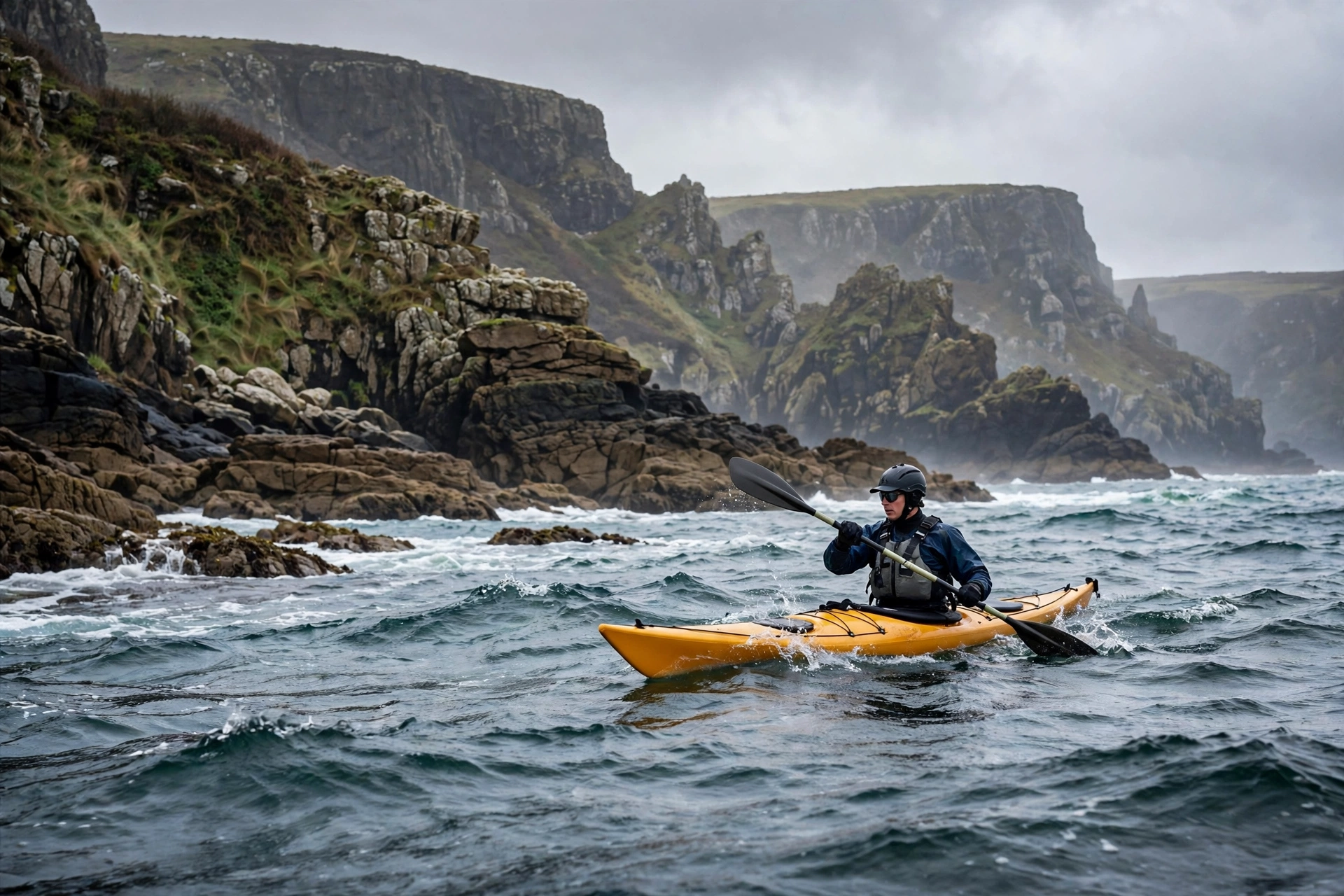
A sea kayak helmet and a whitewater helmet protect against different days: the whitewater helmet prioritises coverage, drainage, and staying put through rolls in rocky current, while a helmet for sea kayaking puts more weight on all-day comfort, sun and wind protection, and working with hoods, hats, and communication gear — and in general terms, either is better than using a helmet designed for neither environment.
This guide explains what actually changes between the two, and how to choose when your paddling covers both.
What Hazards Is Each Helmet Built Around?
The whitewater helmet is built around rock. On a river, the realistic head hazards are boulders at head height during a roll, a swim through a shallow rapid, and ledges met upside down. That drives the design: generous coverage of the sides and back of the head, ear coverage, a close locked-in fit, and quick drainage so the helmet is light again the moment your head is above water.
The sea kayaking helmet — where one is worn at all — is built around exposure and surf. Many sea kayakers paddle helmet-free in open water, because a capsize far from shore rarely puts the head near anything solid; the helmet comes out for rock gardens, surf landings, caves, and tide races, where the hazards start to resemble the river: rock, shallow bottoms, and being tumbled by moving water.
That difference in typical use changes the priorities rather than the principle. Both helmets are watersport helmets of shell and foam made to be soaked repeatedly; they differ in how much coverage, retention, and comfort equipment each assumes you need.
How Does Fit and Coverage Differ on the Sea?
Retention demands are lower, but not absent. A sea kayak helmet must survive a surf tumble and a wet exit, so it still needs a snug, level fit and a secure chin strap. It does not usually need the very low, locked fit of a creeking helmet, and many sea-oriented designs sit slightly higher and lighter as a result.
Coverage follows the hazard. Surf and rock-garden helmets still cover the ears and back of the head for the same reasons river helmets do. But because sea paddlers wear helmets for whole days when they wear them at all, vents, lighter shells, and room for a neoprene hood or a warm hat underneath matter more, and some designs are shaped specifically to sit over cold-water layers.
Brims diverge too: river peaks are tiny or absent so current cannot catch them, while a sea helmet may carry a more useful shade brim for hours of glare on open water — though in a genuine surf zone, the smaller peak remains the safer choice, for the same reason as on the river.

What About Cold, Wind, and Communication at Sea?
Sea kayaking adds equipment the river rarely involves. Paddlers wear hoods against cold and wind, carry radios, and need to hear a group spread out over distance. A helmet that fights your hood, muffles a radio call, or blocks the hearing that open water safety depends on will be taken off — and a helmet in the hatch protects nothing.
Practical sea helmets therefore tend to accommodate layers and leave the hearing as clear as their coverage allows, with ear panels shaped or vented rather than solid. Whitewater helmets make the same hearing compromise, but on the river the distances are short and the water loud anyway; at sea, a missed call can be the start of a real separation problem.
Visibility matters too. Bright colours that show against grey water and sky are a quiet safety feature at sea in a way they are not on a river, and some sea designs come in high-visibility finishes for exactly that reason.
Can One Helmet Serve Both Sea Kayaking and Whitewater?
For many paddlers, yes — with the whitewater helmet doing the covering. A good whitewater helmet worn at sea gives up a little all-day comfort and shade, but its coverage and retention exceed what surf and rock gardens demand, so it is a safe crossover in that direction. Put it on for the rock garden and the surf landing; go without, or keep it handy on deck, for the calm open crossing if that is your usual practice.
The reverse crossover needs more care. A light, comfort-oriented sea helmet used on a rocky river may lack the low coverage, ear protection, and locked fit the river assumes. If your rivers are gentle and deep, it may serve; on shallow, rocky whitewater it is the wrong tool.
Either way, the fit test is the same: level, snug, no rocking, strap secure, and worn with the layers you actually paddle in. And the impact design underneath is the same family of ideas — shell, energy-absorbing foam, and, in some models, systems for the angled rotational forces discussed in this guide to what MIPS is for helmets.
How Do You Decide Which Helmet to Buy First?
Buy for your hardest regular water, not your easiest. If most of your paddling is river running with occasional coastal trips, the whitewater helmet is the first purchase and covers the coast when needed. If you paddle the sea almost exclusively and your helmet is for surf landings and rock gardens, a sea-oriented design you will happily wear all day beats a creeking helmet that lives in the hatch.
- Mostly whitewater: buy the whitewater helmet; use it at sea for surf and rocks
- Mostly sea: buy the comfortable sea design; stay honest about its river limits
- Both seriously: the whitewater helmet first, a second lighter helmet later if comfort demands
Whatever you choose, buy condition as well as design: no crash history, sound straps, foam intact, and a fit checked on your own head. A helmet matched to your water and worn properly is the real answer; the sea-versus-river label is just how you get there.
Frequently Asked Questions
Q: Do sea kayakers normally wear helmets?
A: In general terms, many do not on open water, where a capsize is unlikely to put the head near anything solid, but most carry or wear one for surf landings, rock gardens, caves, and tide races. Local custom, group rules, and conditions on the day guide the choice.
Q: Is a whitewater helmet too much for sea kayaking?
A: No. It is more coverage and retention than the sea usually requires, which is a safe direction to err in. The only real costs are comfort, warmth on a long day, and a smaller shade brim. For surf and rocky coasts it is an entirely sensible choice.
Q: Can I use a sea kayak helmet on a river?
A: Carefully, and only on gentle, deep water. Light sea-oriented designs may sit higher and cover less of the ears and back of the head, and their retention may not match repeated rolling in current. On shallow, rocky whitewater, use a proper whitewater helmet instead.

Olivia
Writer at Helmet Today, covering helmet reviews, fit and riding safety.