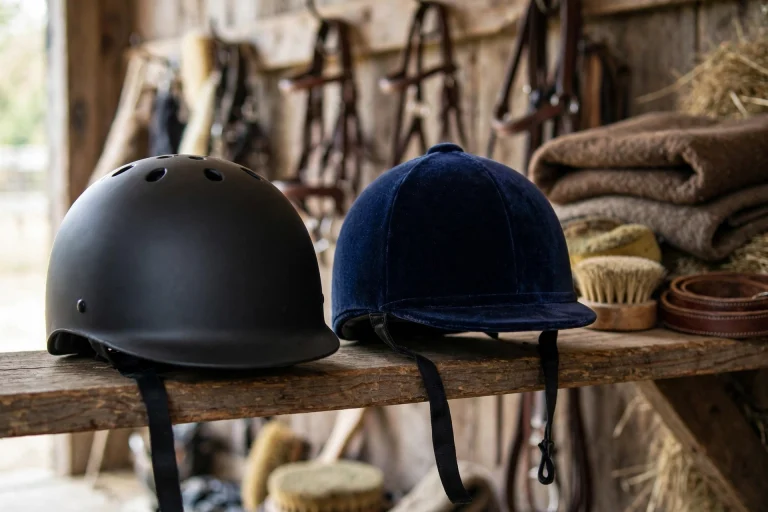
A riding helmet is too small if it perches high on your head instead of sitting level, presses painfully at one or two points — usually the forehead or temples — gives you a headache or leaves a deep red mark within minutes, will not pull down to a finger’s width above your eyebrows, or forces the harness to its limit; a correctly sized helmet feels snug and even all around, never painful at a single spot. Snug is safe; squeezed is too small.
This guide gives you the specific signs to check, in the shop or at home, and what to do when a helmet fails them.
What Are the Clearest Signs a Helmet Is Too Small?
Start with position. A too-small helmet cannot seat fully on the head, so it perches — sitting high, often tilted, with the front edge well above the finger’s width above the eyebrows it should sit at, and a visible gap between the helmet’s lower edge and your ears where coverage should be. If you press it down and it springs back up, it is riding on top of your head rather than around it.
Next, pressure pattern. A helmet that fits squeezes evenly; a small one concentrates force — a band of pain across the forehead, pinching at the temples, or pressure on the crown. That localised pain is the signature of too small. Numbness or tingling anywhere is an immediate verdict.
Finally, time. Put the helmet on, fastened, and keep it on for ten to fifteen minutes while you walk around the shop or tack room. A too-small helmet announces itself within that window with a building headache or a deep red line across the forehead when you take it off. A faint, even mark that fades in minutes is normal; a single deep groove with soreness is not.
How Can You Test the Size Before You Buy?
Measure first. Wrap a soft tape around your head just above the eyebrows and ears, at the widest point, and compare the measurement with the maker’s size chart — charts differ between brands, so use the chart for the helmet in your hands, not a size remembered from another make. If you fall between sizes, that brand’s cut may not suit you, and trying a different model is smarter than forcing the nearer size.
Then use the fitting tests. Level on the head, the helmet should stay put when you shake and nod with the harness undone — too small helmets often pass this test deceptively, because they grip by perching, so combine it with the position check: level, low enough, edges down where they belong. Try to roll the helmet off from the back; a seated helmet resists, a perched one pops up.
Wear it with your riding hairstyle and, if you wear glasses, with your glasses on — arms of glasses trapped by an undersized helmet create a pressure point that only appears after twenty minutes in the saddle.

Too Small or Just New? How Do You Tell the Difference?
This is the judgement that matters most, because new helmets are supposed to feel firm. Newness feels like even, all-around snugness that you stop noticing as you wear the helmet, and it eases slightly over the first several rides as the comfort padding settles. Too-small feels like localised pain that grows with time on your head — and it does not ease, because the shell and foam are a fixed size and your head is not compressing to meet them.
A reliable discriminator is the headache test. Fifteen minutes in a correct new helmet: awareness of snugness, no pain. Fifteen minutes in a too-small one: a headache starting, usually frontal. Another is contact: a small helmet presses hard at two points and barely touches elsewhere.
Do not rely on breaking in to rescue a small helmet. Padding settles by millimetres; a shell that is a size down is wrong by far more than that, and systems inside the helmet — including the rotational liners covered in this explanation of what MIPS is for helmets — are positioned assuming a correctly seated helmet.
What Problems Does a Too-Small Helmet Cause?
The first is simple misery: headaches, forehead pain, and a rider who dreads putting it on — and a dreaded helmet gets left off, loosened, or pushed up out of position, which is where a sizing problem becomes a safety problem.
The second is coverage. A perched helmet leaves the lower back and sides of the head — areas a correctly seated helmet is designed to cover — exposed, and it sits unstably, more likely to shift in the first instant of a fall before the foam can do its work. The harness also suffers: straps at their adjustment limit sit at wrong angles, and the V of the straps lands in the wrong place relative to the ears.
The third is false confidence in the other direction: because a small helmet feels tight, riders mistake it for secure. Tight-at-two-points is not secure — security is even contact plus correct position.
What Should You Do If Your Helmet Is Too Small?
If it is new and unworn, exchange it — for the next size up in the same model first, and if that size then rocks or gaps, for a different model or brand whose head shape matches yours. Round and oval heads are served differently by different makers, and the right helmet often turns out to be a different brand rather than a different size. Keep receipts and tags until the fit is proven across a full quarter-hour wear.
If the helmet is one you already own, do not modify it: never shave the liner, remove padding, or crush the foam to gain room — that removes protection where your head needs it. The manufacturer’s own thinner alternative liner, if offered, is the only acceptable adjustment, and even that cannot fix a shell that perches.
And if a helmet that used to fit now feels too small, ask why before replacing: a new hairstyle worn up, a hat liner added for winter, or — for children — simple growth are the usual answers. Re-measure, re-fit with everything you actually ride in, and replace with the size your head measures now. Fit is a current fact, not a permanent one.
Frequently Asked Questions
Q: Is a red mark on my forehead after riding normal?
A: A faint, even mark that fades within a few minutes is normal with a snug helmet. A deep, sore groove in one place — especially with a headache — means the helmet is pressing at a point rather than gripping evenly, which usually means it is too small or the wrong shape for your head.
Q: My helmet feels tight but the size chart says it is right. What is wrong?
A: Probably head shape rather than size. Charts measure circumference; helmets are also cut round or oval. A helmet can match your measurement and still pinch front-to-back or at the temples. Try another brand or model with a different internal shape before going up a size, which may just trade pinching for rocking.
Q: Can a helmet be too small even if I can fasten the harness?
A: Yes. The harness fastening only shows the straps reach — it says nothing about whether the shell has seated. A too-small helmet perches high, pinches at points, and can still buckle up. Judge by position, even pressure, and the fifteen-minute wear test, not by whether the buckle closes.

Olivia
Writer at Helmet Today, covering helmet reviews, fit and riding safety.