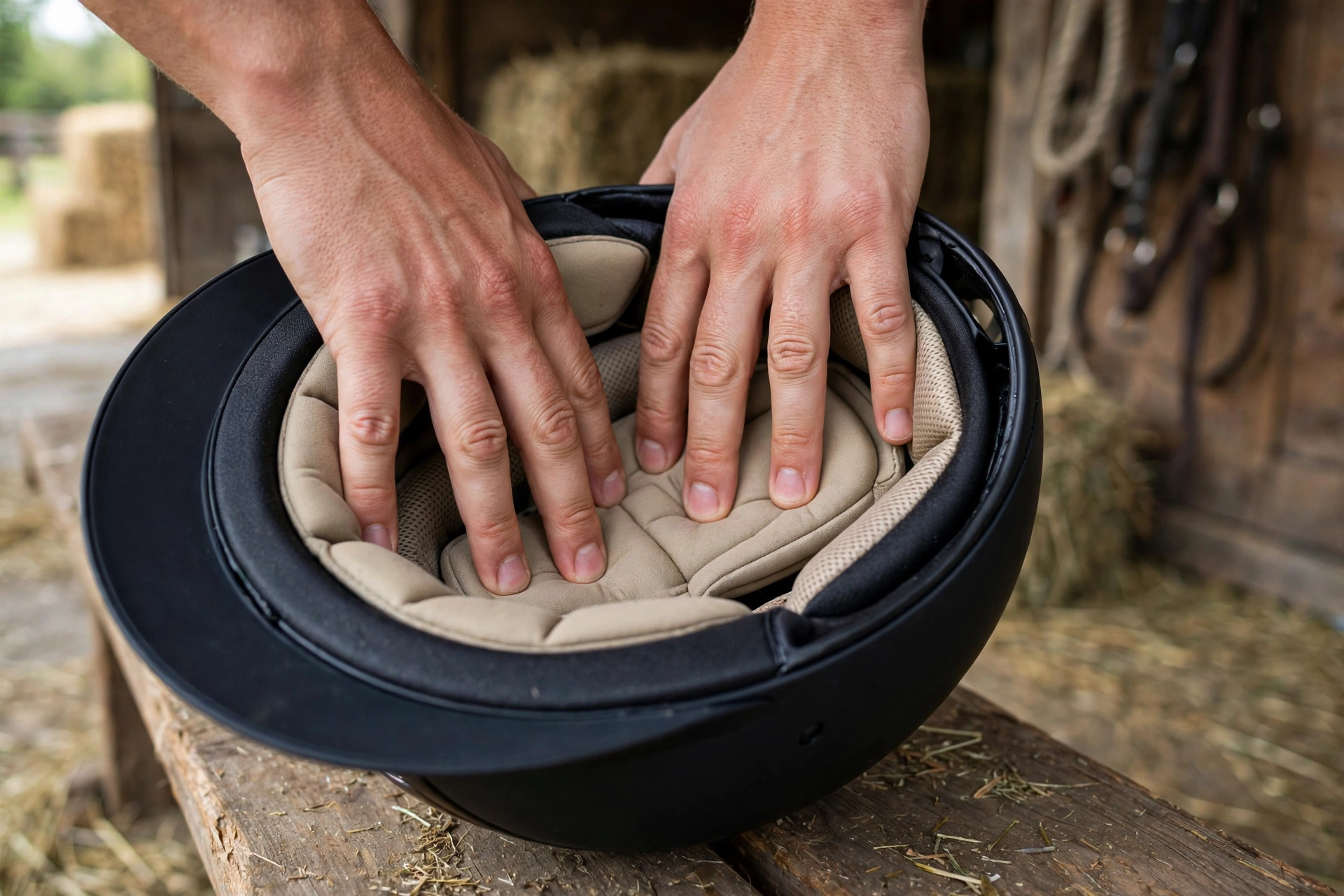
A new riding helmet does not really “break in” like leather boots — the impact foam does not soften or mould to your head — but the liner padding and harness do settle slightly over the first few rides, so a helmet that feels snug-but-comfortable when new usually feels just right within a week or two, while one that hurts or leaves you with a headache is simply the wrong size and will not improve. Judge a new helmet by that rule: firm and even is fine, painful is a return.
This guide explains what changes as a helmet settles, how to wear it in sensibly, and the warning signs that no amount of wearing-in will fix.
What Actually Changes as a New Helmet Settles?
The change happens in the comfort padding, not the protective foam. The soft liner that sits against your head compresses a little with warmth, pressure, and sweat, and moulds gently to the broad shape of your head — in general terms, most of that settling happens across roughly the first five to ten rides. The harness webbing also relaxes slightly and finds its natural path around your ears and chin.
The fit system settles too. Dial-fit cradles bed in and stop feeling prominent at the back, fixed padding stops feeling boardy, and your own habits settle: you learn exactly where the helmet sits level on your head and how the buckle likes to be adjusted. Much of “breaking in” a helmet is the rider and helmet learning each other.
What must not change is the protective structure. The impact foam keeps its shape and density by design — if it genuinely softened with wear, it would be failing at its job. That is why the settling is small by intention: expect a slight easing of newness, never a transformation from tight to loose.
How Should a Brand-New Helmet Feel?
Snug, even, and firm — like a close-fitting hat that grips the whole head rather than pinching one spot. The classic description is that it should feel like it is holding your head, with pressure spread all around and the skin of your forehead moving a little if you try to shift the helmet. It should sit level, about a finger’s width above your eyebrows, and stay put through a head shake with the harness undone.
A slight sense of newness is normal: padding that has never been worn feels firmer than it will in a fortnight, and many riders describe a new helmet as “secure” for the first few rides before it becomes unnoticeable. Unnoticeable is the destination — a well-fitted, settled helmet should disappear from your attention entirely while you ride.
Pain is not part of the process. A specific hot spot — one point on the forehead or temple that throbs — a headache within fifteen minutes, or numbness are all signs of a size or shape mismatch. Head shapes differ, and a helmet that is perfect for your friend in the same size may simply be the wrong shape for you. Exchange it; do not endure it.

How Do You Wear In a New Helmet Sensibly?
Wear it for real rides, in normal doses. There is no benefit to sleeping in it, clamping it, or trying to stretch it — and never attempt to compress the foam deliberately, steam it, or shave padding down, because thinning or crushing the liner removes protection in exactly the spot you altered. The only legitimate tools are time, warmth from your own head, and the manufacturer’s own fit pads or dial adjustment.
Use the adjustment the maker built in. Many helmets come with alternative liner thicknesses or shim pads precisely so the fit can be fine-tuned during the settling period: start with the standard setup, and only swap pads if, after several rides, a consistent slight looseness or tightness remains. Dial systems should be re-checked each ride during the first weeks, since the cradle settles as much as the padding does.
Wear your hair exactly as you ride, from day one — a helmet settled over a low ponytail will not fit the same over loose hair. And keep the tags-and-receipt question in mind: most retailers will exchange an unworn helmet, but a helmet that has been ridden in, dropped, or marked is yours, which is another reason the try-on at the shop deserves real time.
What Problems Will Breaking In Never Fix?
A helmet that rocks front-to-back or side-to-side is the wrong size or shape, and settling only makes rocking worse as padding compresses. A helmet that perches high, leaving a gap at the forehead, will perch forever. A helmet that gives you a headache in the shop will give you one at the yard. All three go back.
The reverse problem also exists: a helmet that feels perfect in the shop because it is already slightly loose will be sloppy within a month. Since padding only ever eases, the right new helmet is the snug one, not the comfy one — within the limits of the no-pain rule above.
And a note on protection systems: liners designed to manage rotational forces need the helmet to sit exactly as fitted to do their work — this piece on what MIPS is for helmets explains why fit precision matters for them. A helmet “broken in” by force or alteration can disturb how those layers sit and move, which is one more reason to let settling happen naturally or not at all.
When Should You Stop Persevering and Exchange It?
Give a promising helmet a fair trial: several proper rides over about two weeks, with the fit re-checked each time. By then the padding has done all the settling it will do. If a mild, even snugness has eased into comfort, you are done — that is a broken-in helmet, and it should now serve for years.
If specific symptoms persist — the forehead hot spot, headaches, a numb patch, rocking that adjustment cannot cure — stop. The helmet is telling you its shape and your head’s shape disagree, and no further wearing changes that. If the shop’s policy allows, exchange for a different model or brand cut; head-shape ranges differ enough between makers that the next one often fits immediately.
If the helmet has been dropped or involved in any fall during the trial, the conversation changes completely: it is not exchanged, it is replaced at your cost and retired, because impact damage is invisible and permanent. Fit experiments never outrank that rule.
Frequently Asked Questions
Q: How long does a riding helmet take to break in?
A: The comfort padding settles over roughly the first five to ten rides — about one to two weeks of normal use. After that, the fit is what it will stay. If the helmet still hurts or rocks after that period, it is the wrong size or shape, not a helmet that needs more time.
Q: Should a new riding helmet feel tight?
A: Snug, yes; painfully tight, no. It should grip evenly all around and stay put when you shake your head, with no single pressure point, headache, or numbness. Buy the snug helmet — never one that hurts hoping it will stretch.
Q: Can I speed up breaking in by stretching or padding the helmet?
A: No. Never crush, steam, shave, or force the liner — altering the foam or padding removes protection. The only safe adjustments are the maker’s own fit pads, alternative liners, or dial system, used as instructed. Genuine settling needs nothing but ordinary rides.

Olivia
Writer at Helmet Today, covering helmet reviews, fit and riding safety.