To fit rugby headgear correctly, choose a size that sits snugly all around your head, pull it on so the ear holes line up with your ears, and fasten the chin strap so the headgear stays put when you move. Rugby headgear is soft padded headgear, not a hard helmet, so a good fit is what keeps the padding where it is meant to be during a game. If it slides, bunches, or covers your eyes, it is the wrong size or it is not adjusted properly.
Fitting matters because rugby headgear only works when the padding stays in contact with the parts of the head it is designed to cover. Loose headgear can shift in a tackle or a ruck, leaving an ear or the side of the head exposed. Headgear that is too tight, on the other hand, can distract you, press on your temples, or give you a headache long before the final whistle. This guide walks through measuring, trying on, adjusting, and testing rugby headgear so you can get the fit right before match day.
What Is Rugby Headgear, and How Is It Different From a Helmet?
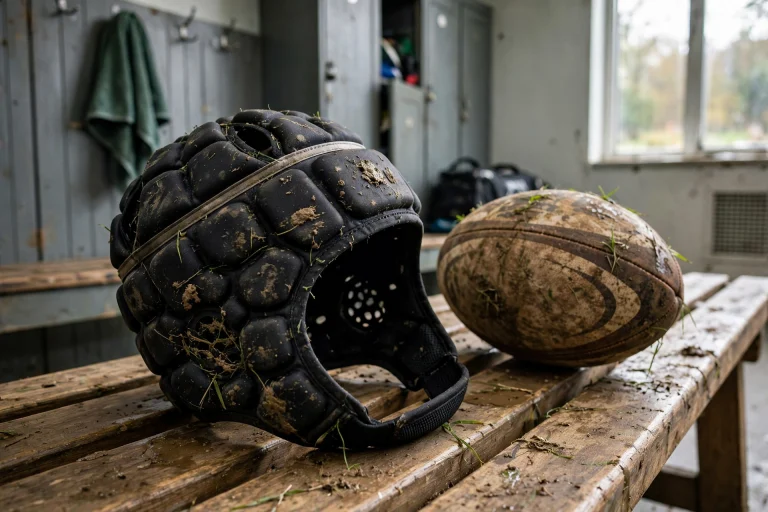
Rugby headgear, often called a scrum cap, is a soft, padded covering made from foam and fabric that fits closely over the head and ears. It is not a hard helmet, and it does not work like one. A hard helmet has a rigid outer shell designed to spread the force of an impact, while rugby headgear is a thin layer of padding that sits directly against the head. In general terms, it is designed to help protect the ears and scalp from scrapes, knocks, and friction in tackles, rucks, and scrums.
That difference matters when you set your expectations. Rugby headgear should not be relied on to prevent concussion, and no soft headgear can make rugby a risk-free sport. What it can do, when it fits well, is reduce cuts and grazes to the ears and scalp, cushion minor bumps, and give players a little extra confidence in contact. Players who wear it for the wrong reasons — believing it makes them invulnerable — may take risks they would otherwise avoid, so it is important to understand what it is and what it is not.
How Do You Measure Your Head for Rugby Headgear?
Start by measuring around your head with a soft tape measure. Place the tape just above your eyebrows and ears, around the widest part of your head, and keep it level all the way around. Take the measurement twice to be sure, and write it down. Then compare that number with the maker’s size chart, because sizes are not the same across brands — a medium from one maker may match a large from another.
If your measurement falls between two sizes, the choice depends on the model. In general terms, headgear with a lot of stretch may suit the smaller size, while a model with firmer foam may be more comfortable in the larger size. If you can try both, do so, and wear each one for several minutes rather than just pulling it on for a second. A size that feels fine for ten seconds in a shop can start to pinch after ten minutes of warming up.
How Should Rugby Headgear Feel When It Is On?
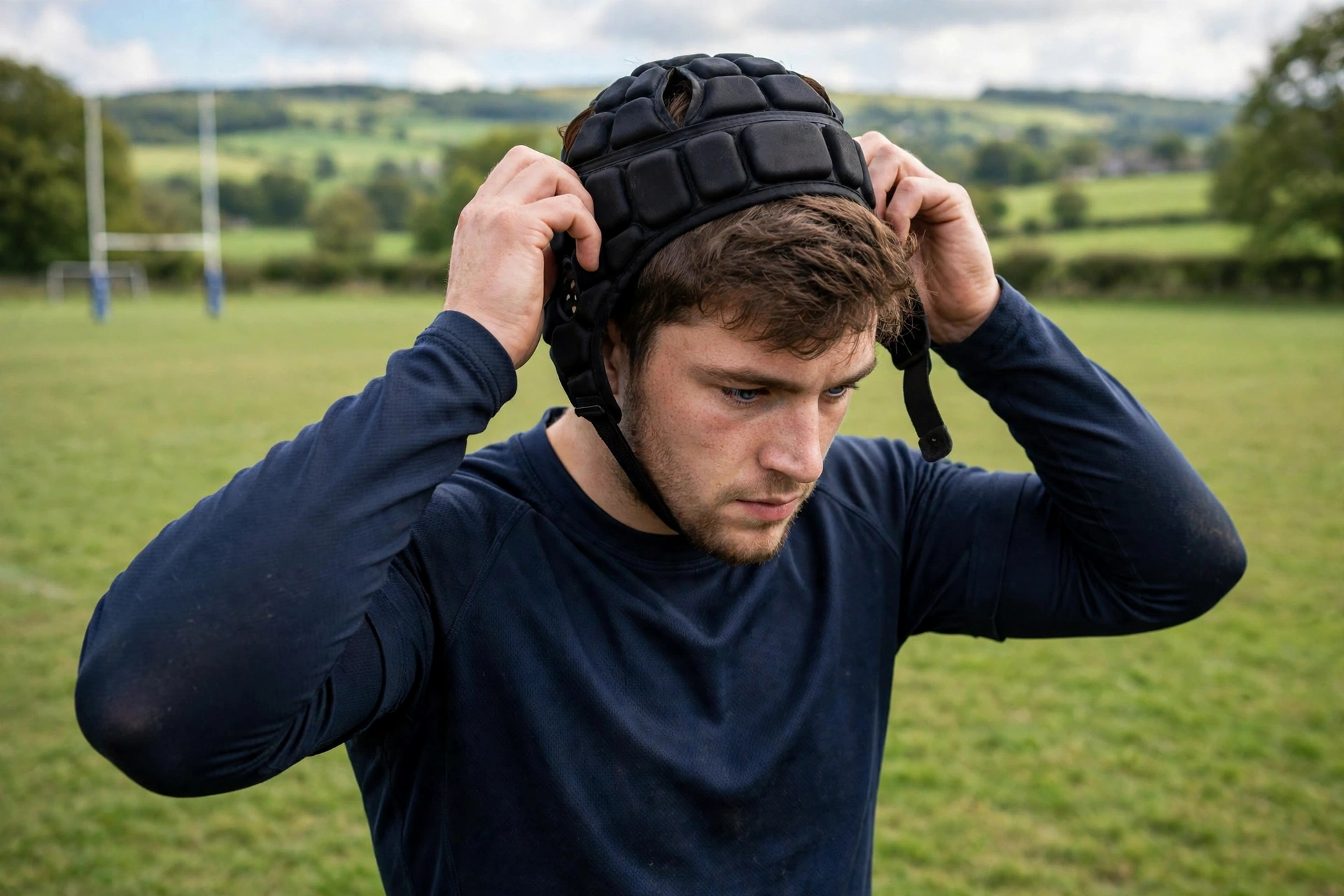
Well-fitted rugby headgear should feel snug all around, like a firm cap, with no loose fabric and no pressure point that throbs after a few minutes. The padding should sit flat against your head without bunching at the front or riding up at the back. Your ears should sit inside the ear holes or ear cups, so you can hear clearly, and the front edge should sit above your eyebrows without sliding down over them.
Do a few simple checks once it is on. Shake your head from side to side and nod up and down — the headgear should move with your head, not slide on its own. Open your mouth wide and talk: the chin strap should hold without cutting into your chin or jaw. Run a finger around the edge: you should feel even contact all the way around, not a tight band in one place and a gap in another. If any of these checks fail, adjust the straps first, and if that does not fix it, try another size.
How Do You Adjust the Chin Strap and Laces?
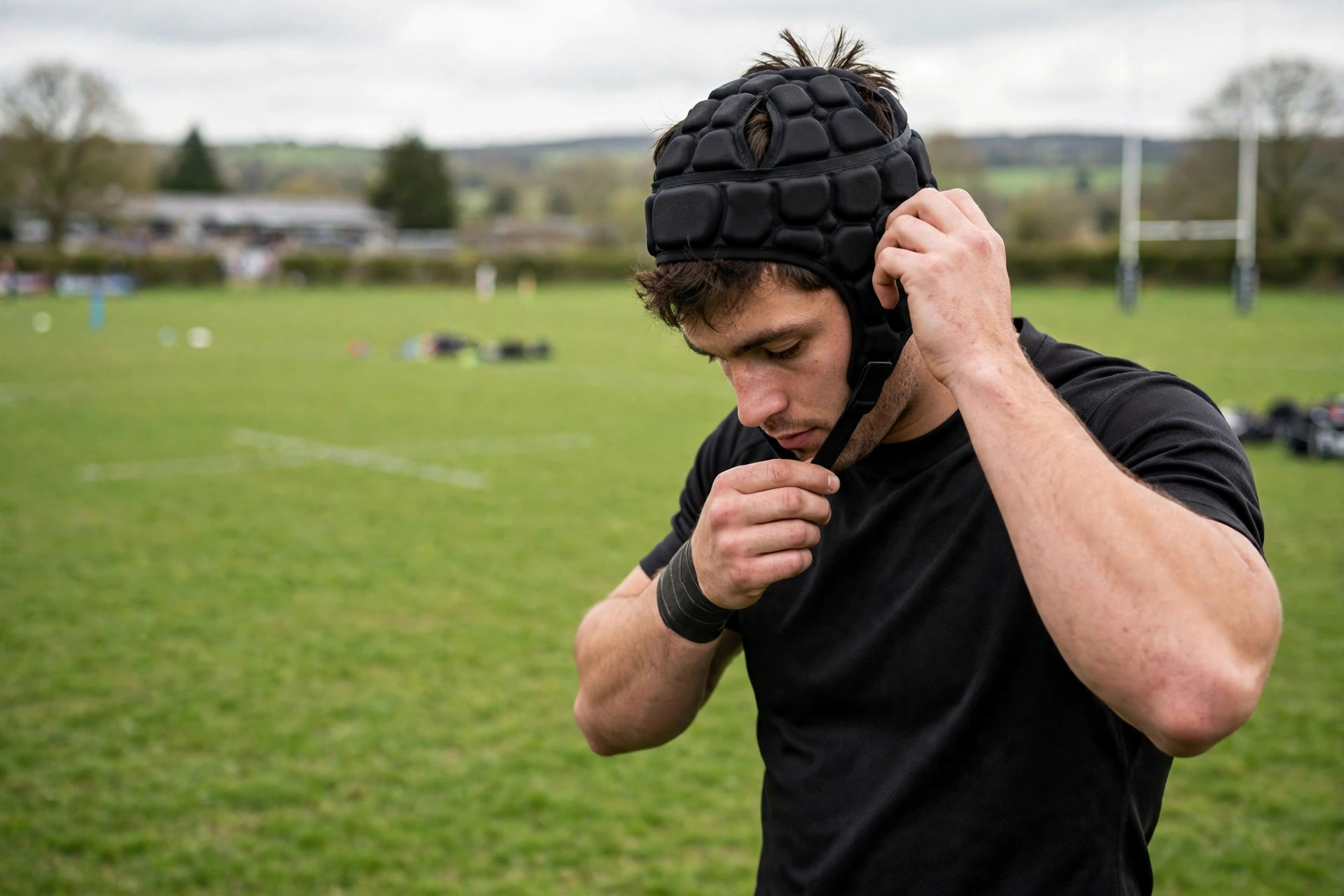
Most rugby headgear fastens with a chin strap, and some models also have laces at the back or a drawstring to fine-tune the fit. Start with the headgear pulled fully on, then fasten the chin strap so it sits snugly under your chin. You should be able to fit one finger between the strap and your chin, but not much more. A strap that hangs loose lets the headgear shift in contact, while a strap pulled too tight can make it hard to talk or breathe comfortably.
Once the straps are set, do a final check by jogging on the spot and turning your head sharply, as you would when tracking the ball. The headgear should stay in place without needing to be pushed back. If you are learning about helmet technology in general, reading about what MIPS is for helmets can help you understand one of the features you may see listed on hard helmet boxes, even though soft rugby headgear does not use that system. Keep the straps as they are once you find a setting that works, and check them again before each game.
What Are the Most Common Fitting Mistakes?
The most common mistake is wearing headgear that is too big. Players often choose a larger size for comfort, but loose headgear is the least useful kind: it slides over the eyes in a tackle, twists to one side in a ruck, and leaves the ears uncovered at the moment it is needed most. If you can easily pull the headgear off without undoing the strap, or if it rotates freely on your head, it is too loose.
The second mistake is wearing it too far back, like a cap pushed up on the forehead. Rugby headgear should sit low enough to cover the forehead and the tops of the ears, with the front edge just above the eyebrows. Worn too far back, it leaves the forehead exposed and lets the padding bunch at the back of the neck. The third mistake is leaving the chin strap undone or too loose, which is common in training — but a strap that is not fastened properly means the headgear can come off or shift in the first contact.
Frequently Asked Questions
Q: Should rugby headgear feel tight when it is new?
A: It should feel snug, but not painful. In general terms, the foam and fabric may give a little with wear, so a fit that is firm but comfortable is right; a fit that pinches or gives you a headache is too tight.
Q: Can I wear rugby headgear over long hair?
A: Yes, but fit it with your hair tied back in the style you will wear for the game. A bun or ponytail changes the shape of the head, so check the fit with your match-day hairstyle, not with your hair loose.
Q: Does rugby headgear need to be replaced if the fit changes?
A: Yes. If the foam has compressed, the fabric has stretched, or the straps no longer hold it snugly, the fit has changed and the headgear may not stay in place. Check the fit regularly and replace it when it no longer fits well.

Olivia
Writer at Helmet Today, covering helmet reviews, fit and riding safety.