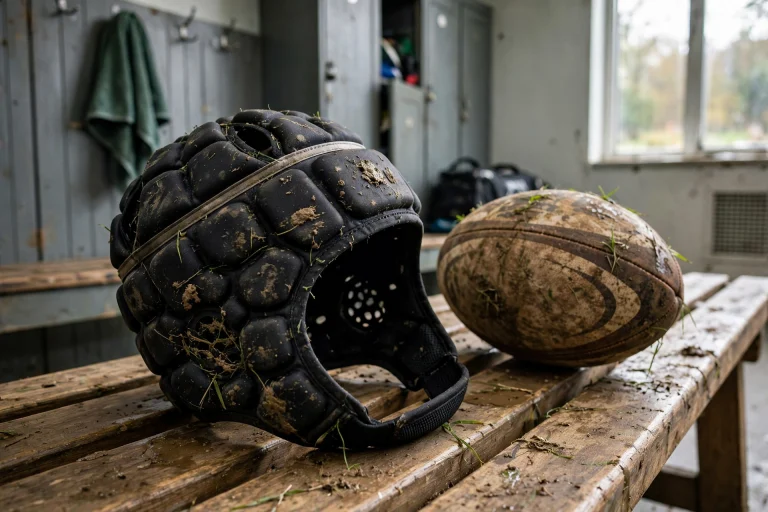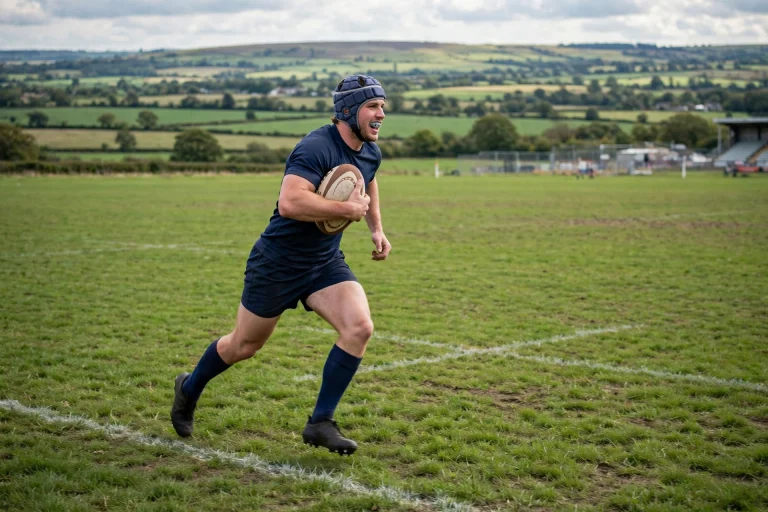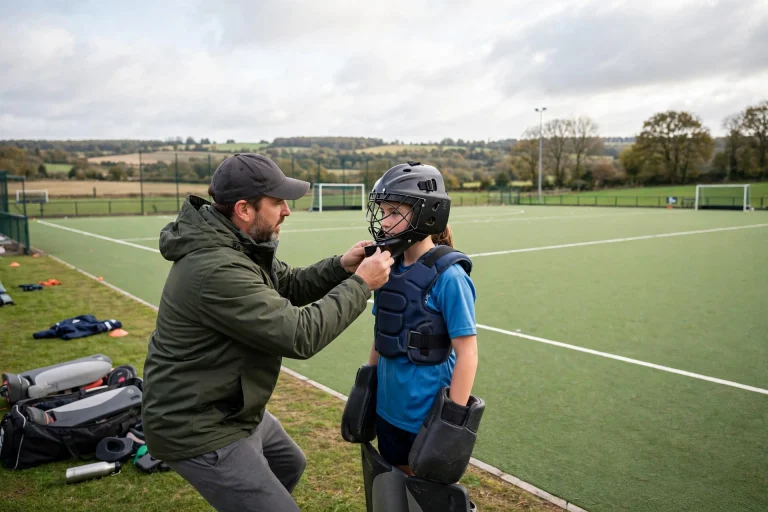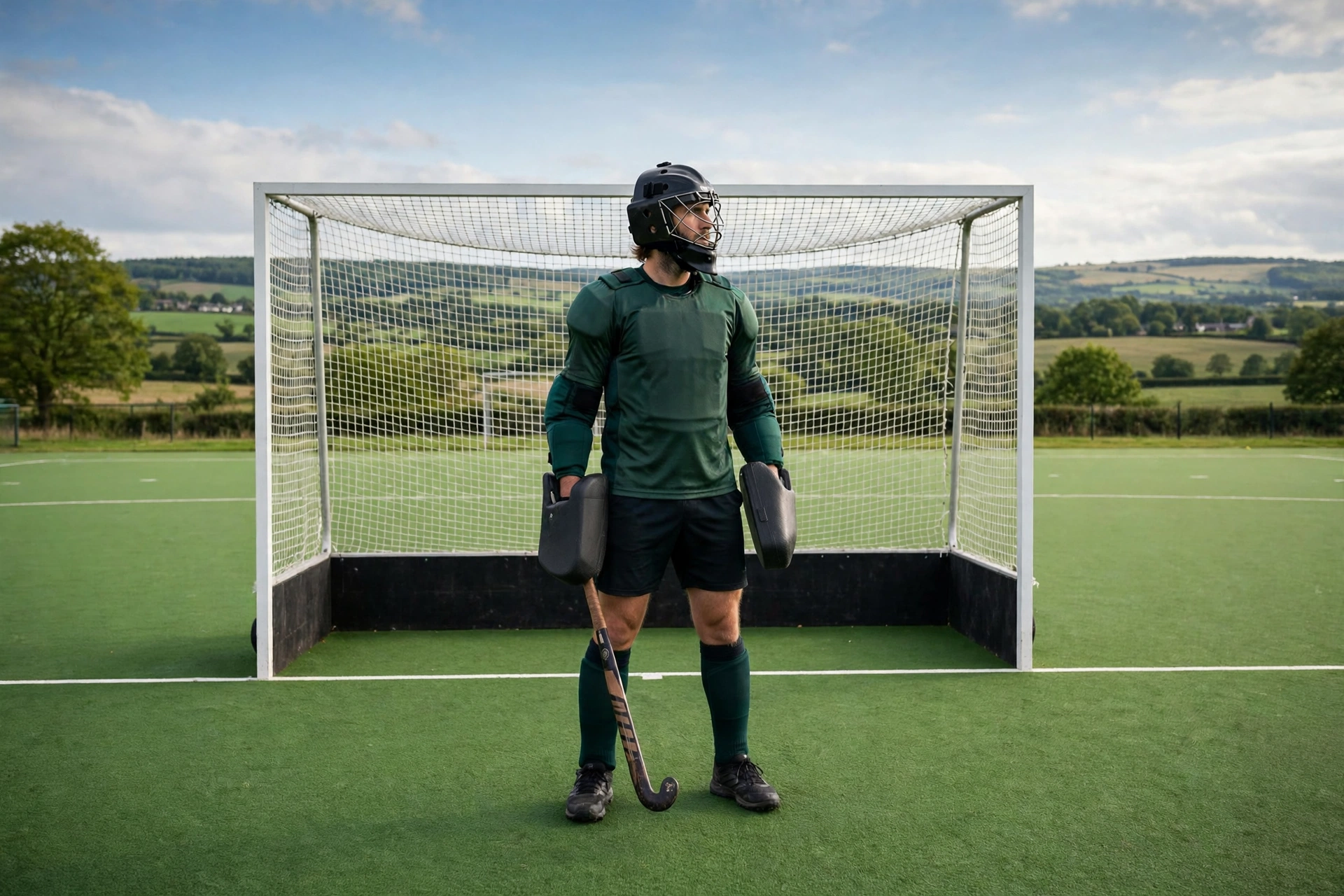
A field hockey goalkeeper helmet is a hard, full-coverage helmet designed to protect the goalkeeper’s head and face from a fast, hard hockey ball and from the stick swings that happen close to the goal. Unlike the light head protection sometimes worn by field players, the goalkeeper helmet covers the whole head and the face, usually with a cage or grille across the front, and it is built to take direct hits at close range.
The goalkeeper is the one player on the pitch who faces the ball head-on, again and again, often from a few metres away. This guide explains what the helmet is, how it differs from other hockey head protection, what it is made of, and what to look for when choosing one.
What Is a Field Hockey Goalkeeper Helmet?
A field hockey goalkeeper helmet is a purpose-built helmet worn by the goalkeeper, the player who defends the goal. It is a hard shell that covers the crown, sides, and back of the head, with a faceguard or cage across the front. The faceguard is usually made of metal bars or a strong grille, arranged so the goalkeeper can see the ball clearly while the face is shielded.
The helmet exists because of the nature of the goalkeeper’s job. Attackers shoot a hard ball at the goal from close range, and the goalkeeper’s head is directly in the line of fire. The ball can be lifted, flicked, or driven at speed, and the goalkeeper may also be close to swinging sticks in a crowded goalmouth. No other player on the pitch faces that combination of risks as often.
How Is It Different From a Field Player’s Head Protection?
Field players in hockey generally wear no helmet at all. Some wear a soft face mask, usually only for short corners, to protect the face while defending a set piece. These masks are lightweight, cover the face only, and are taken off again once the short corner is over. They are not full helmets, and they are not worn for the whole game.
The goalkeeper helmet is a different thing entirely. It is a full helmet, worn for the whole match, and it covers the head as well as the face. It is heavier and more substantial than a field player’s face mask, because it has a harder job to do. A goalkeeper who faces shot after shot needs protection that stays in place and covers everything, not a mask that is put on and taken off.
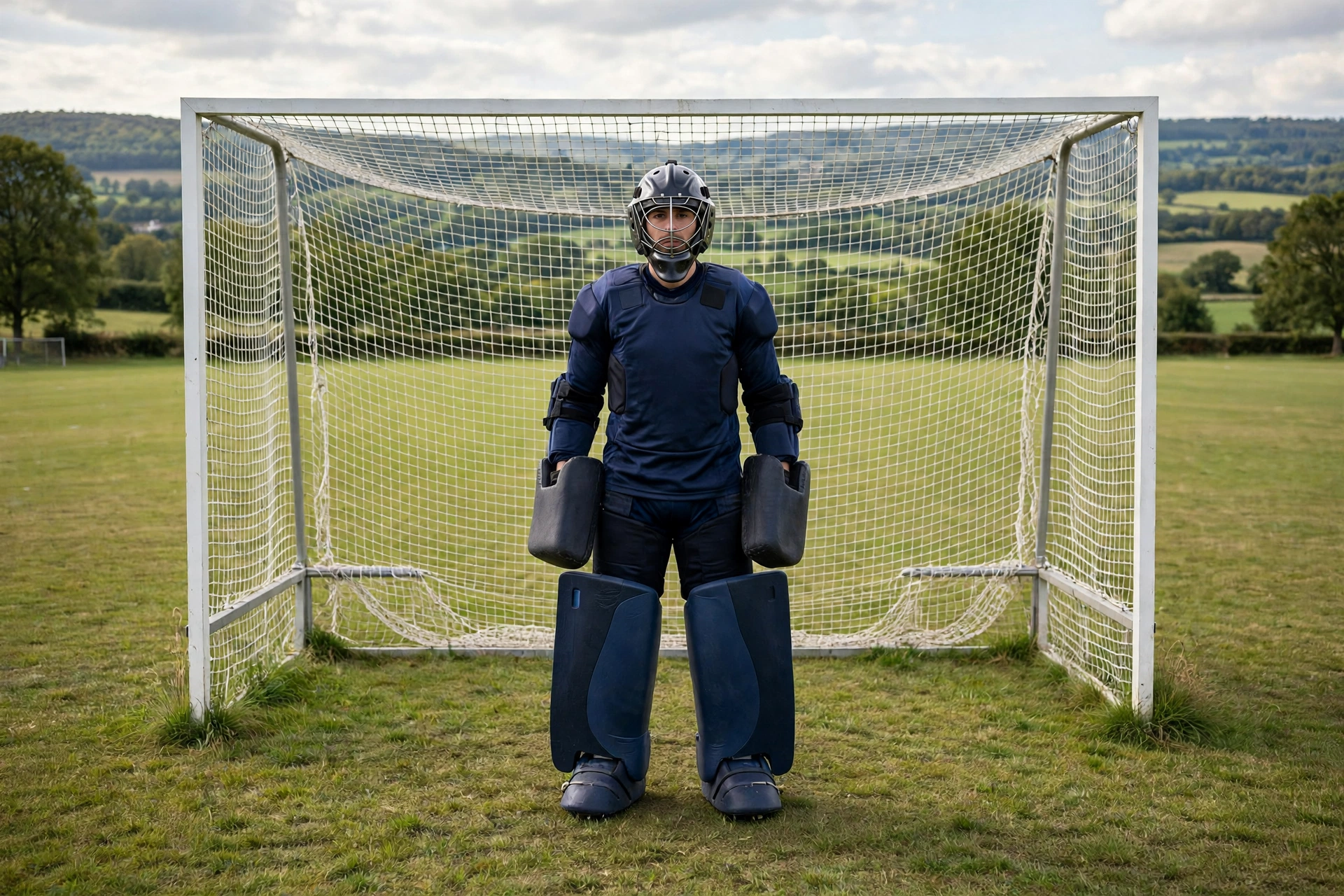
What Parts Make Up a Goalkeeper Helmet?
A goalkeeper helmet has several parts that work together. The outer shell is the hard covering, usually made from a tough plastic or composite material, and it spreads the force of an impact across a wider area. Inside the shell is padding, which cushions the head and helps the helmet fit snugly.
The faceguard is the cage or grille across the front. It is usually made of steel or another strong metal, with bars spaced so the goalkeeper can see through them while the eyes, nose, mouth, and jaw are protected. Some helmets have a faceguard that can be removed or replaced, which is useful if a bar is bent or damaged.
Then there is the fastening system: a chin strap, often with a cup or pad under the chin, and sometimes extra straps or adjustment points at the back. Many helmets also include a throat guard, a padded flap that hangs below the chin to protect the throat, and ear coverage built into the sides of the shell. Together, these parts make a helmet that protects the whole head, not just the top of it.
How Does the Helmet Work With Other Goalkeeper Kit?
The helmet does not work alone: it is part of a full set of goalkeeper equipment. The goalkeeper also wears leg guards, kickers on the feet, a chest protector, arm guards, gloves, and sometimes padded shorts. The helmet needs to fit comfortably with all of these, especially the chest protector and any throat guard, so that nothing pushes the helmet out of position.
The throat guard is the most closely connected piece. Some throat guards attach directly to the helmet, and others hang from the chest protector. Either way, the two should meet without a gap, and without the throat guard pushing the helmet up or the helmet pushing the throat guard down. Checking this in training, not on match day, is the sensible approach.
When Should a Goalkeeper Helmet Be Replaced?
In general terms, a goalkeeper helmet should be replaced if it has taken a heavy impact, if the shell is cracked, if the faceguard bars are bent, or if the straps or padding are worn out. A helmet that has done its job in a hard impact may not be safe to use again, even if the damage is hard to see from the outside. When in doubt, replacing the helmet is the safer choice.
Age and wear matter too. Padding compresses over time, straps stretch, and the shell can weaken with repeated knocks and exposure to sun and weather. A helmet that has been used for several seasons of regular play should be checked carefully at the start of each season, and any sign of damage should be taken seriously.
What Should You Look for When Choosing a Goalkeeper Helmet?
Start with the size range and the fit. A good goalkeeper helmet comes in sizes, and the right one is the size that fits the goalkeeper’s head, not the one that matches an age label. The helmet should sit level, feel snug, and stay in place when the goalkeeper moves, dives, and gets up again.
Look at the faceguard next. The bars should be strong, firmly fixed, and spaced so the goalkeeper can see clearly. Check that the faceguard gives good coverage at the sides of the face and the jaw, and that it does not press against the nose or chin. A removable faceguard is a bonus, because it makes replacement easier if a bar is damaged.
Finally, check the padding, the straps, and the throat protection. Padding should be comfortable and, ideally, removable for washing. Straps should adjust easily and hold firmly. And the throat should be covered, either by the helmet itself or by a throat guard that fits with it. If you want to understand the technology inside modern helmets, reading about what MIPS is for helmets is a helpful introduction, although not every hockey goalkeeper helmet uses this system.
Frequently Asked Questions
Q: Do field hockey goalkeepers have to wear a helmet?
A: In general terms, yes. The goalkeeper wears a full helmet as part of the standard goalkeeping kit, because the goalkeeper faces hard shots at close range. Field players, by contrast, generally wear no helmet, although some wear a face mask for short corners.
Q: Is a field hockey goalkeeper helmet the same as an ice hockey goalie mask?
A: No. They are made for different sports and different risks. A field hockey goalkeeper helmet is designed around a hard ball, a stick, and an outdoor pitch, while an ice hockey mask is designed for a puck and the ice. Each should be used only for its own sport.
Q: How long does a field hockey goalkeeper helmet last?
A: That depends on how often it is used and how hard it is hit. In general terms, a helmet should be replaced if the shell is cracked, the faceguard is bent, the straps or padding are worn, or it has taken a heavy impact. Check it carefully at the start of each season.

Olivia
Writer at Helmet Today, covering helmet reviews, fit and riding safety.