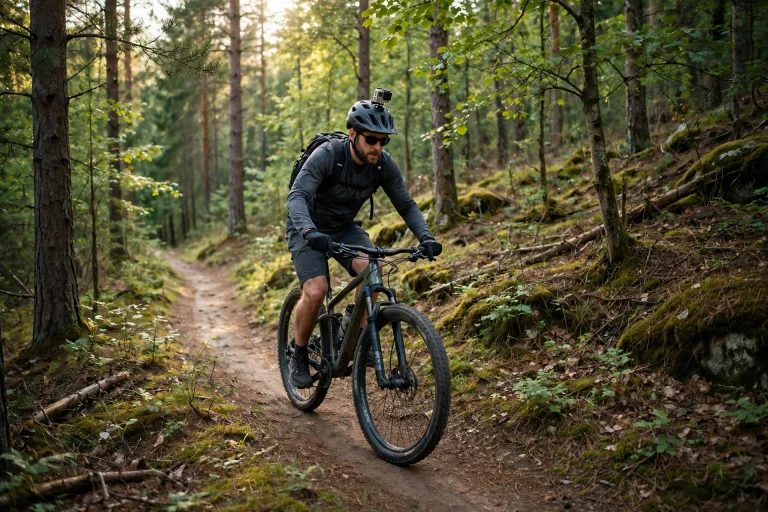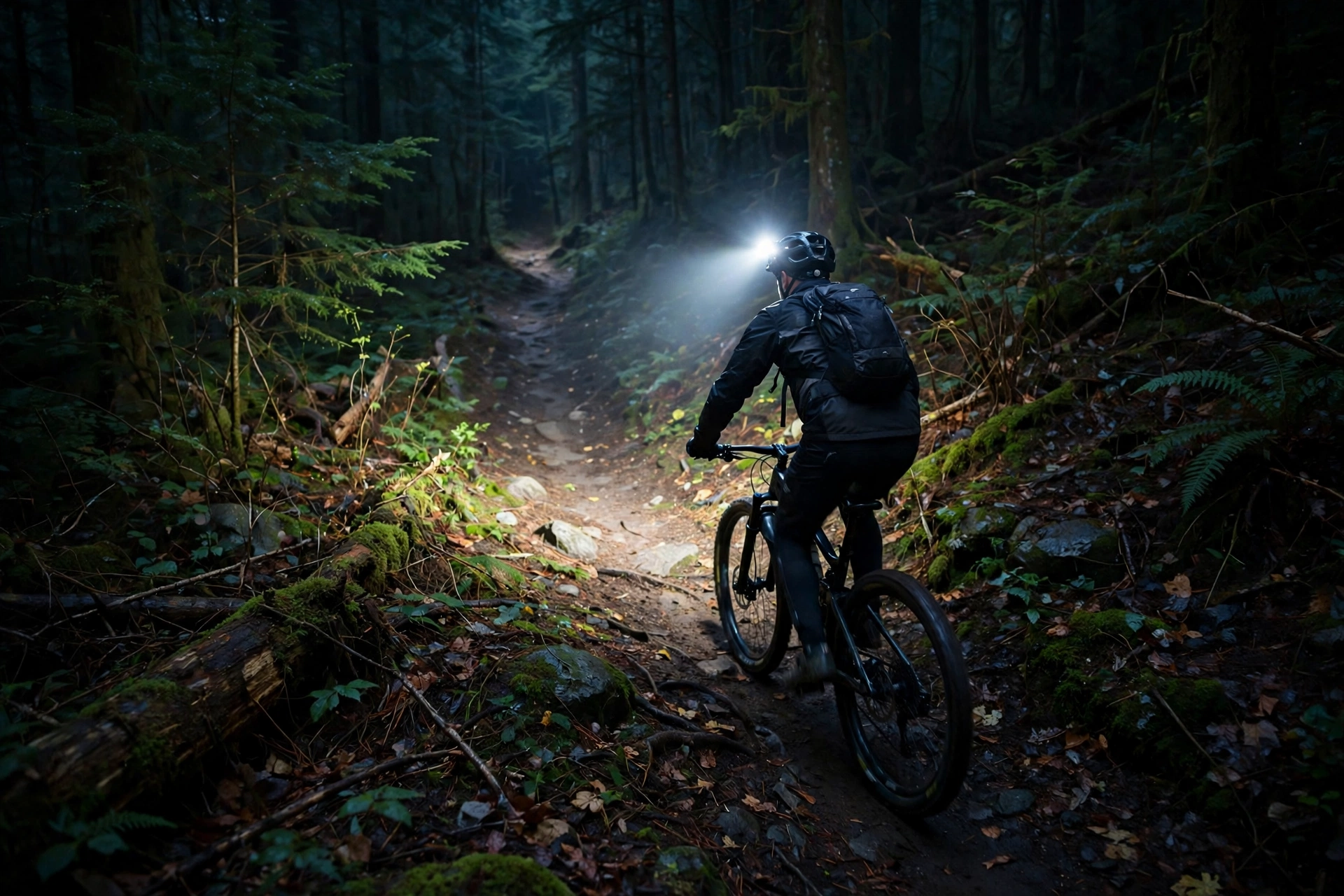
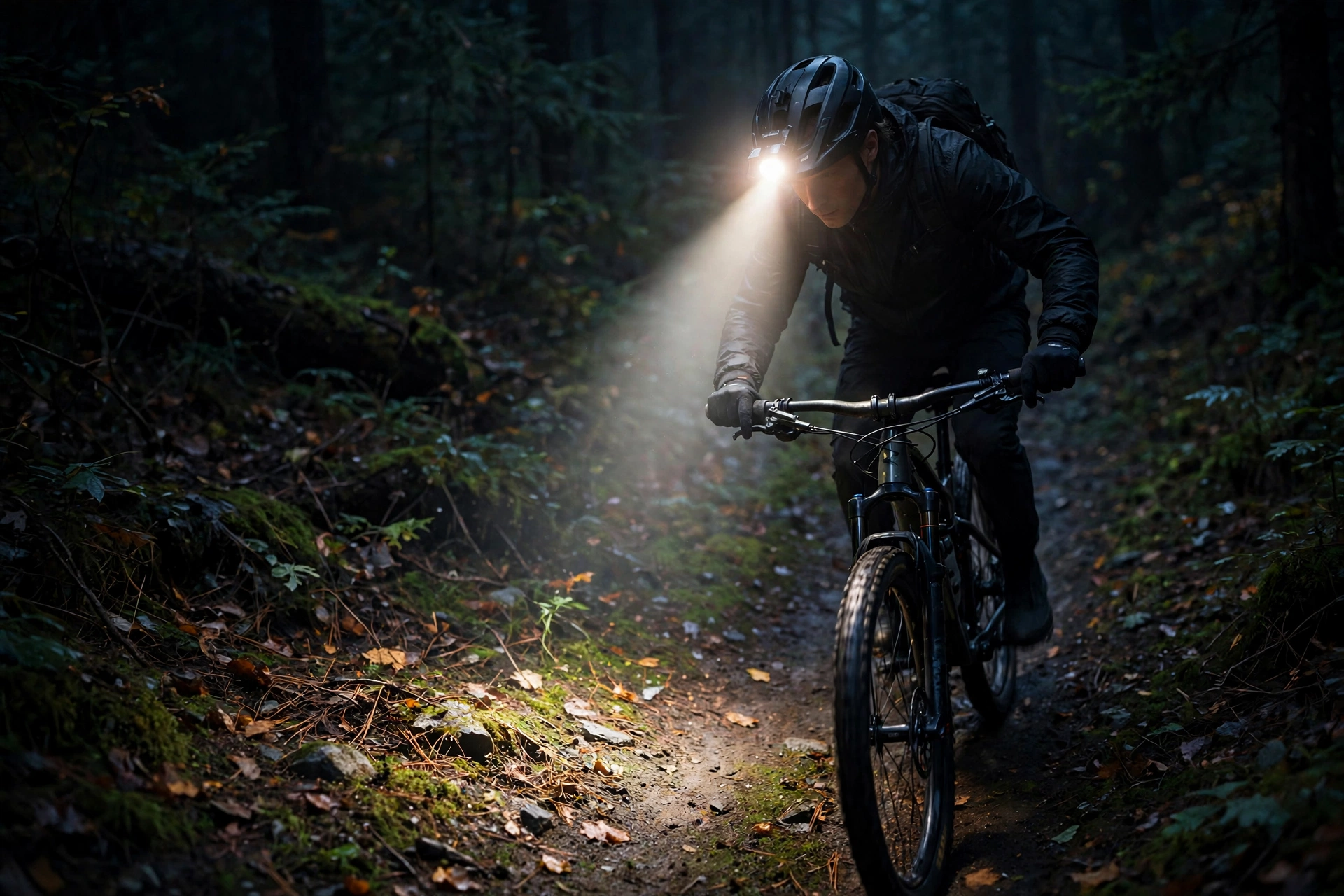
Helmet-mounted lights for night trail riding are bright, rechargeable lights that clip or strap to a bike helmet, and in general terms, they are the best way to see where you are looking on a dark trail, because the beam follows your head rather than your handlebars. A handlebar light shows where the bike is pointing; a helmet light shows where you are looking, which matters on twisty singletrack, where you need to see around a corner before the bike turns into it. Many night riders use both together.
Night trail riding opens up trails after dark, but it changes the riding completely. Roots, rocks, drops, and turns arrive much faster in a narrow beam of light, and your eyes have less time to adjust. A good helmet light gives you a wide, even beam, a secure mount that does not bounce on rough ground, and enough battery for the whole ride. This guide explains how to choose one and use it well.
Why Use a Helmet Light Instead of Just a Handlebar Light?
A handlebar light is fixed to the bike, so it points where the front wheel points. That works well on a straight road, but on a trail the bike and your head often point in different directions. When you look into a corner, scan a junction, or check a line over a rock garden, your head turns first and the bike follows. A helmet light puts light exactly where your eyes are looking, so you can read the trail a moment earlier.
A helmet light also helps with depth and shadows. A single light from the bars casts long shadows that can hide a root or a hole, while a second light from head height fills in those shadows and gives a clearer picture of the ground. That is why many riders run a handlebar light for a wide flood and a helmet light for a focused spot — the two beams together cover more of the trail than either alone.
How Bright Should a Helmet Light Be for Night Trails?
In general terms, trail riding needs a brighter light than road riding, because the trail surface is uneven and the hazards are closer. A light that feels bright on a smooth road can feel thin on a dark, wooded trail, where trees absorb light and roots and rocks need a clear beam to stand out. Look for a light with a stated output that suits technical trails, and a beam pattern that mixes a central spot for distance with a wider spill for the ground close to the wheel.
Brightness alone is not the whole story. A very bright light with a narrow beam can leave the edges of the trail in darkness, while a slightly less bright light with a wide, even beam can be easier to ride with. Beam shape, colour, and how the light handles on the trail matter as much as the headline number. If you can, try the light on a familiar trail before a long night ride, and see how clearly you can pick out roots and turns.
How Do You Mount a Light Securely on a Helmet?
Most helmet lights use one of three mounts: a strap that threads through the helmet vents, a clip that grips a vent or the shell edge, or a dedicated mount that bolts to a GoPro-style adapter on the helmet. Strap mounts are the most universal and suit most helmets, while clip and adapter mounts tend to hold more firmly on rough ground. Whichever you use, the light should sit centrally on the helmet and feel solid when you shake your head.
Fit the mount before you fit the light, and check that it does not cover vents you need or press on the helmet’s retention system. Tighten it until it does not move, but do not overtighten a strap so much that it distorts the shell or pulls the helmet out of shape. Once the light is on, tilt it so the beam lands on the trail a few metres ahead, not up into the trees or down at your front wheel.
What About Battery Life and Weight on a Helmet Light?
Battery life is the practical limit on a night ride. A light that runs for an hour on full power may be fine for a short loop, but a longer ride needs either a lower mode, a larger battery, or a spare. Check the maker’s run-time figures for the mode you actually plan to use, not just the brightest mode, and remember that cold weather can shorten battery life. Charge the light fully before every night ride, and keep a spare battery or a backup light in your pack for longer outings.
Weight matters because the light sits on top of your head, where even a small extra weight is noticeable over a long ride. A heavy light can make the helmet feel top-heavy and can strain your neck on rough trails, especially if it sits high on the shell. Look for a light that balances brightness with weight, and mount it as low and central as you can. Some lights put the battery in a separate pack worn on the body, which keeps the helmet light and the run time long.
It is also worth thinking about how the light affects the helmet itself. A helmet light should never force the helmet into a different position or stop the retention system from working. If you are learning how helmet liners and fit systems work, reading about what MIPS is for helmets can help you understand why the helmet must still sit level and snug once the light is fitted. The light is an accessory; the fit is what protects you.
How Should You Ride Differently at Night with a Helmet Light?
Night riding asks for a different pace, even with a good light. Your field of vision is narrower, depth perception is harder, and hazards appear later than they do in daylight. Slow down a little, especially on unfamiliar trails, and give yourself more braking distance. Ride trails you know well for your first night rides, and build up to technical ground as you get used to reading the trail in a beam.
Finally, think about being seen as well as seeing: a rear light and reflective clothing help other trail users spot you, and letting someone know your route and expected return time is a sensible habit for any night ride.
Frequently Asked Questions
Q: Do I need both a helmet light and a handlebar light for night trail riding?
A: In general terms, one good light can be enough for easier trails, but most night riders use both: a handlebar light for a wide flood and a helmet light for seeing where they look. The pair gives better coverage than either alone.
Q: Will a helmet light make my helmet feel heavy?
A: It can, especially if the light is heavy or sits high on the shell. Choose a light that balances brightness with weight, mount it low and centrally, and consider a model with a separate battery pack worn on the body.
Q: How long should a helmet light battery last for a night ride?
A: It depends on the length of your ride and the brightness mode you use. Check the run time for your planned mode, charge fully before riding, and carry a spare battery or backup light on longer rides.

Olivia
Writer at Helmet Today, covering helmet reviews, fit and riding safety.