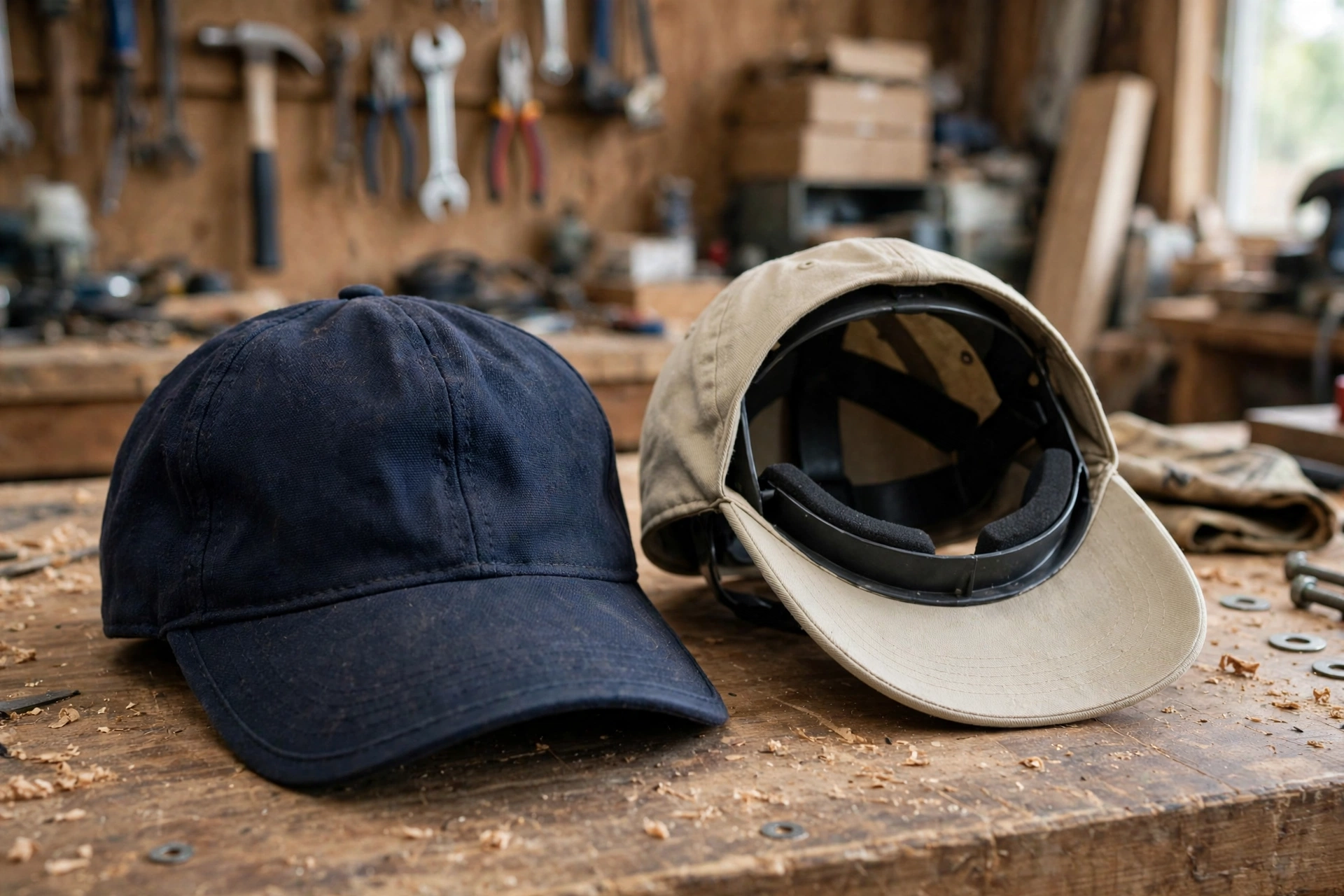
The difference is testing and accountability: a bump cap is a complete product designed and tested as bump protection — a shell insert permanently built into a cap, meeting the bump-cap standard — while a baseball cap with a helmet insert is an ordinary cap plus a separate plastic insert you buy and drop in yourself, and in general terms many of those add-on inserts are not tested or certified as protective equipment at all. One is safety gear; the other is an accessory that looks like safety gear.
They sit side by side in catalogs at similar prices, and they are not the same product. This guide explains where each one stands.
What Is a Rated Bump Cap?
A bump cap is manufactured as a unit: a baseball-style cap with a hard plastic shell and padding built into it, designed to protect the wearer from knocking their head against stationary objects — low pipes, shelf edges, machine frames, vehicle interiors. The cap and insert are engineered together, so the insert’s position, coverage, and retention are fixed by design.
Crucially, bump caps are tested. In general terms there is a recognized standard for bump protection, and a genuine bump cap is marked to it. That standard is deliberately light — it covers bumps and scrapes from objects you walk into, not falling objects, and a bump cap is never a substitute for a hard hat where one is required.
Because it is one tested product, an employer can specify it, an inspector can check its markings, and you know what protection you are actually wearing.
What Is a Baseball Cap With a Helmet Insert?
The insert is a separate molded plastic shell — sometimes with foam padding — sold as an accessory to turn any baseball cap into something helmet-like. You slide it into the cap’s crown, and the cap holds it, loosely or otherwise, depending on the cap’s shape and size.
The appeal is obvious: cheaper in some cases, works with a cap you already like, invisible from outside. Sellers market them for cycling, skating, warehouse work, and general head protection, often with language that sounds very close to a safety rating without ever quite stating one.
That wording is the tell. In general terms, loose inserts are commonly sold without certification to the bump-cap standard or any other protective standard — they are consumer accessories. Some may be well made; none of them have proven it in the way a rated product has.

How Does Their Protection Compare in Practice?
Start with what the bump to your head actually meets. In a rated bump cap, the insert is positioned by the cap’s construction, covers the crown consistently, and the padding and shell work as a tested pair. In a loose-insert setup, the shell can sit off-center, ride high or low depending on the cap, shift when you move, and press its edges into your scalp — protection that moves is protection that may not be there for the knock.
Then there is the energy question. Any head protection earns its keep by managing the force of a hit — hard hats use shell and suspension, sports helmets use foam liners and, at the higher end, rotational-impact systems like MIPS. A tested bump cap is the bottom rung of that same ladder: modest, but measured. An untested insert is a rung of unknown strength — it is not that it does nothing, it is that nobody verified what it does.
Neither product protects against falling objects, and neither replaces a hard hat. The comparison between them is only about the light-duty job both claim to do — and for that job, the tested, integrated product is the defensible choice.
Which One Do Sites and Employers Allow?
Where an employer has assessed a workplace as a bump-cap area, in general terms they will specify bump protection that meets the standard — which means a rated bump cap with markings an inspector can check. A homemade combination of cap and insert has no markings to check and no standard to point to, so most safety policies cannot accept it even if the wearer means well.
Personal use is different. Nobody regulates what you wear in your own workshop, and for genuinely low-risk DIY — working under your own car, in your own attic — an insert is better than a bare head. The problem is only the false equivalence: believing the accessory gives you workplace-grade protection because it looks the part.
If you are buying for a team, the paperwork settles it: specify rated bump caps, record what was issued, and skip the inserts. If you are buying for yourself for work, the same logic applies the moment your employer’s policy enters the picture.
How Do You Choose Between Them?
Ask one question: does anyone — an employer, an insurer, a site rule, or your own honest risk assessment — need this protection to be real? If yes, buy the rated bump cap and check its markings. If the area’s hazards are falling objects rather than bumps, skip both and wear a hard hat.
Check the fit either way. A bump cap should sit low and snug like a proper cap, with the insert’s coverage centered over your crown. An insert in a cap should at minimum not shift when you shake your head — and if it does, it has answered the question for you.
The price gap between the two is small, and it buys the only thing that matters in protective equipment: proof. In head protection, proof is the product.
Frequently Asked Questions
Q: Is a helmet insert better than nothing?
A: Yes — a plastic shell between your scalp and a pipe is better than bare skin, and for low-risk jobs around the home it is a reasonable precaution. Just do not mistake it for tested protective equipment or wear it where a rated bump cap or hard hat is required.
Q: How can I tell if a bump cap is genuinely rated?
A: Look for the standard marking on the product or its label — a rated bump cap states the bump-protection standard it meets, along with the maker’s name. If the listing only uses vague words like “protective” or “safety” with no standard named, treat it as an accessory, not PPE.
Q: Can I put a rated insert into my own cap to make a bump cap?
A: In general terms, no — the rating belongs to the complete cap as manufactured and tested, not to the insert alone. A shell dropped into an untested cap is an insert setup, regardless of the shell’s quality.

Olivia
Writer at Helmet Today, covering helmet reviews, fit and riding safety.