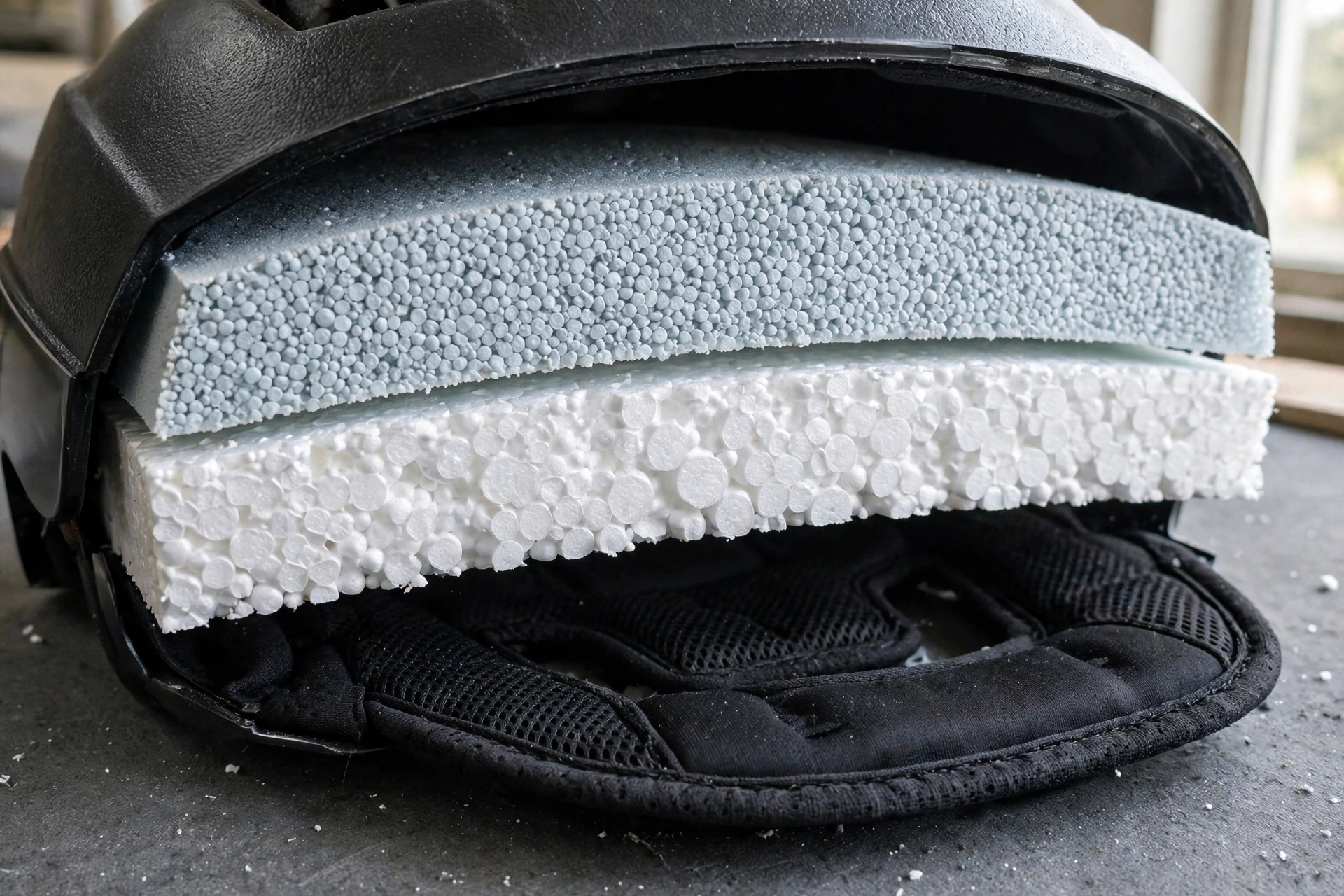
Dual-density EPS is a helmet liner made from expanded polystyrene in two different firmness levels, arranged so the softer foam handles light impacts and the firmer foam takes over in harder ones. It is a specific version of the multi-density idea, applied to the most common liner foam in helmets. By combining two densities of the same material, makers can widen the range of impacts the liner handles well.
You will find dual-density EPS in many motorcycle, cycling and ski helmets. This guide explains how it is built, how each density behaves, where the two densities sit, and what to look for when you choose a helmet.
What Is Dual-Density EPS?
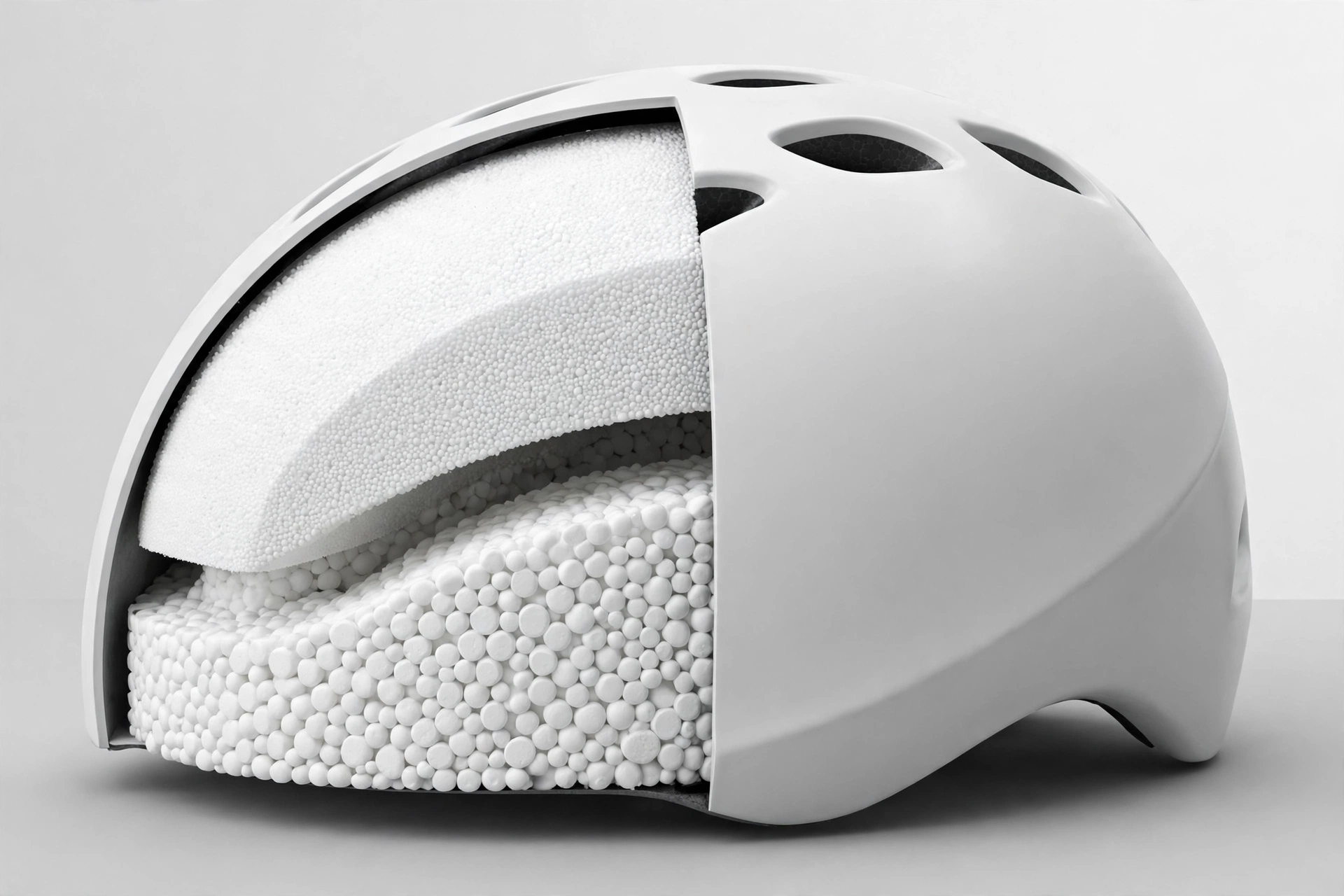
EPS, or expanded polystyrene, is the foam used in most helmet liners. It is made by expanding polystyrene beads with steam until they fuse into a light, rigid foam. In a single-density liner, the whole foam layer has the same firmness. In a dual-density liner, the foam is made in two densities, usually described as soft and firm, and the two are combined in one liner.
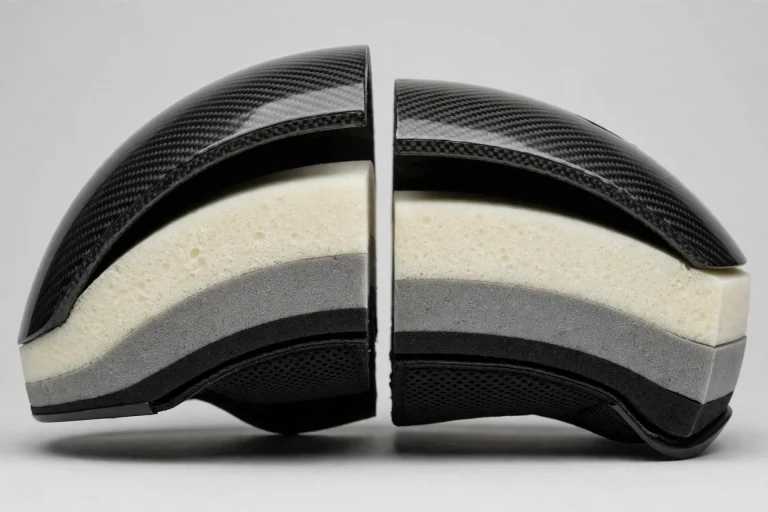
The two densities may be stacked in layers, with one density next to the shell and the other next to the head, or they may be arranged as separate zones, with firmer foam in some areas and softer foam in others. Some liners use both approaches at once.
The idea is simple: a single foam density is a compromise, and two densities let the maker tune the liner more precisely. The softer foam responds to lighter loads, and the firmer foam responds when the load grows.
How Does Each Density Behave in an Impact?
EPS protects by crushing. When the helmet takes an impact, the foam compresses and the beads break apart, turning the energy of the impact into deformation and slowing your head more gently than a sudden stop would. The density of the foam decides how much load it takes to start crushing.
Soft EPS starts crushing under a light load, so it is good at taking the edge off low-speed knocks. But it can crush completely in a hard impact, leaving nothing to slow your head further. Firm EPS needs a bigger load before it crushes, so it stays intact longer and handles harder impacts, but it may barely crush in a light impact and pass more force to your head.
A dual-density liner aims to get the best of both. The softer foam handles the lighter impacts, while the firmer foam takes over as the load grows. In general terms, this gives the helmet a wider working range than a single-density liner.
Where Do the Two Densities Sit in a Helmet?
Makers place the densities where they expect them to be needed. Firmer EPS often sits around the crown and the sides of the head, where a hard impact is most likely to land. Softer EPS may sit near the forehead or around the edges, where lighter knocks are more common and comfort matters too.
In a layered design, the softer foam may sit next to the head, so it responds first to a light knock, with the firmer foam behind it to take over if the impact is harder. In other designs, the order is reversed, with the firmer foam next to the shell. The exact layout is part of the maker’s design and testing.
The layout is tuned alongside the shell, the shape of the helmet and the safety standard it must meet. That is why two helmets with dual-density EPS can feel and perform differently, even though they use the same idea.
What Are the Advantages and Trade-Offs?
The main advantage is a wider range of protection. A dual-density liner can cushion a light knock without feeling harsh, and still have firm foam in reserve for a harder hit. Riders who use one helmet for different kinds of riding may benefit most, since the impacts they face can vary.
There are trade-offs. A dual-density liner is more complex to design and make than a single-density one, which can add cost. It can also be slightly heavier, because the maker is adding extra foam pieces and joins. And the benefit depends on the design being done well: a poorly arranged dual-density liner is no better than a good single-density one.
Fit is not directly affected, since the densities sit inside the shell and the comfort padding sits between the liner and your head. But a liner with more pieces can have more joins, so it is worth checking that the helmet feels smooth and even when you try it on.
The weight difference is small but real. A dual-density liner uses more foam pieces and more joins, which can add a few grams compared with a single-density liner. For most riders, that difference is barely noticeable, and it is a fair trade for the wider range of protection. Competitive riders who count every gram may prefer a lighter single-density helmet, but for everyday riding the extra weight is not a reason to avoid a dual-density liner.
How Can You Tell If a Helmet Has Dual-Density EPS?
The simplest way is to check the maker’s description. Helmet makers usually mention a dual-density liner in the product details, often with a name of their own for the system. If the description says the liner uses two densities of EPS, that is what you are looking at.
You cannot tell by looking at the outside of the helmet, and the liner is usually covered by comfort padding, so you may not see the foam at all. If the padding is removable, you may be able to see joins or colour differences between foam pieces, but not every maker marks them.
When you compare helmets, treat dual-density EPS as one feature among several. Check the safety standard, the fit, the weight and the ventilation too. If you are learning about helmet technology, reading about what MIPS is for helmets can help you understand another feature that may sit alongside the liner inside the helmet.
Frequently Asked Questions
Q: Is dual-density EPS better than single-density EPS?
A: In general terms, a well-designed dual-density liner can protect across a wider range of impacts. But a good single-density liner in a helmet that fits well is still a solid choice.
Q: Does dual-density EPS make a helmet heavier?
A: It can add a little weight, because it uses more foam pieces. The difference is usually small, and many riders will not notice it in normal use.
Q: Do I need to replace a dual-density helmet after a crash?
A: Yes. EPS crushes in an impact and does not spring back, whatever its density. Replace any EPS helmet after a significant crash.

Olivia
Writer at Helmet Today, covering helmet reviews, fit and riding safety.