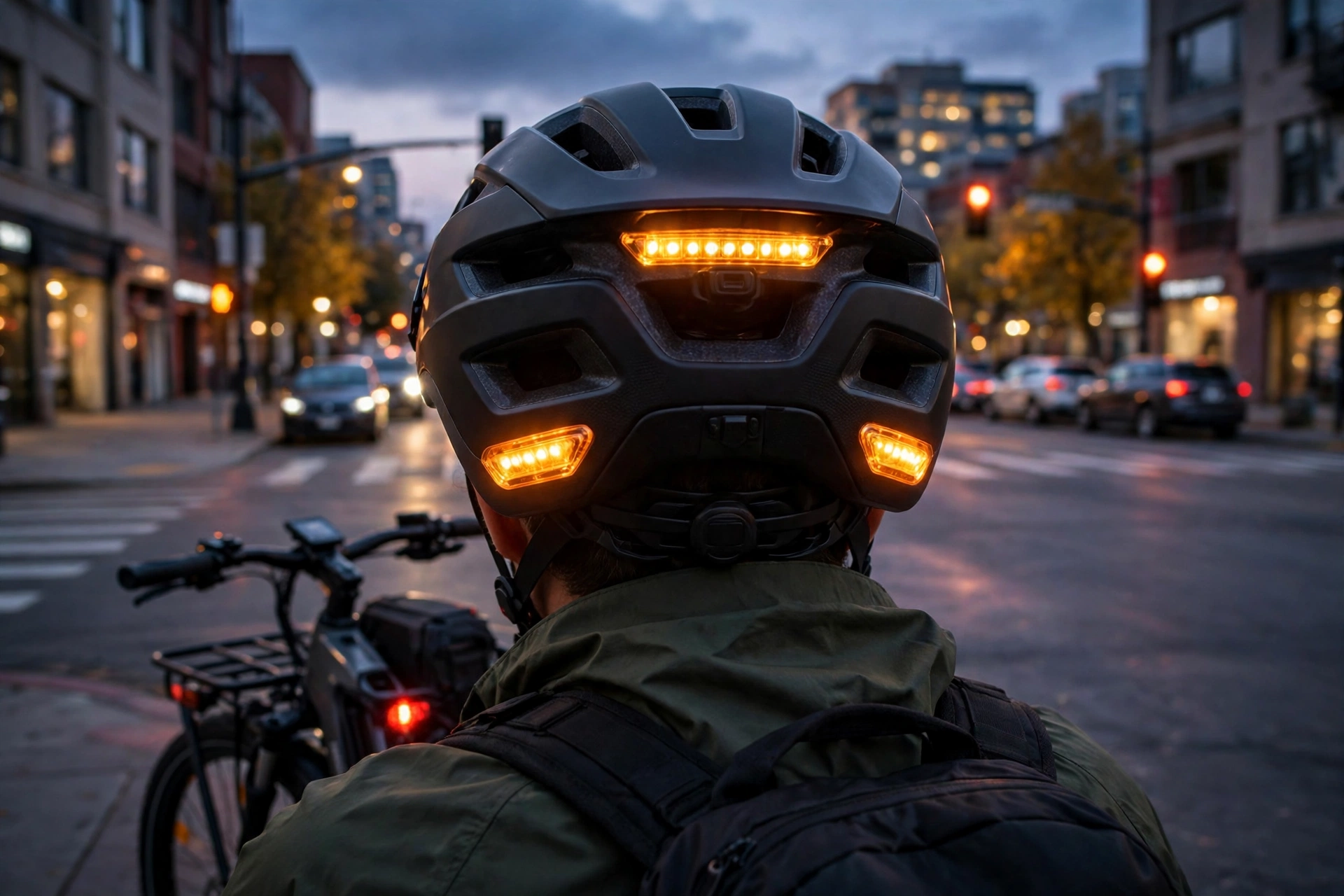
An e-bike helmet with turn signals and a brake light puts bright rear indicators where drivers actually look — at head height — and flashes them from a handlebar remote or an automatic sensor. It does not replace hand signals or bike lights, but it makes your intentions much harder for traffic to miss, especially after dark.
Signaling on an e-bike has a real problem: taking a hand off the bar at 20-plus mph, on a heavy bike, in traffic, is something many riders quietly stop doing. Signal helmets were built to fix exactly that moment. This guide explains how the lights, remotes, and brake sensors work, what they do well, and what to check before you spend the extra money.
How Do Helmet Turn Signals Work?
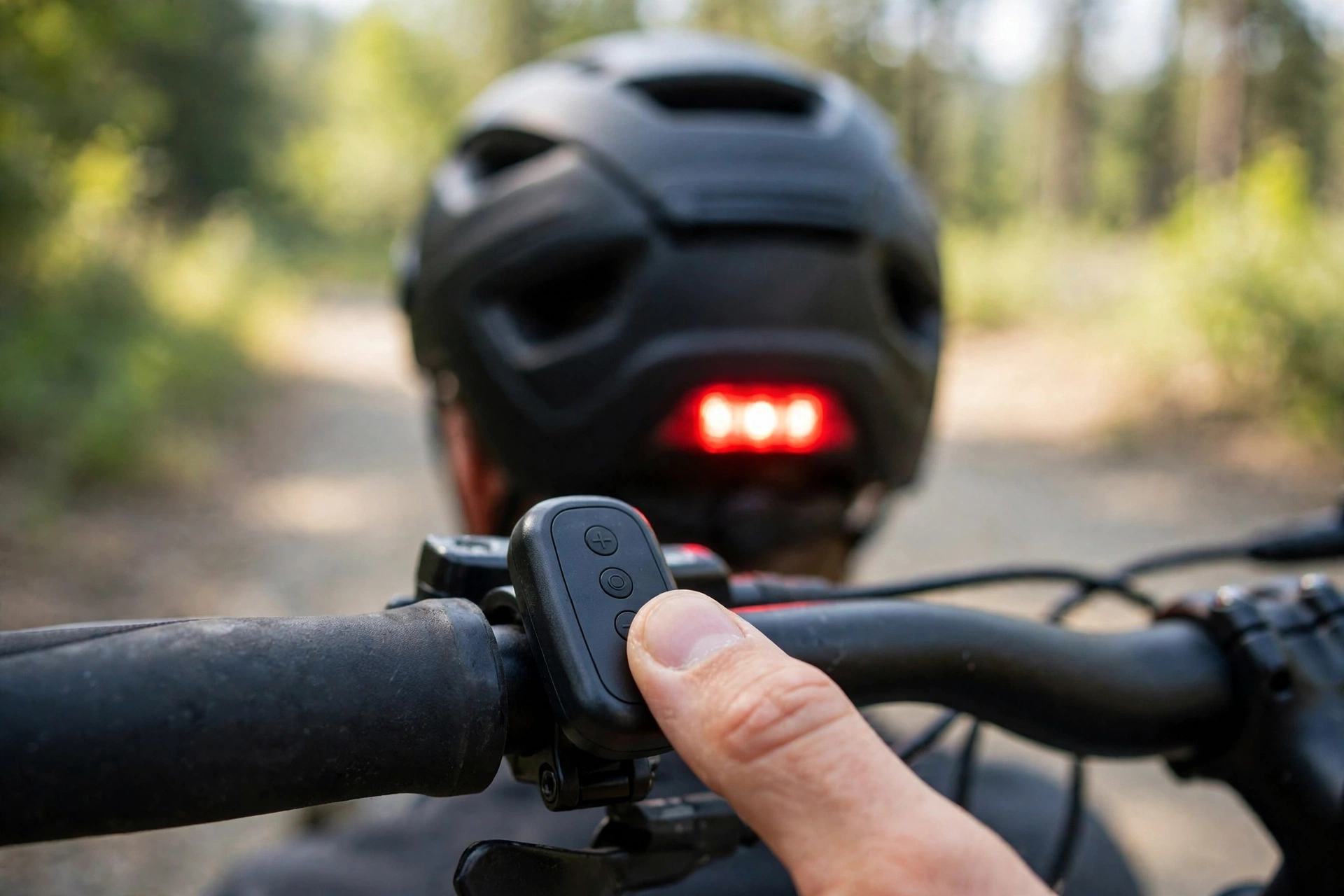
The common design is a panel of LEDs across the back of the helmet — often wrapping slightly around the sides — that flashes amber on the left or right half. You trigger it with a small wireless remote clipped to the handlebar, within thumb reach, so both hands stay on the grips and your eyes stay on the road.
The remote pairs with the helmet like other bike electronics, and the signal typically flashes for a set period or until you cancel it, depending on the model. Some helmets add a gentle beep or a small indicator so you know the signal is actually running — an important detail, because a turn signal you forget to cancel confuses drivers just as it does on a car.
Position is the whole advantage. A helmet signal sits roughly at a following driver’s eye level and moves with your head, which makes it conspicuous in a way a low seat-stay blinker is not. Side wrap matters too: signals visible only from directly behind are of limited use at intersections, where the traffic you need is often beside or approaching you.
How Does the Automatic Brake Light Work?
Most signal helmets add a motion sensor — an accelerometer — inside the helmet. When it detects firm deceleration, it drives the rear LEDs to a bright, solid brake-light mode for a few seconds. There is nothing for you to press; braking is enough.
Sensitivity is the engineering challenge, and it varies between models in general terms. Set too eagerly, the light fires when you nod, hit a pothole, or coast over rough pavement, which trains drivers to ignore it. Set too conservatively, it misses gentle but real slowing. Better designs filter for sustained deceleration rather than a single jolt, and some let you adjust sensitivity in a companion app.
Test yours honestly before trusting it: ride a quiet street, brake at different strengths, and have a friend follow or film you. You want the light on solidly for real stops and calm the rest of the time. Remember it is an addition to — not a replacement for — a proper always-on rear bike light where the law requires one.
Are Signal Helmets Still Proper Protective Helmets?
They must be, and the good ones are. The electronics live in or on the shell without changing the job of the foam underneath: any signal helmet sold for US road use should carry the same CPSC certification as any other bike helmet, and faster e-bike models may add NTA 8776 certification, which in general terms tests higher-energy impacts and requires more coverage.
Two checks are worth making. First, find the certification label inside the helmet yourself — if there is no standard label, the lights are decoration on an uncertified product, whatever the listing says. Second, check how the battery and light unit are mounted: reputable designs keep hard components away from the impact foam or use mounts that release in a crash, and the maker should be able to say so.
The rest of helmet safety is unchanged. Fit still comes first — level, snug, no rocking — and rotational protection remains available on some smart models; our explainer on what MIPS is and how it works covers that technology if you are comparing feature lists. And like every helmet, a signal helmet is replaced after a crash, electronics and all.
What Should You Check About Battery, Brightness, and Weather?
Battery life decides whether the system works on your longest ride or only on your shortest. Manufacturers quote runtimes that vary a lot with signal use, temperature, and light mode, so compare conservatively and prefer USB charging you can do at a desk or cafe stop. A helmet whose lights die mid-commute is just a helmet — ride as if drivers can no longer see the signals once the battery is gone.
Brightness matters in daylight, not just at night. A signal that glows nicely on a dark street can wash out completely in summer sun, which is when a large share of riding happens. Look for high-output LEDs and flashing patterns designed for daytime conspicuity, and check them outdoors, not just in the shop.
Weather sealing is the third check. The light unit, charging port, and remote all live outside in the rain. Look for a stated water-resistance rating in general terms, keep the port cover seated, and dry the helmet indoors after wet rides rather than sealed in a bag. The handlebar remote takes the worst of it — a design that detaches easily for charging and storage tends to survive longer.
Do Signal Helmets Replace Hand Signals and Bike Lights?
No — they supplement both, and in many places the law is written around the older tools. Traffic law in general terms typically requires cyclists to signal turns, and a hand signal remains the most universally understood signal there is; drivers, police, and other riders all read it instantly. A helmet signal repeats that message in lights, which is most valuable at night, in rain, and on fast descents where your hands belong on the brakes.
Bike lights are similar. Many jurisdictions require a white front light and a red rear light or reflector on the bicycle itself after dark, mounted on the bike — a helmet light alone may not satisfy that requirement. Treat the helmet system as a third layer: bike lights for legal baseline visibility, hand signals as the primary turn message, and helmet signals and brake light as the amplifier that gets both noticed sooner.
Used that way, riders consistently report the same benefit: drivers give earlier, clearer responses — holding back instead of crowding a turn, easing off when the brake light fires. That earlier response, bought with a thumb press instead of a one-handed wobble at speed, is exactly what the technology is for.
Frequently Asked Questions
Q: How do you activate the turn signals while riding?
A: With a small wireless remote mounted on the handlebar within thumb reach. Press left or right and the rear LEDs flash on that side of the helmet, usually for a set time or until cancelled. Your hands never leave the grips.
Q: Does the brake light work automatically?
A: On most models, yes. An accelerometer senses real deceleration and switches the rear LEDs to a bright solid brake mode for a few seconds. Test sensitivity on a quiet street — it should fire for genuine braking, not for bumps or head movements.
Q: Is a signal helmet legal as my only rear light?
A: In most places, no. Laws generally require lights mounted on the bicycle itself after dark. Use the helmet signals and brake light as an extra, highly visible layer on top of proper bike lights and hand signals.

Olivia
Writer at Helmet Today, covering helmet reviews, fit and riding safety.