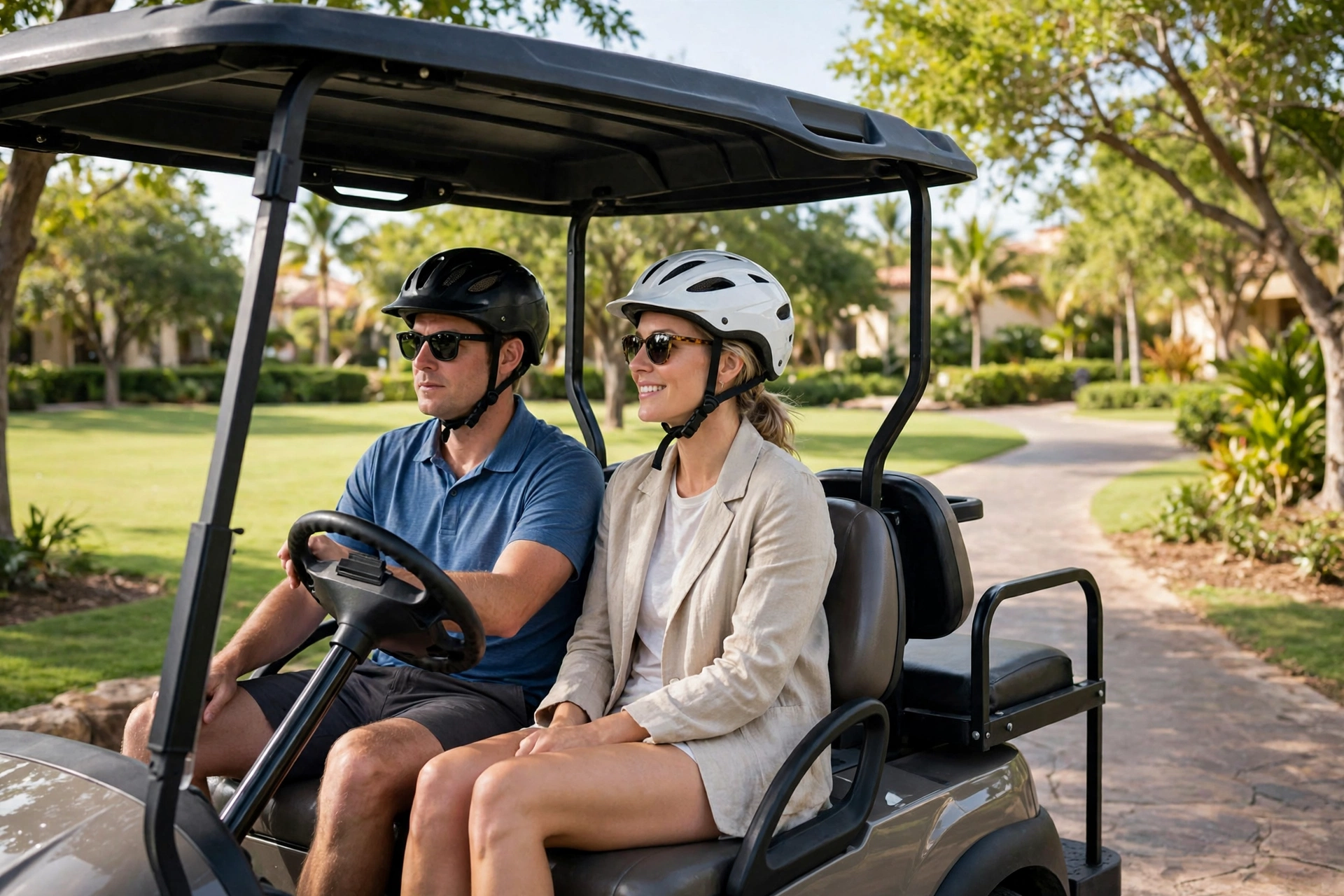
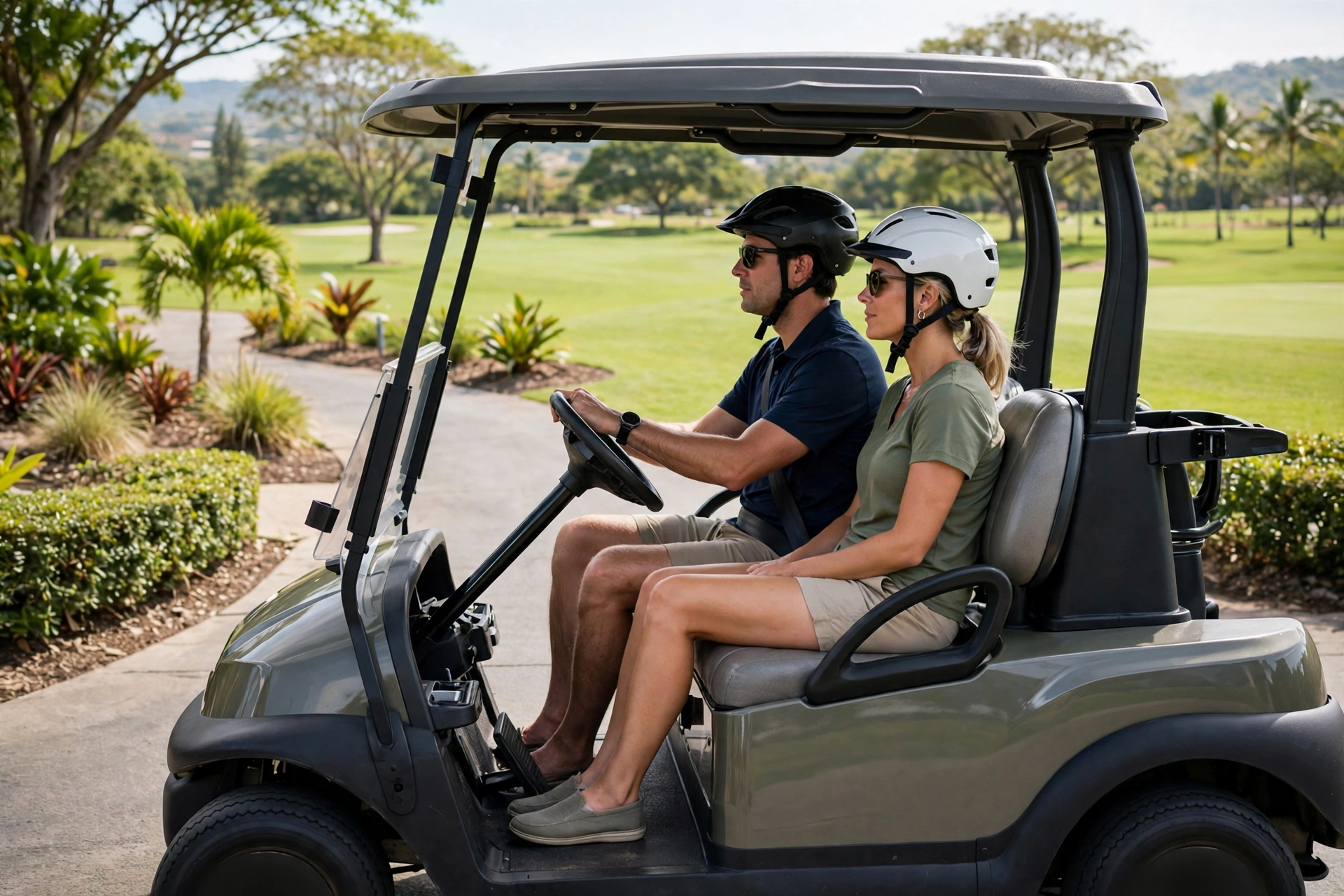
A helmet for golf cart passengers is a well-fitting protective helmet worn by someone riding as a passenger in a golf cart, to protect the head if the cart stops suddenly, turns sharply, or hits a bump. In general terms, golf carts travel slowly and feel safe, but a passenger can still be thrown about or fall out, especially on uneven ground. A helmet adds a simple layer of protection for the head, and it is worth considering whenever passengers ride in a cart away from a smooth, flat path.
Golf carts are used far beyond the golf course today. They carry people around resorts, holiday parks, farms, campuses, and large private grounds, and passengers often include children, older people, and guests who have never ridden in one before. A passenger is not holding a steering wheel and cannot always brace for a sudden turn, so the case for wearing a helmet is stronger than many people expect.
Do golf cart passengers need a helmet?
In general terms, whether a golf cart passenger needs a helmet depends on where the cart is used and who is riding in it. On a flat, smooth golf course at walking pace, many passengers ride without one. But on bumpy tracks, slopes, or shared roads, the risk of a jolt or a fall rises, and a helmet becomes a sensible precaution. Some resorts, parks, and workplaces have their own rules asking passengers to wear helmets, so it is worth checking the local rules before setting off.
Children deserve extra thought here. A child passenger is lighter, sits higher relative to the cart’s sides, and may not hold on firmly when the cart turns. In general terms, a helmet that fits a child properly is one of the easiest ways to reduce the harm from a fall out of a slow-moving cart. The same applies to older passengers, who may be less steady on their feet if they have to step down quickly. A helmet does not make a cart ride risk-free, but it does protect the part of the body that is hardest to mend.
What kind of helmet suits a golf cart passenger?
A helmet for golf cart passengers should be light, comfortable, and easy to wear for a short ride. In general terms, a standard bike helmet is a practical choice for most passengers, because it is ventilated, widely available, and designed for low-speed falls. A skate-style helmet is another option, since it covers more of the back of the head and sits lower, which some passengers find reassuring. Either type works, provided it fits well and is in good condition.
What matters most is that the helmet is not damaged and has not already taken a hard knock. A helmet that has been dropped heavily or involved in a crash may look fine on the outside while its protective lining is no longer able to absorb an impact as it should. In general terms, a passenger helmet should be replaced after a hard impact, and it should be checked regularly for cracks, worn straps, and loose padding. A helmet that is comfortable to wear is also more likely to be worn, so fit and comfort are not minor details — they decide whether the helmet actually gets used.
How should a golf cart passenger helmet fit?
A helmet for a golf cart passenger should sit level on the head, low enough to cover the forehead, and snug enough that it does not wobble when the wearer shakes their head gently. The straps should form a neat V under each ear, and the chin strap should be tight enough that only one or two fingers fit between the strap and the chin. In general terms, if the helmet slides forward over the eyes or tips back off the forehead, it is either the wrong size or adjusted badly, and it will not protect the head properly.
Passengers often share helmets at resorts and hire fleets, so the adjustment system matters. A helmet with a simple dial or sliding straps at the back can be sized to different heads in a few seconds, which makes sharing far more practical. If a helmet cannot be adjusted to fit a passenger snugly, it is better to find another one than to wear a loose helmet for the sake of it. A loose helmet can shift in a jolt and leave the head exposed at the very moment protection is needed.
When is a helmet most useful in a golf cart?
A helmet is most useful when the cart leaves smooth, flat ground. Bumpy tracks, gravel paths, grass slopes, and speed bumps all make a cart bounce and sway, and a passenger who is not holding on tightly can be thrown sideways. In general terms, the risk also rises when the cart carries several passengers, when children are riding, or when the driver is turning often, as on a winding resort road. A helmet is a simple precaution in exactly these everyday situations, not only in dramatic accidents.
After rain, grass and paths can be slippery, and at dusk a passenger may not see a bump coming. In these conditions, a helmet works together with the cart’s own safety features, such as seat belts where fitted, grab handles, and a sensible speed.
What else keeps golf cart passengers safe?
A helmet works best when the rest of the ride is safe too. Passengers should sit facing forward, keep their feet inside the cart, and hold on to a handle or the seat in front, especially on turns and slopes. In general terms, standing up in a moving cart, hanging off the back, or riding with legs dangling over the side are all habits that turn a small bump into a fall. Children should sit in the middle of a seat where possible, and small children should ride with an adult holding them steady.
The driver has the biggest role of all. Driving slowly on turns, braking gently, and avoiding steep slopes keeps the cart stable and the passengers comfortable. It also helps to keep the cart in good order: tyres pumped up, brakes working, and seats and handles secure. Some helmets include a system designed to reduce rotational forces in a fall, such as MIPS, which is a feature worth knowing about when choosing a helmet for any low-speed riding. A helmet is a sensible extra for passengers, but it works best alongside a careful driver, a sensible speed, and passengers who stay seated and hold on. Together, those habits make a golf cart ride the relaxed trip it is meant to be.
Do golf cart passengers have to wear helmets?
In general terms, it depends on the place and the local rules. Some resorts, parks, and workplaces ask passengers to wear helmets, while others leave it to the rider’s judgement, so check before you set off.
Can a bike helmet work in a golf cart?
Yes, in general terms a well-fitting bike helmet is a practical choice for a golf cart passenger, because it is light, ventilated, and designed for low-speed falls. A skate-style helmet is another good option.
Should children wear helmets in golf carts?
Yes, children are good candidates for helmets in golf carts, because they are lighter, may not hold on firmly, and can be thrown about more easily on bumps and turns. Make sure the helmet fits the child’s head snugly.

Olivia
Writer at Helmet Today, covering helmet reviews, fit and riding safety.